
Infrastructure Economics
The cheapest infrastructure is not always the lowest-cost decision.
AI infrastructure economics is shaped by when capital is committed, when capacity becomes productive, how fully assets are utilized, and whether today’s investments remain useful as the system grows. The real question is not simply what infrastructure costs, but what business value it creates over time.
Where is the economic pressure showing up?
Infrastructure economics becomes difficult when cost, timing, utilization, and long-term requirements stop moving together. Start with the pressure point closest to your project.
Capital is committed before capacity is useful
We're spending now, but productive capacity is still months away.
How much capital is sitting idle before it creates value?
Examine time to value »
The lowest price is winning the comparison
One option costs less to buy.
Does it still win after timing, utilization, operating exposure, and rework are counted?
Compare the whole system »
Demand or timing is uncertain
We know the direction, but not the exact ramp.
How much should be committed before the forecast becomes real?
Examine capital timing »
Existing assets may lose value
Today's solution may not fit what comes next.
What useful value remains if assumptions change?
Protect residual value »
Acceleration has a premium
We can move sooner, but it costs more.
Is the value of time saved greater than the incremental cost and risk?
Value the time saved »
Near-term savings may create later rework
We can minimize Day One spend.
What replacement, migration, or disruption cost is being deferred?
Compare lifecycle exposure »
Infrastructure value begins when capacity becomes productive.
Capital committed to land, equipment, compute, power, cooling, or construction does not create the intended business value merely because it has been spent. Value begins when the system can support useful work. A lower initial price can therefore produce the worse economic outcome if it delays operation, suppresses utilization, or forces expensive rework later.
Cost is not value
Purchase price matters, but only within the larger question of what the infrastructure enables and when.
Timing changes returns
The same asset can have a very different economic value depending on when it becomes usable and how long it sits idle.
Optionality has economic value
When demand, power timing, or technology remains uncertain, preserving choices can be worth more than optimizing around one forecast.
Evaluate the system, not the purchase price.
A credible infrastructure comparison has to look beyond nominal capex. The economic outcome is shaped by the value of productive capacity minus the cost of capital, delay, inefficiency, transition, and rework. The weighting of each factor will differ by project.
Time to productive capacity
How long from capital commitment until the infrastructure can support useful compute?
Capital timing
When must each dollar be committed, and how long is it exposed before producing value?
Utilization
How much of the installed capacity is actually used during each stage of the deployment?
Operating exposure
What ongoing power, cooling, maintenance, efficiency, and reliability costs follow the design?
Transition and rework
What must be replaced, moved, redesigned, or interrupted as the system grows?
Residual and option value
What useful capability or strategic choice remains if assumptions, demand, or timing change?
What does waiting actually cost?
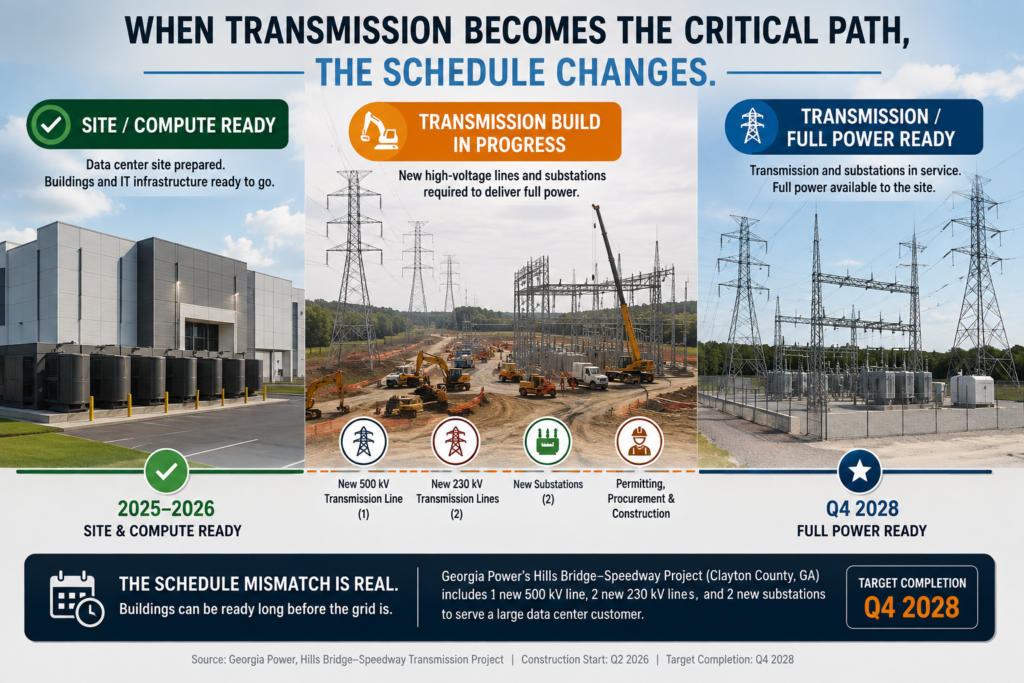
A delayed infrastructure date is more than a schedule issue when it also delays productive compute. But acceleration is not automatically better. The relevant test is whether the economic value of the time saved exceeds the incremental cost and risk required to move sooner.
Delayed business output
Revenue, research, internal AI capability, or customer capacity may all depend on infrastructure becoming usable.
Idle or reserved compute
High-value compute can be purchased, reserved, or contractually committed before the supporting infrastructure is ready.
Capital carrying time
Land, engineering, construction, and equipment capital can remain tied up while the critical dependency catches up.
Customer and market commitments
Timing can affect whether promised capacity is available when customers, partners, or strategic programs need it.
Opportunity cost
Capital, sites, teams, and management attention committed to a delayed path cannot be redeployed elsewhere without consequence.
Match capital commitment to when capacity can create value.
The economic question is not simply how much infrastructure will ultimately be required. It is when capital is committed relative to when capacity can generate value, how long that capital may sit underutilized, and what economic value remains if demand or timing changes.
Build for the ultimate state now
Strength: Can reduce future expansion friction when demand, timing, and architecture are highly certain.
Risk: Commits more capital earlier and may leave capacity underutilized while demand or dependencies ramp.
Stage capital with demand
Strength: Aligns investment more closely with productive load and can keep capital uncommitted until demand becomes real.
Tradeoff: Smaller increments may carry higher unit cost or require more coordination; the economic question is whether that premium is outweighed by better utilization and lower idle-capital exposure.
Minimize initial capital
Strength: Minimizes near-term spend.
Risk: Can defer spend at first but create rework, replacement, operating disruption, or stranded assets later, turning apparent savings into a more expensive lifecycle outcome.
The goal is not minimum Day One spend. It is maximum productive use of each dollar committed.
What a credible economic strategy must accomplish
A sound strategy should improve the economics of the infrastructure system without assuming that one architecture, one timing model, or the lowest initial cost is always right.
Put capital to work sooner
Reduce the gap between capital commitment and useful operating capacity when acceleration creates real value.
Match investment to actual load
Commit infrastructure in proportion to the capacity that can realistically become productive at each stage.
Protect residual asset value
Account for how much useful economic value remains in early assets when later capacity, technology, or infrastructure changes.
Make transition costs visible
Account for replacement, migration, interruption, and integration rather than treating them as future details.
Compare whole-life, risk-adjusted outcomes
Evaluate timing, utilization, operating exposure, rework, and uncertainty alongside initial capital cost.
Value optionality explicitly
Treat the ability to defer, expand, repurpose, or change course as an economic asset when power, demand, technology, or scale remains uncertain.
The same capital can produce very different economic outcomes.
Infrastructure alternatives should be compared by more than installed cost. The economic outcome changes with when capital is committed, when capacity becomes productive, how fully it is used, what transition or rework costs arise, and what residual or option value remains if assumptions change.
BUILD AHEAD
Capital is committed early. Productive capacity catches up later, creating greater idle-capital exposure and lower early utilization. Rework can be low if the forecast is right, but residual and option value may suffer if it is wrong.
DEMAND ALIGNED
Capital is committed closer to productive need, usually narrowing the idle-capital gap and improving utilization. Smaller increments may cost more or require more coordination, so the premium should be weighed against reduced exposure and preserved options.
MINIMUM NOW / REPLACE LATER
Near-term capital is minimized, but later changes can create a rework or replacement spike, interrupt utilization, and destroy residual value. The apparent Day One savings may therefore produce the highest lifecycle cost.
The best economic path minimizes the gap between capital committed and value realized while pricing the cost of flexibility, rework, and uncertainty.
The economic answer changes when time, utilization, and uncertainty are counted.
Earlier value can justify higher near-term cost.
Acceleration makes economic sense only when the value created by moving sooner exceeds its incremental cost and risk.
Utilization often matters more than nominal capacity.
Installed megawatts create little value if power, compute, cooling, customers, or operating readiness prevent them from being used.
Residual value changes the true cost of transition.
An asset that remains useful, reusable, or redeployable produces a different economic outcome from one that must be replaced or abandoned.
Optionality has economic value when assumptions are uncertain.
The ability to defer, expand, repurpose, or change course can reduce the economic cost of being wrong when key assumptions remain uncertain.
Optimize for productive capital, not minimum capital.
The best infrastructure strategy is the one that turns capital into useful capacity at the right time, sustains high utilization, accounts for transition and operating exposure, and preserves residual or option value where uncertainty is material.
Follow the economics into the underlying decisions
- Power for AI
- Infrastructure Economics

- Deployment Strategy
What else changes the economic answer?
Infrastructure economics cannot be separated from the decisions that determine when capacity is available, how it is built, and how the system changes over time.
Power for AI
Usable-power timing determines when infrastructure can become productive and how much acceleration may be worth.
Explore Power for AI »
Adaptive Infrastructure
Modularity and additive expansion determine whether capital can be staged and whether earlier investments retain value.
Explore Adaptive Infrastructure »
Data Center Architecture
Electrical, cooling, building, density, and resilience choices shape capital intensity, utilization, operating exposure, and rework.
Explore Data Center Architecture »
Deployment Strategy
Sequence determines what must be committed first, when investments become productive, and which dependencies remain on the critical path.
Explore Deployment Strategy »
Explore Your Infrastructure Economics
Use the AI Advisor to test timing, utilization, capital, operating exposure, transition cost, and option value in context or use the Technical Library to investigate related technical questions.
Ask the AI Advisor
Explore your infrastructure questions in context and identify the constraints, dependencies, risks, and decisions that deserve attention next.
Start Exploring »
Technical Library
Explore technical explanations, decision frameworks, and reference material behind AI infrastructure choices.
Explore the Technical Library
CONTINUE YOUR INFRASTRUCTURE DECISION
Technical guidance for AI infrastructure decisions
Explore the seven Decision Areas