
Deployment Strategy
Deployment strategy determines how power, site work, equipment, compute, cooling, network, commissioning, and operations are sequenced into a credible path from decision to productive capacity.
The sequence is part of the architecture.
Does the Entire Project Need to Wait?
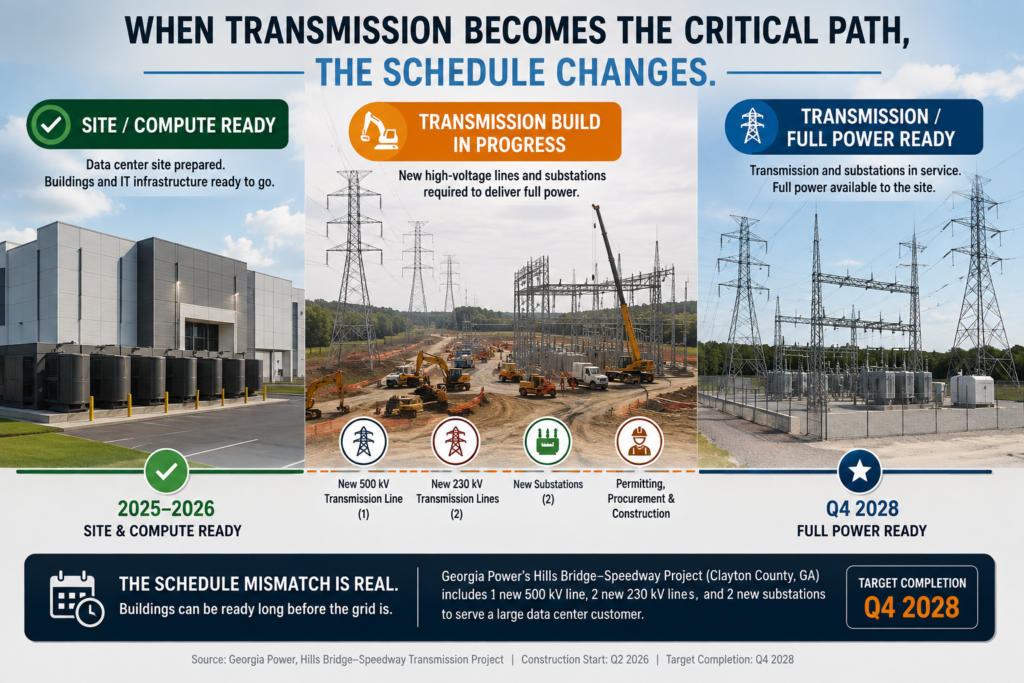
The Utility Date Is Too Late
Explore Critical Path →
Demand Ramps in Phases
Explore First Capacity vs. Final Capacity →
Permitting Moves on a Different Clock
Explore Parallel Workstreams →
Equipment Lead Times Diverge
Explore Critical Path →
An Existing Site Has Constraints
Explore First Capacity vs. Final Capacity →
The Ultimate State Is Still Moving
Explore Deployment Strategy Framework →
The Sequence Is Part of the Architecture
A project schedule is not enough.
Power Path
Permitting + Site
Procurement
Facility + Systems
Compute + Network
Commissioning
Operations
The Longest Activity Is Not Always the Controlling Activity
The deployment question
Gate
Dependency
Parallel Opportunity
Commitment Point
The First Operating State Does Not Have to Be the Final State
What must exist now?
Systems: Complete electrical, thermal, network, controls, and safety paths for the first operating block.
Operations: A maintainable, observable state that can run without depending on unfinished future infrastructure.
What must be prepared next?
Handoff: Identify the systems, cutovers, and dependencies that must be ready before the transition begins.
Commitment timing: Release the next work, equipment, or capacity only when its controlling inputs are sufficiently resolved.
Waiting Should Be Selective, Not Systemic
POWER + INTERCONNECTION
SITE + FACILITY
EQUIPMENT + PROCUREMENT
COMPUTE + NETWORK
Six Tests for a Credible Deployment Path
Critical Path
Identify the dependency chain that actually controls useful operation.
First Useful State
Define the smallest complete operating state that creates productive capacity.
Dependencies
Separate physically necessary dependencies from procedural or inherited assumptions.
Parallel Workstreams
Advance independent workstreams without creating uncontrolled rework or transition risk.
Transition Plan
Define how interim and permanent systems connect, migrate, and hand off under operation.
Decision Gates
Define the conditions and deadlines that determine when the next commitment, capacity block, or transition should begin.
Sequence Toward Productive Capacity
SITE + ENABLING WORK
INITIAL POWER + COMPUTE
PHASED CAPACITY EXPANSION
PERMANENT INFRASTRUCTURE INTEGRATION
Time-to-Capacity Is Designed
Useful Capacity Matters More Than Final Completion
Dependencies Should Be Tested, Not Inherited
Interfaces Determine Parallelism
Transition Risk Is Part of the Schedule
Sequence for Useful Capacity, Not Ceremonial Completion
Deployment Strategy Insights
- Power for AI

- Infrastructure Economics

- Data Center Architecture
Keep Following the Decision
Power for AI
Adaptive Infrastructure
Infrastructure Economics
Explore Your Deployment Strategy
Use the AI Advisor to examine critical paths, dependencies, parallel workstreams, transition plans, and decision gates in context or use the Technical Library to investigate related technical questions.
Ask the AI Advisor
Explore your infrastructure questions in context and identify the constraints, dependencies, risks, and decisions that deserve attention next.
Start Exploring »
Technical Library
Explore technical explanations, decision frameworks, and reference material behind AI infrastructure choices.
Explore the Technical Library
CONTINUE YOUR INFRASTRUCTURE DECISION
Technical guidance for AI infrastructure decisions
Explore the seven Decision Areas