Most infrastructure projects have a date everyone watches.
Substantial completion. Utility energization. Commissioning. Full campus availability.
Those milestones matter. But none necessarily answers the question an economic buyer ultimately cares about:
When does the infrastructure begin doing useful work?
For a campus capable of being developed in phases, that may be materially earlier than full completion. A 20 MW campus that reaches full operation in month 30 and a 20 MW campus that begins operating useful capacity earlier may arrive at the same destination, but they do not necessarily travel the same economic path.
The milestone that creates value
Completion is an engineering milestone. Productive operation is an economic milestone.
Infrastructure consumes capital before it performs the function for which that capital was committed. For a commercial operator, productive capacity may support contracted customer demand. For an enterprise, it may support internal AI workloads. In either case, the useful milestone is not simply that equipment can be energized. It is that the infrastructure can credibly support the intended compute.
This extends the question raised in You Need 6 MW Next Summer. The Utility Can Deliver 2 MW. What Now?: if the first productive state can occur before the ultimate infrastructure state, what is that earlier state actually worth?
Two 20 MW campuses can have different economics
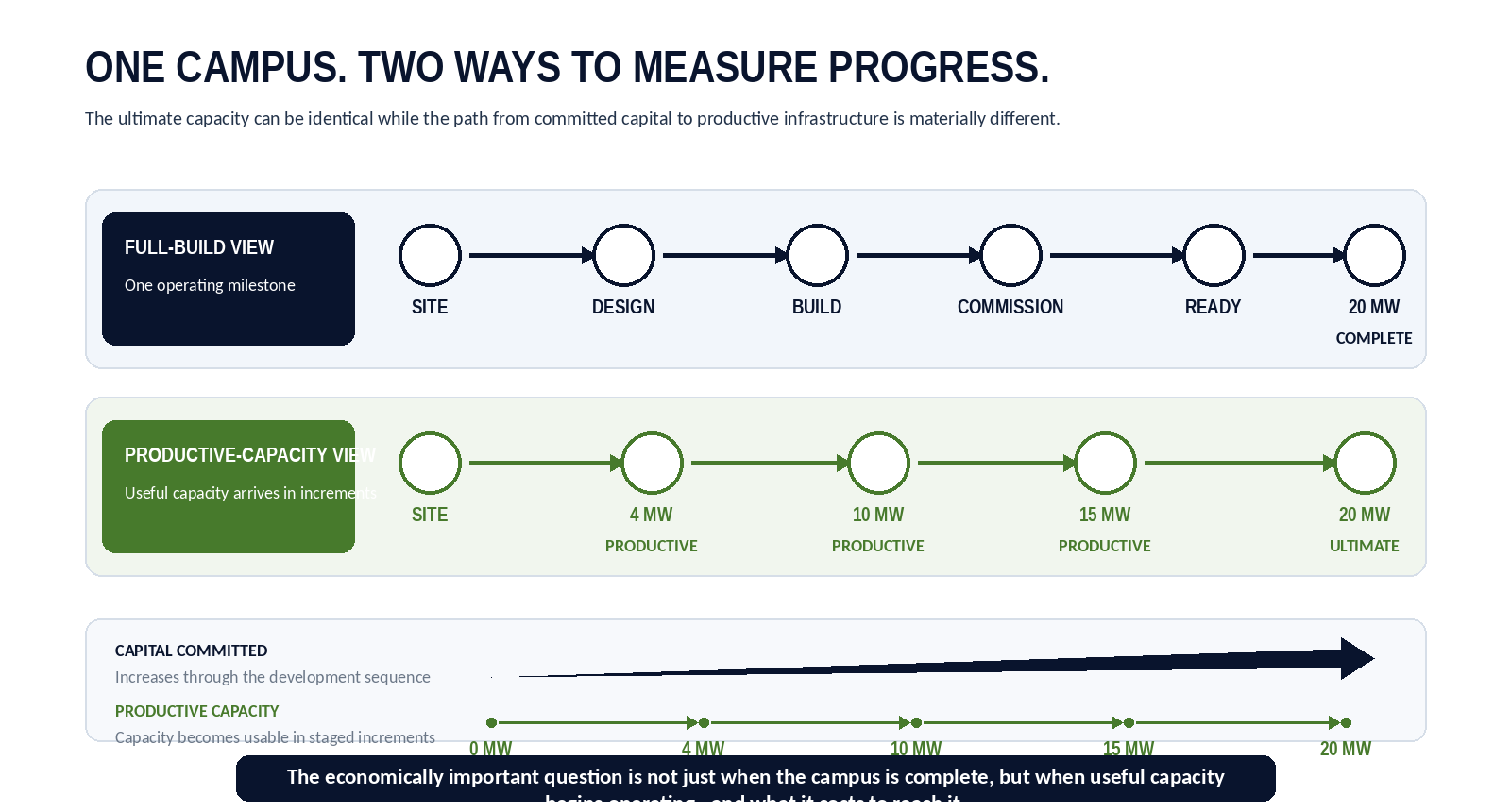
Consider two hypothetical projects. Both are ultimately designed for 20 MW.
Project A follows a full-build sequence: site, construction, infrastructure, commissioning, then 20 MW productive.
Project B develops in usable increments: 4 MW productive, then 10 MW, then 15 MW, then the same 20 MW ultimate state.
That does not make Project B automatically better. It changes the questions management should ask:
- How much capital had to be committed before the first productive capacity became available?
- Was there real demand for that earlier capacity?
- Did the first-phase investments remain useful as the campus expanded?
Large data center operators already commit and deliver capacity in stages. As of March 31, 2026, Digital Realty reported 1,169 MW of projects underway globally, with 61% of that capacity pre-leased, while retaining more than 5 GW of additional future development capacity. Source: Digital Realty SEC filing
Equinix describes expansion decisions in similarly economic terms. Its 2025 annual report says expansion criteria include customer demand, power availability, market capacity, incremental investment and lead time to free-cash-flow break-even. It also notes that substantial resources may be committed before customer contracts are secured. Source: Equinix SEC filing
Riot Platforms provides a visible AI example. In August 2026 it reported an initial 25 MW deployment delivered in May, another 25 MW expansion under construction, and a separate 191 MW AI project divided into a 96 MW first phase and a 95 MW second phase. Source: Riot Platforms SEC filing
The point is not that phasing is always superior. It is that a large campus may have more than one economically meaningful operating milestone.
Why earlier productive capacity can matter
Earlier productive capacity may let a commercial operator support customer commitments sooner, allow an enterprise to begin using compute before the ultimate campus is complete, provide real operating information before later design assumptions become irreversible, and allow subsequent investment to follow demonstrated demand rather than forecast demand alone.
It can also shorten the period during which committed capital remains entirely unproductive.
Those benefits can be meaningful. But none is free.
Earlier can be more expensive
A phased project can actually cost more.
Getting an initial phase operating early may require duplicated electrical equipment, temporary interconnections, repeated commissioning, transitional cooling or power systems, lower early-stage utilization, construction around live infrastructure or later migration work.
The wrong early-state design can create exactly the outcome it was supposed to prevent: stranded capital. A project can improve its first-operating date while making the ultimate campus less efficient, more complicated or more expensive.
The objective should not be the first possible megawatt. It should be the first productive megawatt that improves the economics of the complete project.
What counts as productive?
A megawatt is not economically useful merely because it can be energized. The infrastructure has to support the function for which the investment was made.
- Can useful compute operate at the required reliability and cooling conditions?
- Can customers or internal workloads actually use the capacity?
- Can the environment be commissioned while later construction continues safely?
- Can the infrastructure serving the first phase remain useful when the next phase arrives?
If not, the project has reached an earlier construction milestone, not meaningful productive capacity.
The capital-conversion question
Total project cost matters. But two projects with the same eventual cost can expose capital very differently over time.
One may require most of its investment before any useful capacity operates. Another may commit capital in stages, with productive infrastructure appearing between investment increments. Neither structure is inherently superior; the answer depends on demand certainty, equipment lead times, power availability, financing, construction sequencing, technology risk and the cost of building in increments.
But examining only total CapEx can hide that difference.
How much capital must we commit before the first meaningful unit of capacity becomes productive – and what do we learn before committing the next increment?
That turns phasing into a capital-allocation decision rather than merely a construction technique.
What Time-to-Function actually measures
We think of the interval required for infrastructure to reach a credible productive state as Time-to-Function.
- Technically credible: the infrastructure actually works.
- Operationally reliable: the intended workload can be supported under acceptable operating conditions.
- Economically useful: the capacity creates sufficient value to justify reaching that state.
Remove any one of those and speed alone has accomplished very little. For a phased campus, productive capacity may therefore arrive in several increments even though the project still has one ultimate completion date.
Do not optimize the wrong milestone
Recognizing the value of early productive capacity creates an opposite risk: optimizing everything around the first phase.
If reaching 4 MW six months earlier requires infrastructure that must later be removed, forces inefficient cooling or electrical architecture, or interferes with later construction, the project may have improved one date and weakened everything behind it.
The better question is not, “How soon can we operate something?” It is, “What is the earliest productive state that improves rather than damages the economics of the ultimate system?”
Six questions for the executive team
- What is the smallest capacity increment that creates meaningful economic value?
- When could that increment operate credibly?
- How much capital must be committed before reaching it?
- What additional cost, risk or complexity does earlier operation introduce?
- Which early investments remain useful as the site expands?
- Does operating earlier improve the total risk-adjusted economics of the project?
If those questions cannot be answered, “faster” is still only a schedule objective. It is not yet an economic strategy.
Sometimes that supports an earlier first phase. Sometimes the better economic decision is to build more before operating. The important point is to know why.
Go deeper
Explore Infrastructure Economics to examine how utilization, committed capital, capacity timing, optionality and stranded infrastructure affect AI infrastructure development.
Technical depth:
- Capacity Utilization and Stranded Infrastructure
- Modular Power Infrastructure for Phased AI Deployment
Then continue into Deployment Strategy to examine how procurement, construction, commissioning and operating around continued expansion affect the earliest credible productive state.