AI INFRASTRUCTURE INSIGHTS

AI Infrastructure

Understand how power, compute, cooling, networking, the physical environment, controls, and operations must work together to turn AI ambition into scalable infrastructure.

AI infrastructure is more than compute. It is the interconnected system of power, physical architecture, cooling, networking, controls, and operations required to turn AI capacity into reliable business capability.

start with your situation

AI Infrastructure Problems Rarely Start in the Same Place

The issue may appear to begin with power, compute, density, facilities, timing, or changing requirements - but each quickly exposes dependencies elsewhere in the infrastructure system.

The compute is ready before the infrastructure

“We know what we want to deploy, but the facility, power, cooling, or network environment is not ready.” What has to come together before that compute can become productive? Explore infrastructure readiness »

Our infrastructure plans are developing in silos

“Power, compute, cooling, networking, and facilities are being planned by different teams.” Where do those decisions need to connect before they create conflicts? Connect the systems »

The density assumptions keep changing

“The workload and hardware roadmap are moving faster than the facility design.” Which other infrastructure systems become limiting as density increases? See how requirements propagate »

We need capacity sooner than the final buildout

“The full end state will take time, but some useful capacity could potentially come online earlier.” If one workstream moves faster, which dependencies still prevent useful capacity from operating? Examine dependency convergence »

Our existing data center was not designed for this

“The facility works for traditional workloads, but AI is changing the power, cooling, and density requirements.” Which infrastructure layers can support the new workload, and which become limiting? Assess the existing environment »

We are making decisions before requirements are stable

“Technology, demand, and capacity requirements are still evolving, but infrastructure decisions have to be made now.” Which assumptions have the greatest downstream impact across the infrastructure system? See how changes propagate »

Different Starting Points, One Systems Problem

Different starting points create different symptoms. The underlying challenge is the same: usable AI capacity depends on multiple infrastructure systems becoming ready together.

AI INFRASTRUCTURE READINESS FRAMEWORK

Having the components is not the same as having a working system.

AI capacity becomes usable only when compute and its supporting infrastructure are ready together. A project can have GPUs, power, cooling, or space available and still be unable to operate if a critical dependency is missing or misaligned.

AI INFRASTRUCTURE DIMENSION WHAT READINESS ACTUALLY MEANS
Compute Are the required GPUs, servers, storage, and supporting systems available when the infrastructure is ready for them?
Power Can sufficient usable power be delivered at the required time, voltage, reliability, and growth profile?
Cooling Can the thermal system support the actual rack densities and workload profile without constraining performance or expansion?
Networking Is the required internal and external connectivity available with the bandwidth, latency, resilience, and topology the workloads require?
Physical environment Does the facility support the required density, electrical distribution, cooling equipment, security, access, and operational needs?
Controls & operations Can the systems be monitored, managed, protected, and operated together as one reliable environment?
Dependency Alignment Are the handoffs between systems defined, and are the critical dependencies ready together when the workload needs to operate?
System Validation Has the combined environment been validated under the workload conditions it is expected to support?

The Limiting Dependency

AI infrastructure is a system. Its usable capacity is determined not by the strongest component, but by the dependency that is least ready when the workload needs to operate.

SYSTEMS ARE INTERDEPENDENT

The bottleneck moves.

Solving one infrastructure constraint does not necessarily remove the constraint - it often shifts the limiting dependency somewhere else in the system.

Infrastructure performance is constrained by the system, not the component.

Adding capacity in one area creates requirements elsewhere. More compute can require more power, cooling, networking, physical capacity, and operational support before any additional AI capacity becomes productive.

More Compute

Higher compute capacity can immediately increase power demand, heat rejection, network traffic, and infrastructure density.

More Power

Additional utility or on-site power is useful only if electrical distribution, cooling, and the facility can actually support the resulting load.

Higher Density

Increasing rack density can change cooling architecture, electrical distribution, floor loading, maintenance access, and redundancy requirements.

Accelerating One Workstream

Moving one layer faster can simply shift the limiting dependency to permitting, equipment, commissioning, networking, power, cooling, or another system.

Greater Resilience

Additional redundancy can improve availability while also increasing equipment, space, power, controls, and operating complexity.

Created by Amethyst Studiofrom the Noun Project

Technology Change

New compute or cooling technologies can alter assumptions elsewhere in the system and make a previously sound infrastructure design less suitable.

Local optimization can create a system-level constraint.

The objective is not to maximize every component independently. It is to keep the critical infrastructure dependencies aligned as requirements, technology, and capacity change.

SYSTEM CONVERGENCE

Critical Dependencies Have to Converge

Power, compute, cooling, networking, the physical environment, controls, and operations do not have to progress at the same speed. But useful AI capacity cannot operate until the dependencies required by the workload converge into a working system.

Coordination creates usable capacity.

Critical systems required by the workload must converge into an operating environment that can actually function. Progress in one area cannot compensate for a missing dependency elsewhere.

KEY QUESTIONS FOR SYSTEM CONVERGENCE

Which dependencies must be ready together?

Identify the systems whose absence or misalignment prevents the workload from operating reliably.

Where do systems hand off to one another?

Make the electrical, thermal, network, control, operational, and organizational dependencies between systems explicit.

What happens when one layer gets ahead?

Determine whether additional capacity in one system simply creates a new constraint somewhere else in the infrastructure environment.

Can the complete operating environment actually function?

Test readiness at the system level rather than validating each component independently. The combined environment must support the workload under real operating conditions.

SYSTEM INTERDEPENDENCE

A Change in One Layer Changes the System

AI infrastructure assumptions are connected. A change in workload, compute density, power availability, cooling technology, network design, or operating requirements can change what other parts of the system must provide.

SYSTEM EFFECTS

A local change becomes a system decision when it alters requirements elsewhere.

Higher density changes power and cooling. Different cooling can change power, space, controls, and operations. More compute increases power, heat, and network load. Higher resilience adds equipment, pathways, controls, and operating complexity.
Which dependencies change when one assumption moves?
Explore Adaptive Infrastructure »
AI INFRASTRUCTURE DECISION FRAMEWORK

Six Tests for a Working AI Infrastructure System

A credible AI infrastructure approach must make system-level readiness visible. It should align dependencies, clarify handoffs, balance capacity across layers, expose the limiting constraint, integrate operations, and validate the complete operating state.

Align Critical Dependencies

Are the systems required by the workload actually ready together rather than optimized independently?

Make the Handoffs Explicit

Are cross-system interfaces, responsibilities, and dependencies clearly defined where one infrastructure layer hands off to another?

Balance Capacity Across Layers

Are we adding capacity where the overall system can use it rather than creating isolated headroom in one layer?

Expose the Limiting Dependency

What currently prevents additional workload from becoming productive, and does added capacity elsewhere simply move that constraint?

Integrate Controls + Operations

Can the environment be monitored, protected, controlled, maintained, and operated reliably as one system?

Validate the Complete Operating State

Has the combined infrastructure been assessed under the workload conditions it is expected to support, rather than only component by component?

A Working System Is More Than a Collection of Capable Components

The test is whether the required systems, handoffs, controls, and operations can support the workload together under real operating conditions.

SYSTEM READINESS IN PRACTICE

Usable Capacity Is Limited by the System

Individual capacity does not add up to usable AI capacity unless the critical dependencies can support the workload together.
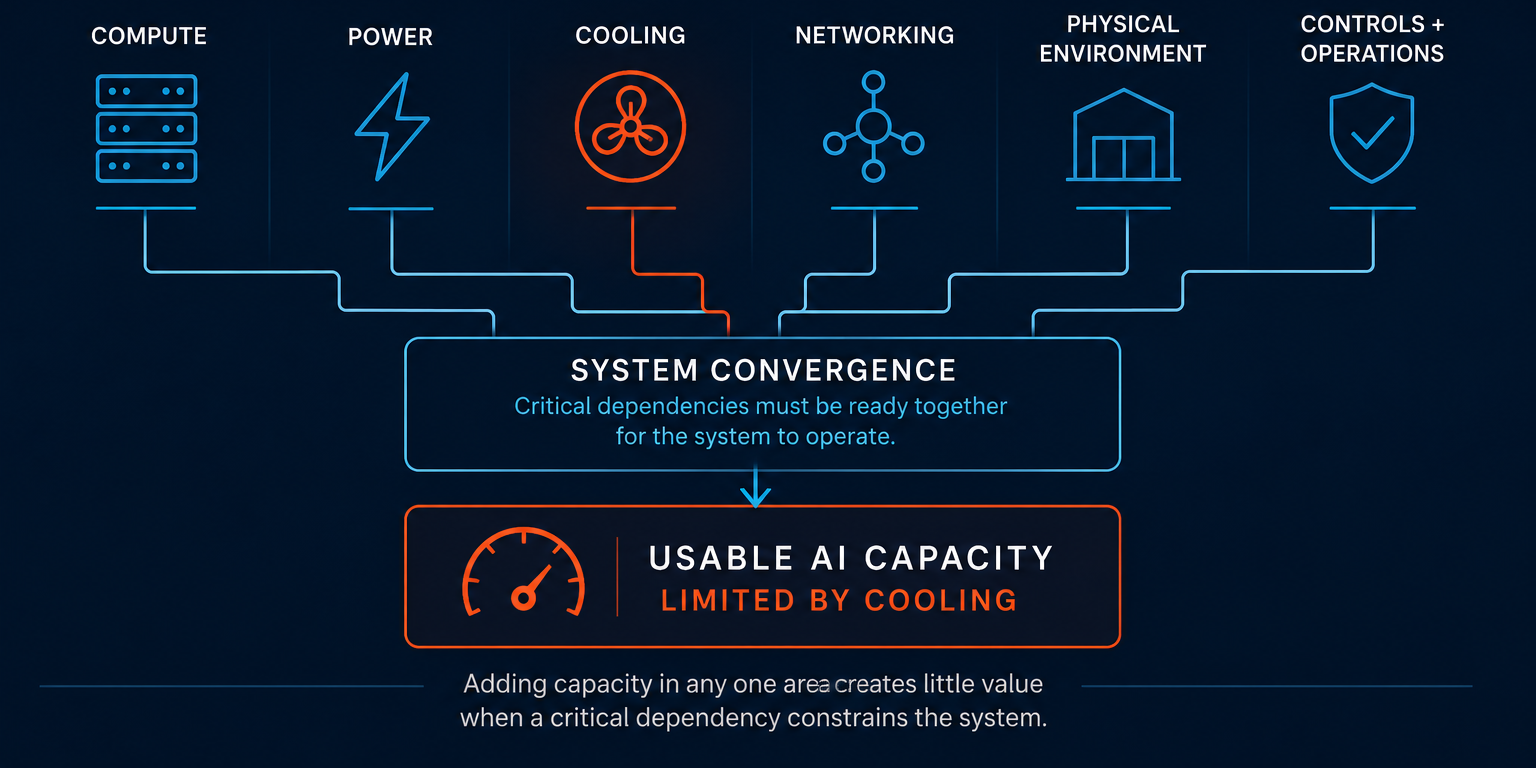
System convergence diagram showing compute, power, cooling, networking, physical environment, and controls and operations combining into usable AI capacity, with cooling as the limiting dependency.

The strongest component cannot compensate for a missing critical dependency elsewhere in the system.

Where the evidence leads

Build the System, Not the Components

AI infrastructure succeeds when the required systems operate as one environment. The objective is not maximum capacity in every layer; it is a balanced system in which power, compute, cooling, networking, facilities, controls, and operations collectively support productive workload capacity.

Readiness is System-Level

Useful capacity depends on the critical dependencies becoming ready together.

Target Streamline Icon: https://streamlinehq.com

The Bottleneck Moves

Solving one constraint often exposes the next somewhere else in the system.

Sequence iconAscending sequence of four steps with a checkmark badge above the highest step.

Local Optimization Is Not System Optimization

Additional compute, power, cooling, or redundancy creates little value when another critical layer prevents the workload from using it.

Path forward iconBlack and white line icon showing a starting state, a forward path through checkpoints, and an arrow indicating progress.

Operations Are Part of the Infrastructure

A technically complete environment is not ready until it can be monitored, controlled, protected, maintained, and operated reliably.

Usable Capacity Is a System Outcome

AI infrastructure is ready only when compute and its supporting power, cooling, networking, physical environment, controls, and operating systems can support the workload together. Maximizing one layer does not create productive capacity when another critical dependency remains constrained.

AI Infrastructure STRATEGY TAKEAWAY

Usable Capacity Is a System Outcome

AI infrastructure is ready only when compute and its supporting power, cooling, networking, physical environment, controls, and operating systems can support the workload together. Maximizing one layer does not create productive capacity when another critical dependency remains constrained.

The objective is not simply to make every system ready. It is to make them ready together.

AI infrastructure is ready only when compute and its supporting power, cooling, networking, physical environment, controls, and operating systems can support the workload together. Maximizing one layer does not create productive capacity when another critical dependency remains constrained.

Go Deeper

AI Infrastructure Insights

Continue into analysis of the systems, dependencies, and decisions that shape AI infrastructure outcomes.
An OT alert does not choose the response. Define when to contain and when a separately isolated environment can support useful, bounded
A useful digital twin preserves cause and effect, timing and operating limits. Learn how to assess physical credibility without confusing it with
An isolated digital twin can support OT investigation without making the live power system the experiment. Evaluate boundaries, model credibility, evidence and
Connected decision areas

Keep Following the Decision

AI infrastructure decisions rarely stand alone. Continue into the decisions most directly connected to the systems, constraints, and dependencies explored here.

Power for AI

Determine whether the required power can actually be delivered when it is needed, and how utility timing, available capacity, resilience, and expansion shape the infrastructure path.
Explore Power for AI »

Data Center Architecture

Infrastructure requirements ultimately have to become a workable physical architecture across power, cooling, compute, networking, and site systems
Explore Data Center Architecture »

Adaptive Infrastructure

Changing density, technology, capacity, and deployment assumptions require infrastructure that can evolve without forcing premature replacement or stranded investment.
Explore Adaptive Infrastructure »

The Decisions Stay Connected

A change in power, architecture, capacity, or deployment assumptions can shift the answer elsewhere. The strongest infrastructure strategies account for those dependencies before they become constraints.

CONTINUE THE EXPLORATION

Explore Your Infrastructure Path

Use the AI Advisor to explore infrastructure questions in context, or investigate the technical questions behind them in the Technical Library.

Ask the AI Advisor

Explore your infrastructure questions in context and identify the constraints, dependencies, risks, and decisions that deserve attention next.

Start Exploring »

Technical Library

Explore technical explanations, decision frameworks, and reference material behind AI infrastructure choices.

Explore the Technical Library

Continue the exploration

Explore Your Infrastructure Path

Use the AI Advisor to explore infrastructure questions in context, or investigate the technical questions behind them in the Technical Library.


Ask the AI Advisor

Explore your AI infrastructure questions in context and identify the system dependencies, readiness gaps, sequencing decisions, and assumptions that deserve attention next.

Start Exploring ≫

Technical Library

Explore technical explanations, decision frameworks, and reference material behind AI infrastructure choices.

Explore the Technical Library

CONTINUE YOUR INFRASTRUCTURE DECISION

Explore the related Topic Hubs for decision context, then use the Technical Library to investigate the technical questions behind it.

Technical guidance for AI infrastructure decisions
Explore the seven Decision Areas

Continue Your Infrastructure Decision

What infrastructure dependencies, sequencing decisions, and changing requirements matter most for your path to usable AI capacity?

CONTINUE YOUR INFRASTRUCTURE DECISION

Explore how power, cooling, compute, communications, and cybersecurity work together to support productive AI capacity. Technical guidance for AI infrastructure decisions