An isolated model can create room to investigate suspicious behavior. Its value depends on a verified boundary from production, credible physical behavior, and accountable response decisions.
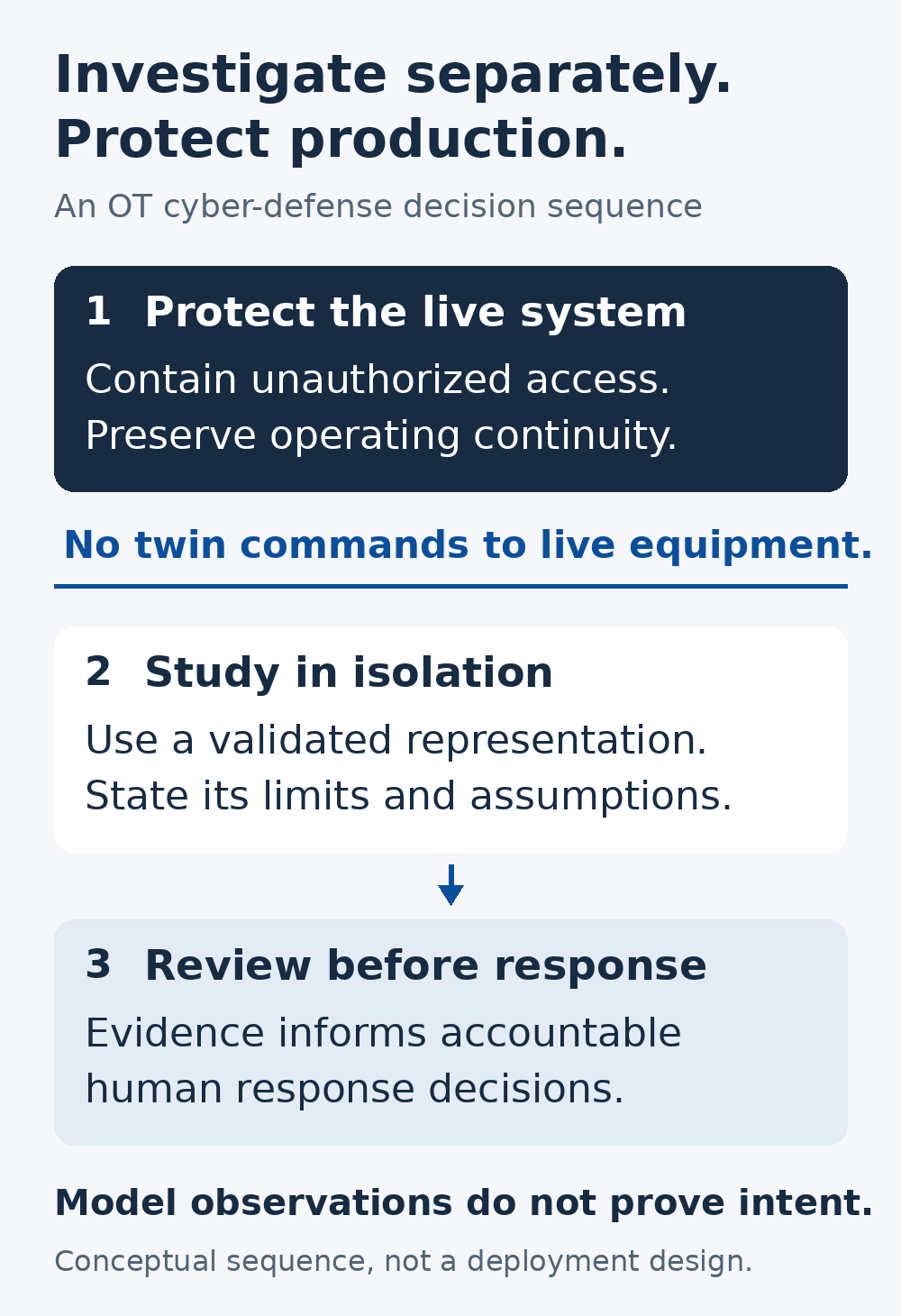
A suspicious command reaches a power-control environment. The operating team has two immediate responsibilities: protect the physical system and preserve enough evidence to understand what happened. Those responsibilities can compete when investigating an interaction would expose equipment or interrupt a critical service.
An isolated digital twin changes where part of that investigation can occur. A representative model can support controlled examination of commands, sequences, and possible consequences without making the live power system the experiment. It does not make an intrusion harmless, establish an attacker’s identity, or remove the need for containment.
The useful question is specific: What can we learn in a separate environment that improves a real response decision, without giving that environment authority over production?
What isolation changes
A digital twin is an electronic representation of a real-world entity and relevant behavior. For this defensive use, the important distinction is between representing the power system and controlling it. A simulation may depict equipment states and consequences; that does not require permission to operate the corresponding equipment.
Consider an illustrative attempt to change an operating setpoint. In production, the priority is to keep unauthorized changes from affecting equipment. In a properly bounded model, an authorized analyst can examine the attempted sequence and the modeled consequence. The resulting evidence may help identify an affected function, refine a detection rule, or improve a response exercise.
These are potential uses, not evidence that a particular product performs them. The model’s operating limits and the facility’s incident procedures determine which uses are defensible.
Our earlier article, Digital Twins for OT Cyber Defense: What Must Be True Before They Help, established the evaluation criteria. Here, the emphasis is on the separation between live operations, investigative interaction, and response authority.
Containment remains the first responsibility
Immediate blocking can end an interaction before the team has observed its full sequence. That does not make blocking a mistake. When safety, availability, or containment requires access to end, further observation is secondary.
Controlled deception can sometimes offer an additional place to observe behavior, provided the interaction occurs inside a separately governed environment. It is not permission to leave an adversary in the live system. Nor should a project assume every suspicious session can be redirected safely or convincingly.
Teams need to distinguish three activities: replaying recorded events, conducting authorized exercises, and observing an active interaction in a deception environment. They have different risks and evidence limits. A successful replay demonstrates what the model does with that input; it does not demonstrate that an adversary would behave the same way in a separate environment.
The boundary must be demonstrated
Calling an environment isolated is insufficient. The team must be able to show that investigative actions cannot operate production equipment or create a route back into the live control environment. That includes the less obvious dependencies: shared credentials, administrative access, communications services, and records used by operators.
Data entering the model also needs a defined purpose and boundary. A model can use approved representations, captured information, or suitably controlled inputs without becoming an uncontrolled copy of the facility. More detail is not automatically better if it increases exposure or maintenance burden.
The boundary must survive failure and change. What happens if a model service stops, an input becomes stale, or an administrator changes an access rule? A useful acceptance test checks those conditions as well as the normal demonstration. The exact implementation belongs in project engineering and protected technical diligence.
Physical credibility determines what the evidence means
A power-system model must represent the relationships that matter to the question being investigated. Changes in demand, source capability, stored energy, equipment state, and control response have physical consequences. A display that changes numbers plausibly is not necessarily a validated model of those consequences.
Physics consistency means modeled states and transitions obey the relevant physical constraints within a stated operating range. It does not mean every transient or protection function is reproduced. Validation should identify which behaviors are represented, which are simplified, and which are outside scope.
A model might be sufficient to examine a command sequence yet inadequate to predict a protection response. The analyst should report that distinction. For operating teams, a qualified conclusion is more useful than a precise-looking prediction with an unknown error.
The same discipline applies to observability. As discussed in Observability Is the First Requirement for Defensible Power Operations, useful evidence requires understandable system state. Model logs and live observations must remain clearly distinguishable.
Observation is evidence, not proof of intent
An interaction may reveal a sequence of requested actions, functions of interest, or behavior worth investigating. It cannot by itself establish the actor’s identity, complete objective, or the consequence that would occur in production. A participant may recognize the simulation, change behavior, or stop interacting.
Model configuration and uncertainty therefore belong with the findings. Security analysts and power engineers should review what was observed, what was inferred, and what still requires confirmation before a result influences the live facility.
A useful deliverable is a bounded finding: the observed action, the modeled response, the assumptions behind it, and the response decision it could inform. A dramatic demonstration without that chain is weak evidence.
The operating burden is part of the decision
Someone must maintain the model, review its access, validate changes, preserve investigative records, and connect findings to incident procedures. Equipment replacements, software updates, and operating-mode changes can make an earlier representation less useful.
The economic test is whether better evidence justifies that continuing work. If the team lacks a reliable asset inventory, controlled remote access, practiced incident response, or recovery procedures, strengthening those foundations may deliver more immediate value. An isolated twin supplements those controls.
A practical acceptance test
Before adopting this approach, ask the security lead, power engineer, and operations owner to answer five questions together.
Decision: What response decision will the investigation improve?
Boundary: What evidence shows that investigative actions cannot command live equipment or create an unintended production dependency?
Credibility: Which physical behaviors are validated, and where must the model’s output be disregarded?
Authority: Who can end observation, approve a response, and protect operating continuity?
Maintenance: Who keeps the representation and procedures current as the facility changes?
An isolated digital twin can create a useful place to learn. Its value rests on the boundary that protects production and the quality of the decision that follows.
Continue your infrastructure decision
Use the Technical Library to explore the engineering principles behind integrated AI infrastructure.
Technical references
NIST SP 800-82 Revision 3, Guide to Operational Technology Security, addresses OT security in the context of physical performance, reliability, and safety. NIST IR 8356, Security and Trust Considerations for Digital Twin Technology, examines digital-twin functions and their security and trust challenges. The decision framework in this article is an engineering interpretation, not a NIST endorsement of a particular defensive method or Blueflux capability.