Instrumentation can produce enormous amounts of data without giving operators a reliable picture of what the power system is actually doing. Defensible operations begin when telemetry becomes operational understanding.
Modern AI infrastructure can generate enormous amounts of operating data.
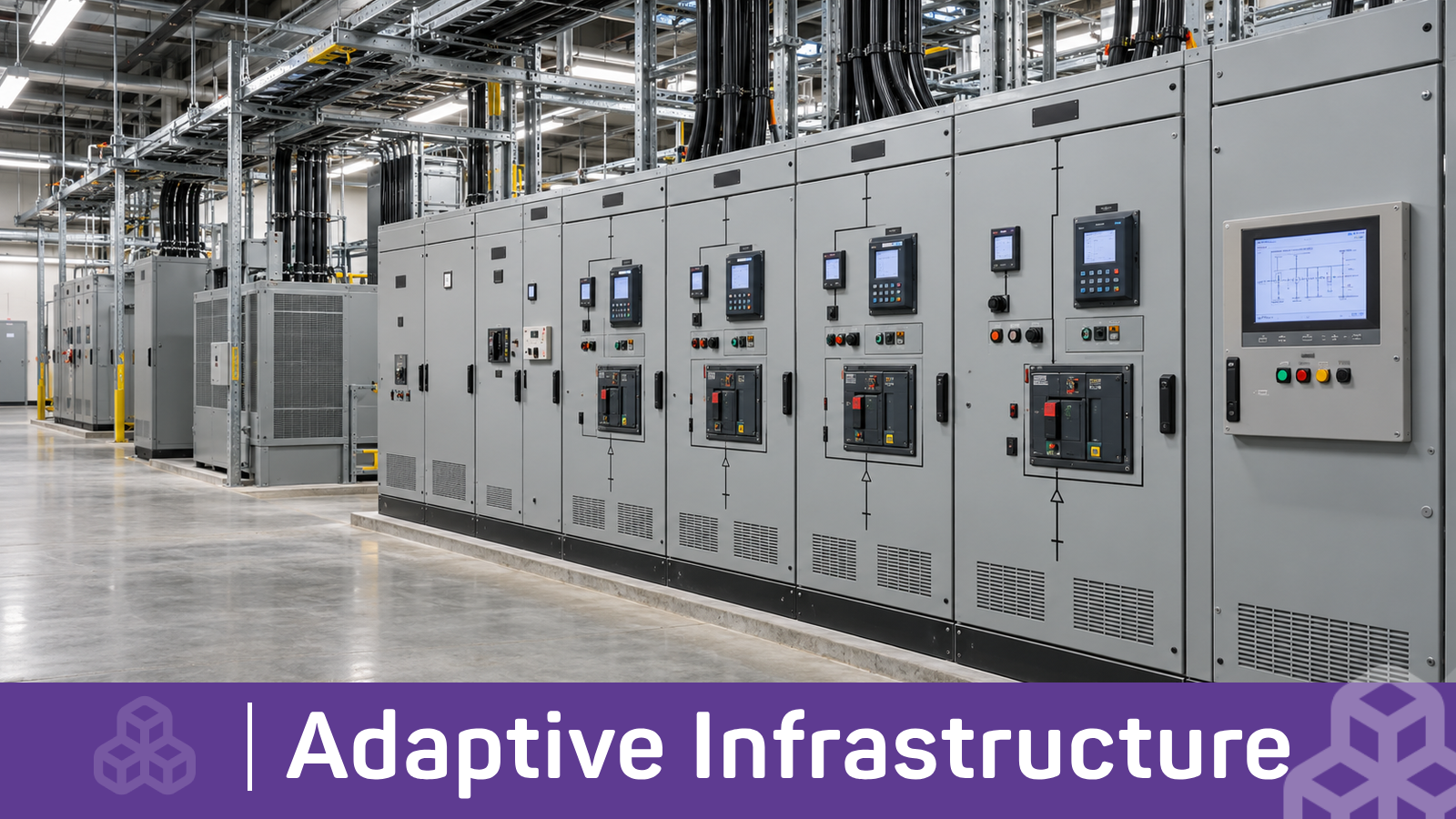
Meters report voltage and current. Controllers record status. Protection devices create events. Battery systems expose charge state. Cooling systems report temperatures and flows. Network infrastructure records communications. Facility systems generate alarms.
That does not necessarily mean the infrastructure is observable.
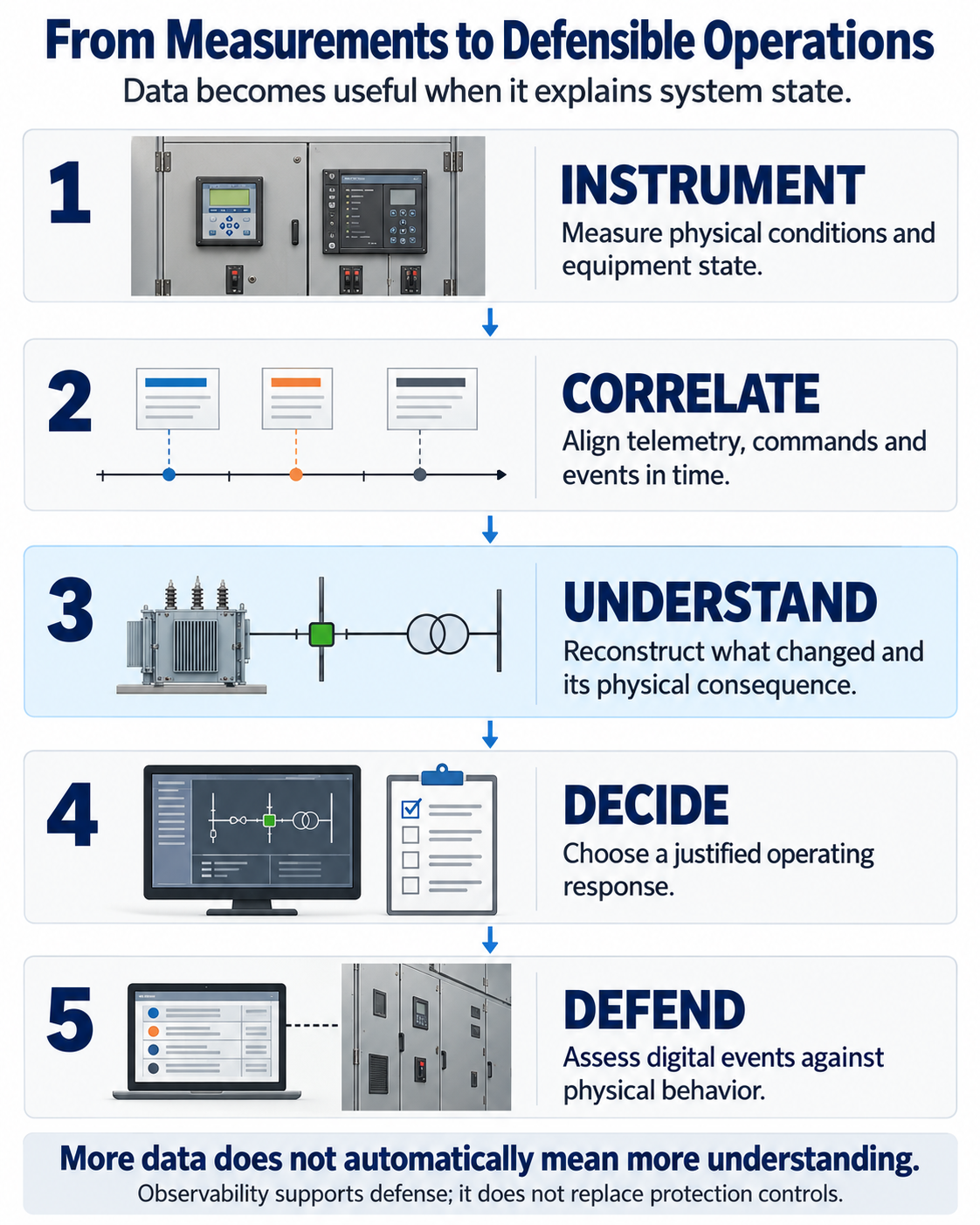
Data availability tells you that measurements exist. Observability tells you whether those measurements can be assembled into a trustworthy understanding of what the physical system is doing.
That distinction matters increasingly as power infrastructure becomes more interconnected, automated and software-controlled.
Instrumentation is necessary, but it is not the objective
You cannot understand a physical system without measuring it.
Voltage, current, frequency, temperature, equipment state, protection events, control commands and other measurements establish the raw evidence from which an operating picture can be developed.
But adding sensors does not automatically improve the operator's understanding.
A facility can have thousands of measurements and still leave basic questions difficult to answer:
- What changed first?
- Which change was a cause and which was an effect?
- Is the condition local or system-wide?
- Does the measurement agree with the expected physical behavior?
- Is the system moving toward instability?
- Did a device fail, did a control action produce an unintended result, or did someone issue an unauthorized command?
The important design question therefore is not simply what can we measure?
It is what must we understand?
Telemetry needs context
A measurement becomes more useful when it can be interpreted relative to the rest of the system.
Consider a voltage deviation.
A single meter can show that voltage changed. That does not by itself explain whether the change originated upstream, followed a rapid load transition, resulted from a local control response, accompanied a distribution imbalance or reflects a measurement problem.
The same principle applies to temperature, current, frequency, breaker state, storage response and control-system activity.
Operational understanding comes from relationships.
That means observability depends not only on sensors, but also on time alignment, system context, equipment state and the ability to correlate events across disciplines.
This is particularly important in operational technology. OT systems interact directly with physical processes, which is why cybersecurity guidance for these environments must account for reliability, safety and operational behavior—not merely conventional information-security concerns. NIST Computer Security Resource Center
Observability changes troubleshooting
Without good observability, troubleshooting often begins after an event with teams collecting evidence from separate systems.
The power team checks electrical data.
Controls engineers examine controller logs.
Facilities personnel review environmental alarms.
Network teams inspect communications.
Cybersecurity teams look for anomalous access or traffic.
Each view may be individually correct while still being incomplete.
A more observable architecture gives these teams a common chronology of the event.
Instead of asking only, What alarm fired?, the team can ask:
What sequence of physical and control-state changes produced the condition we observed?
That is a fundamentally stronger operating position.
It helps distinguish symptoms from causes and can shorten the path from detection to diagnosis.
Observability is also a cybersecurity requirement
Cyber defense introduces another reason why system state matters.
Suppose an unauthorized command reaches a power-system controller.
Network monitoring may establish that unusual communication occurred.
But the operating question does not end there.
Did the command change anything?
Did protection respond?
Did another controller compensate?
Did the physical process continue inside its expected operating envelope?
Did the event reveal a vulnerability in the architecture?
Those questions require visibility into both the digital event and the resulting physical behavior.
NIST's OT guidance treats monitoring and control of physical processes as defining characteristics of operational technology, and its latest draft expands attention to network monitoring and detection within OT security architecture. NIST Computer Security Resource Center
For power infrastructure, that means cyber observability cannot stop at packets and login events.
It needs enough physical context to determine what the system actually did.
More data is not always more observability
There is a temptation to solve the visibility problem by collecting everything.
That can create a different failure mode.
If operators receive more measurements than they can interpret, additional telemetry can increase noise rather than understanding.
Useful observability therefore requires discipline.
Measurements should exist because they help answer an operating question. Alarms should identify conditions that matter. Historical information should allow events to be reconstructed. Different systems should share enough context that their data can be compared meaningfully.
The objective is not maximum data collection.
It is decision-quality visibility.
Observability should be designed with the architecture
This is why observability belongs in early infrastructure design.
Once equipment, controls, communications and monitoring systems have been selected independently, it becomes much harder to create a coherent operating picture afterward.
Designing observability earlier changes the questions teams ask:
What state information will operators need?
Which measurements establish that state?
What needs to be time-correlated?
What behavior should be visible during normal operation?
What must remain visible during a fault?
What information will be required to investigate an abnormal or potentially malicious event?
Those are architecture questions, not dashboard questions.
And they become increasingly important as generation, storage, distribution, controls and critical compute operate as a coordinated system.
The practical test
A useful way to evaluate observability is to imagine that something unexpected happens tomorrow.
Then ask:
Could the operating team reconstruct what happened, determine which subsystem changed first, understand the physical consequence and make a defensible decision about what to do next?
If the answer requires several teams to manually assemble disconnected logs after the event, the facility may have extensive instrumentation without having true observability.
For increasingly interconnected AI power systems, that distinction matters.
You cannot reliably control what you cannot understand. And you cannot credibly defend a system whose operating state you cannot see.