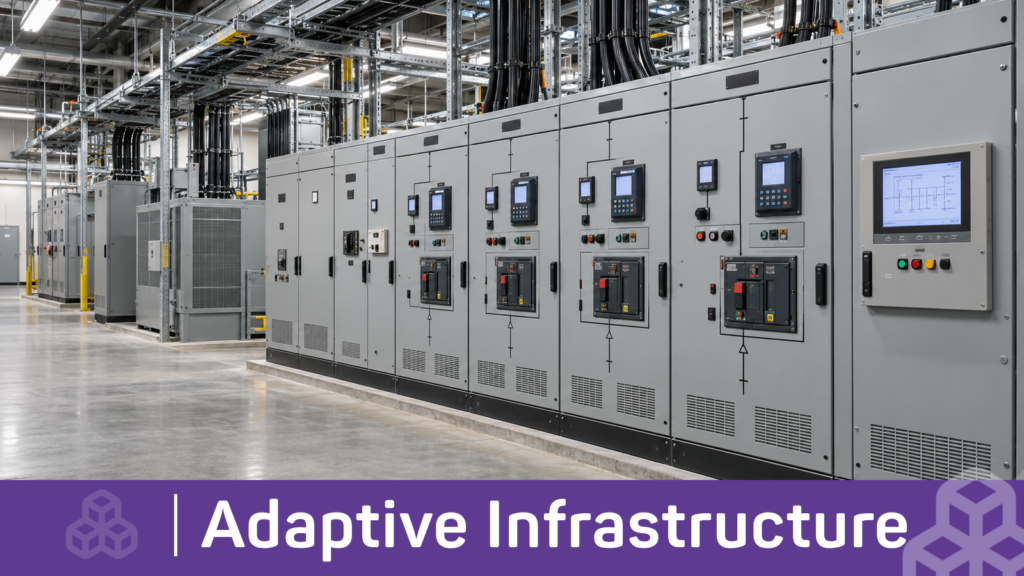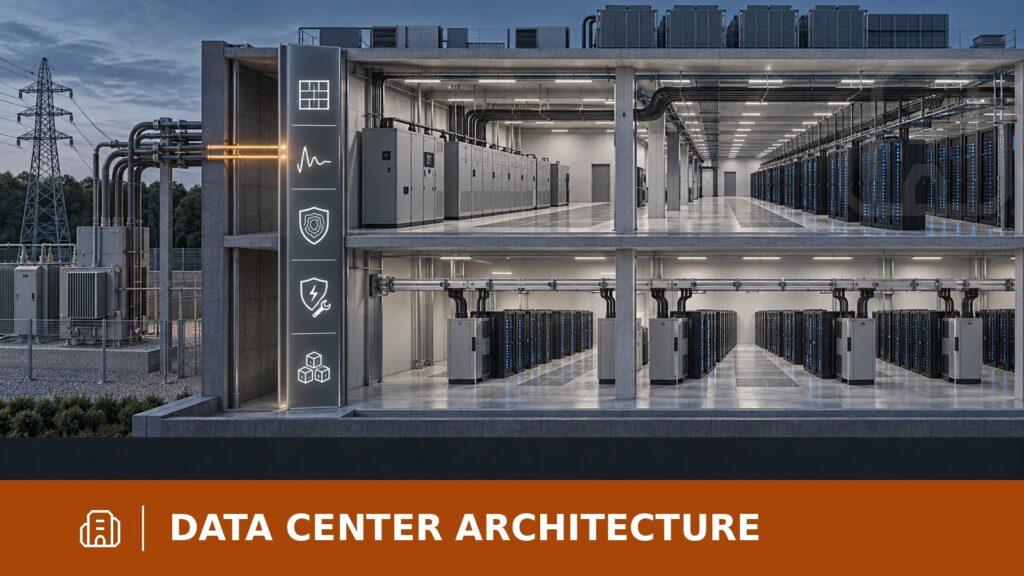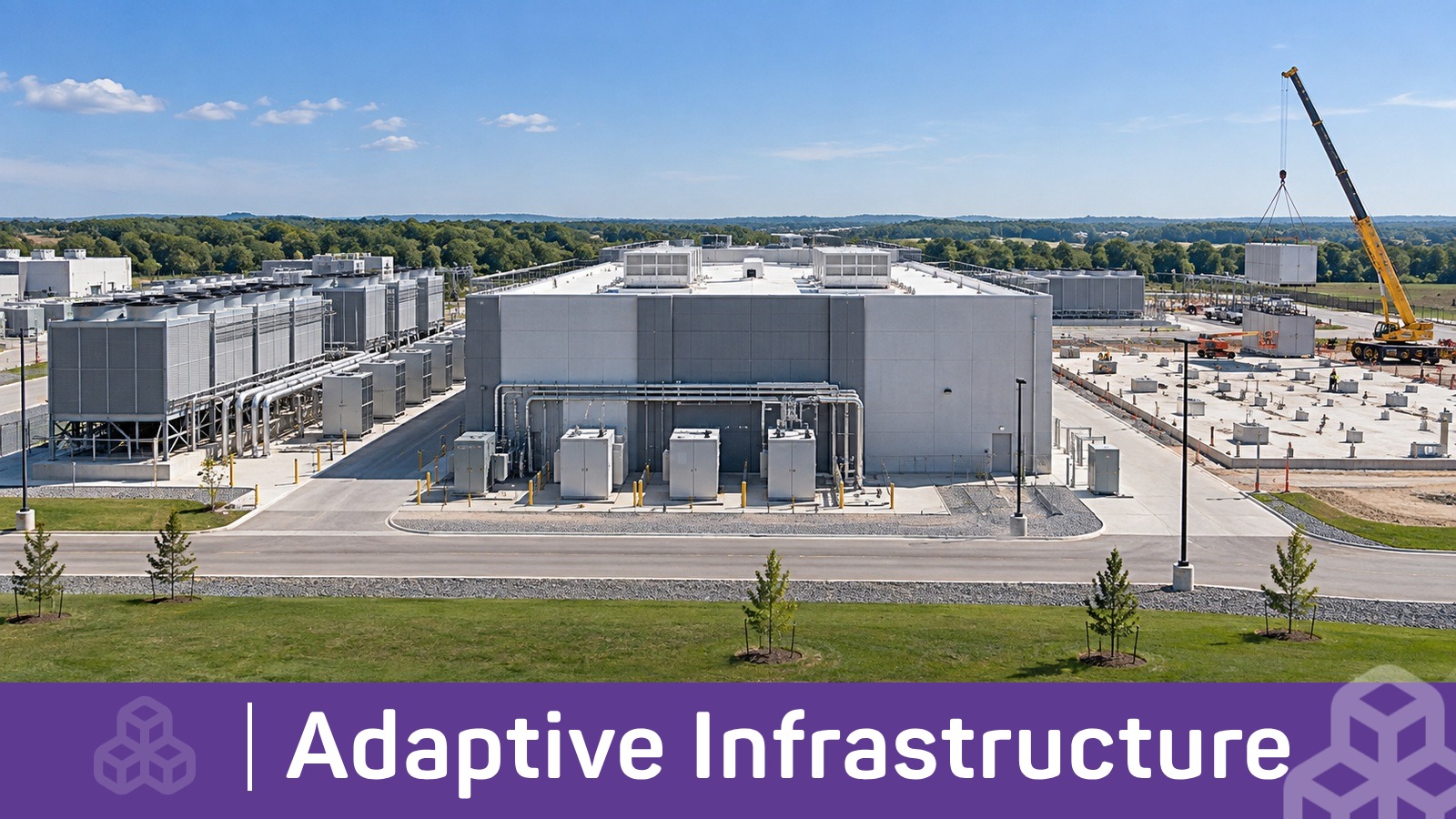
Adaptive AI infrastructure is often mistaken for modular construction. The two ideas overlap, but they are not the same. A project can be assembled from modules and still become difficult, expensive, or risky to change.
True adaptability begins at the system level. It determines which decisions should remain stable, which layers should be allowed to evolve, and how power, cooling, compute, communications, cybersecurity, and operations will continue to work together as the site changes.
The objective is not unlimited flexibility. It is controlled change: the ability to add capacity, introduce new equipment, alter the power mix, or support a different compute requirement without repeatedly redesigning the infrastructure beneath it.
Adaptive is not the same as modular
Modularity describes how equipment or facilities are packaged. Adaptability describes how the complete system responds to change.
A modular generator, cooling unit, data hall, or compute block may reduce field assembly and create a repeatable deployment unit. But the benefit disappears if each addition requires new protection studies, incompatible controls, major distribution changes, interrupted operations, or the replacement of equipment installed in an earlier phase.
That is why a collection of modular components is not automatically an adaptive architecture. The interfaces, operating logic, expansion path, and transition states matter as much as the modules themselves.
Open Compute Project describes an industry working toward open solutions across AI and machine learning, advanced power management, cooling, optics, and composable silicon. That broader ecosystem illustrates the underlying requirement: infrastructure must accommodate changes across several technical domains, not just accept another physical box.
Why AI infrastructure needs a different design assumption
Traditional infrastructure planning often assumes that the primary technical requirement can be defined early and remain sufficiently stable through design, procurement, construction, and operation. AI infrastructure weakens that assumption.
Compute platforms, rack configurations, cooling requirements, network topology, and deployment priorities can change while the supporting facility is still being developed. At the same time, electrical interconnections, substations, mechanical systems, buildings, and civil works are long-lived assets with slower planning and construction cycles.
The result is not merely a faster version of conventional data center design. It is a coordination problem between systems that change at different rates.
The U.S. Department of Energy’s data center design guidance reinforces the importance of treating information technology, environmental conditions, air management, cooling, electrical systems, heat recovery, and operating metrics as connected decisions. A change in one layer can create cascading effects in the others. Adaptability therefore depends on system integration, not isolated component flexibility.
What should remain stable, and what should be designed to change?
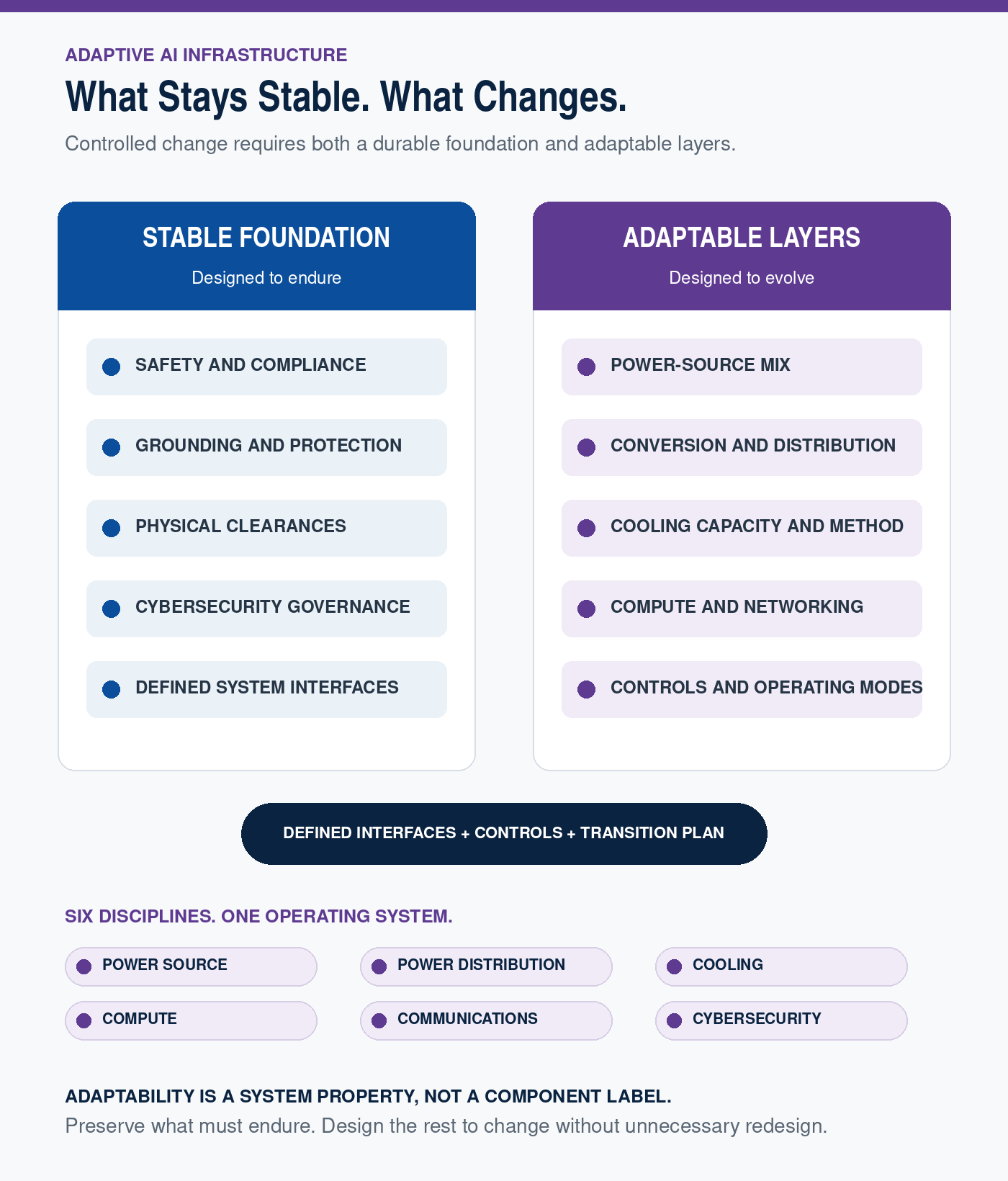
An adaptive design does not make every element variable. Some foundations should be deliberately durable because changing them later would create unacceptable safety, reliability, regulatory, or operating risk.
Stable foundations commonly include:
- Safety, grounding, protection, and code-compliance principles.
- Physical clearances, access routes, structural limits, and maintainability requirements.
- Cybersecurity governance, identity, segmentation, and control-authority rules.
- Defined technical interfaces between major systems.
- Operating responsibilities, failure responses, and change-control procedures.
Adaptable layers may include:
- The mix of utility service, onsite generation, storage, and other power resources.
- Power-conversion stages, distribution paths, and capacity blocks.
- Cooling modules and heat-rejection configurations matched to changing density.
- Compute, rack, and network configurations.
- Control sequences, operating modes, monitoring, and the timing of expansion.
The practical design task is to create enough stability that the system remains safe and governable, while preserving enough optionality that changing one layer does not force unnecessary reconstruction elsewhere.
Six disciplines must remain coordinated
Adaptability is tested at the boundaries between disciplines. Each one can be engineered competently on its own and still produce a weak overall result if the interfaces are unresolved.
Power source and generation
The available power mix may change by phase. Utility capacity can increase, onsite generation may shift from a bridge role to resilience support, and storage may take on different operating duties. The architecture should define how those resources are added, dispatched, synchronized, and retired or reassigned.
Power distribution and conditioning
Distribution must support current loads without preventing later changes in capacity, voltage, conversion, protection, or topology. Spare physical space alone is insufficient; ratings, fault current, selectivity, controls, and connection standards must also support the expansion path.
Cooling
Cooling requirements follow the compute load and equipment design. An adaptive approach anticipates that air, liquid, and heat-rejection requirements may not remain uniform across the campus or across time. Capacity should be added in useful increments without destabilizing the operating system.
Compute
Compute is the productive load, but it should not be treated as an isolated endpoint. Rack density, power quality, workload characteristics, service commitments, and maintenance tolerances shape the supporting infrastructure. The design must accommodate meaningful change without promising compatibility with every future technology.
Communications
Networking, telemetry, control communications, and external connectivity must scale with the operating state. Physical pathways, logical architecture, timing, redundancy, and ownership boundaries need defined expansion rules.
Cybersecurity
More connected and software-controlled infrastructure creates more interfaces that must be governed. NIST’s Cybersecurity Framework 2.0 organizes cybersecurity outcomes around Govern, Identify, Protect, Detect, Respond, and Recover. Those functions are not a final commissioning exercise; they must remain effective as equipment, vendors, control relationships, and operating states change.
Five tests of an adaptive architecture
A proposed architecture should be tested against more than its first-phase performance.
- Changeability: Can a planned change be made without replacing unrelated infrastructure?
- Interoperability: Are the physical, electrical, thermal, communications, and control interfaces clearly defined?
- Expandability: Can capacity be added in useful increments while the existing system continues to operate?
- Observability and control: Can operators understand the complete system, manage transitions, and respond to abnormal conditions?
- Transition value: Does first-phase equipment retain a credible role after the later state is reached, or does it become stranded capital?
These tests expose a common weakness in nominally flexible designs: the components may be movable or repeatable, while the system relationships remain rigid.
Where modularity can fail
Modularity creates value when repeated units share compatible interfaces and a credible operating model. It creates complexity when standardization exists only within individual vendor packages.
Different modules may carry incompatible assumptions about voltage, cooling temperature, communications protocols, protection, maintenance access, redundancy, or control authority. Adding more units can also increase the number of failure modes and coordination points. If those relationships are resolved only during field integration, the project has postponed engineering rather than eliminated it.
The architecture must therefore specify the rules of composition: what can connect, under which conditions, who controls it, how it fails safely, and how the transition is commissioned.
When a fixed design is the better answer
Adaptability is not free. Additional interfaces, controls, spare capacity, physical allowances, and qualification work can increase first cost and design effort.
A more fixed design may be appropriate when the load is stable, the operating life is short, the expansion path is unlikely, or standardization around one proven configuration produces greater reliability and lower lifecycle cost. It may also be preferable when the organization lacks the operating discipline to manage multiple configurations safely.
The right question is not whether adaptability is desirable in the abstract. It is which uncertainties are material enough to justify preserving options, and which decisions should be fixed to simplify the system.
A practical decision sequence
- Define the productive compute requirement and the earliest credible operating state.
- Identify which assumptions are likely to change during the asset’s life.
- Separate durable foundations from adaptable layers.
- Define interfaces and control authority across all six disciplines.
- Model the intermediate operating states, not only the final build.
- Test reliability, permitting, maintainability, cybersecurity, cost, and stranded-asset risk at every transition.
This sequence connects adaptability to deployment economics. As discussed in The New AI Infrastructure Problem, compute, power, and construction do not move on the same schedule. The architecture should turn that mismatch into a managed sequence of operating states rather than a series of emergency redesigns.
Go deeper
Explore Adaptive Infrastructure for the broader decision framework. Then review Data Center Power Alternatives and First Productive MW vs. Full Build to see how flexible architectures affect power strategy, sequencing, and capital deployment.