
Power for AI
The right power. In the right configuration. At the right time.
Power availability becomes usable AI capacity only when the source, electrical configuration, reliability, load profile, and timing work together. The practical question is which power state can serve the workload now, and how that state connects credibly to permanent service.
Where is the power constraint showing up?
Power constraints show up differently from project to project. Start with the situation closest to yours.
Power available is not the same as power ready.
A stated megawatt figure tells you how much power may be available. It does not tell you whether that power can support deployment when, where, and how the project requires it.
Power Timing Changes the Business Case
Energization timing determines when compute can operate. That makes power timing economically important, but the detailed valuation belongs in Infrastructure Economics; here the question is whether an earlier power state materially changes the infrastructure decision.
Usable Power Can Change Before Permanent Service Arrives
A project may move through more than one technically credible power state before permanent service is complete. The power strategy should define what can safely serve the initial load, how interim sources and distribution connect, and how permanent service is integrated without creating an electrical reset.
POWER STATES TO PLAN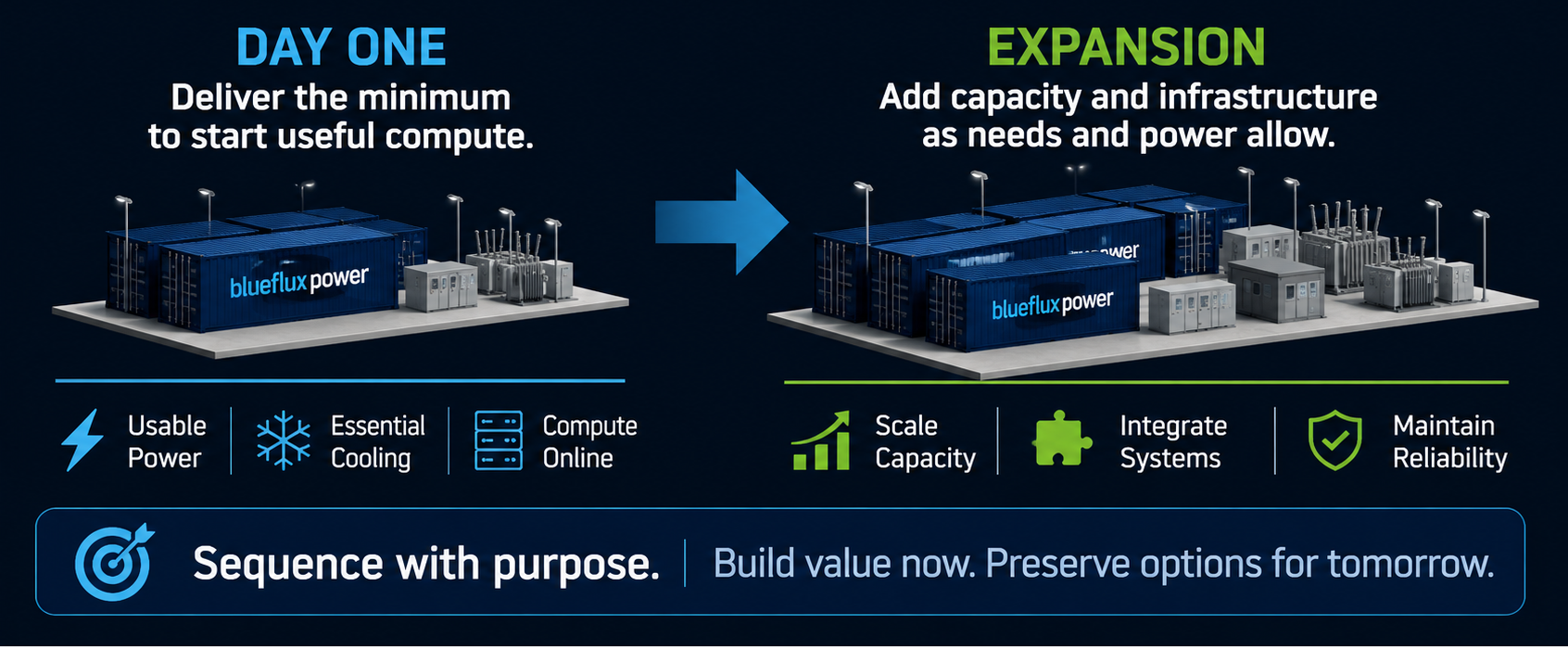
What happens when permanent power arrives?
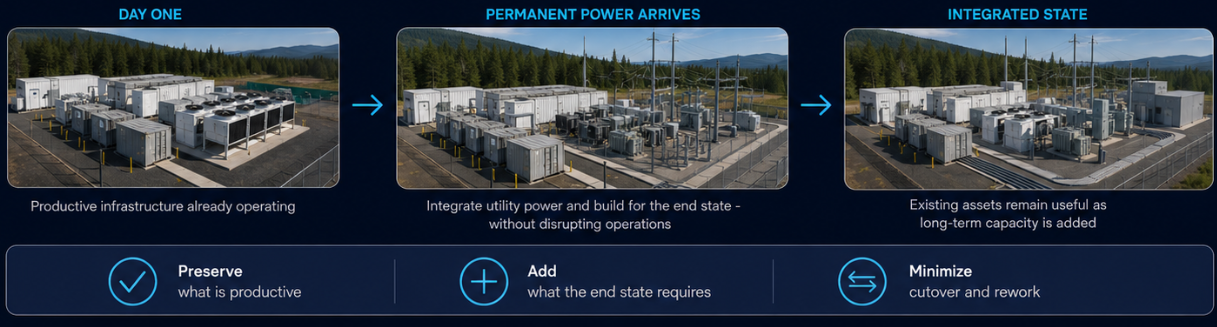
An interim power state should be judged by whether permanent service can be integrated safely and predictably. The transition must preserve electrical compatibility, protection coordination, controls behavior, reliability, and continuity of service to operating load.
The power decision is bigger than the power source.
Taken together, these questions point toward a broader conclusion: power strategy is not simply about securing megawatts, but about aligning source, electrical configuration, timing, reliability, load, and the transition to permanent service.
Interim Power Should Connect to Permanent Service
A credible power strategy can use an interim source or service configuration without treating it as a disconnected temporary system. The electrical interfaces, protection, controls, transformation, and distribution should allow permanent service to be integrated without forcing a wholesale reset.
What Must a Credible Power Strategy Be Able to Do?
A credible power strategy must do more than identify a source of megawatts. It must connect source, electrical configuration, load, timing, reliability, and transitions between power states into a system the workload can actually use.
Power Strategy Is a Path, Not a Source.
The right power strategy connects source, electrical configuration, load, timing, and reliability into a credible path from the first usable power state to permanent service. The objective is to deliver power the workload can actually use without creating an avoidable electrical reset when the source or service configuration changes.
Power for AI Insights
Continue into analysis of power readiness, utility and interconnection constraints, source timing, electrical configuration, reliability, and transitions between interim and permanent power service.



Keep Following the Decision
Power decisions rarely stand alone. The credible power path depends on the physical architecture that receives it, the project sequence that brings it online, and the economic value of when usable capacity becomes available.
Explore Your Power Path
Bring your utility timing, available capacity, load ramp, deployment schedule, and intended end state into a more focused exploration of the options available to your project.
Continue Your Infrastructure Decision
What is the economically rational way to address your particular power and deployment constraints?