POWER FOR AI INSIGHTS

Power for AI

The right power. In the right configuration. At the right time.

Power availability becomes usable AI capacity only when the source, electrical configuration, reliability, load profile, and timing work together. The practical question is which power state can serve the workload now, and how that state connects credibly to permanent service.

start with your situation

Where is the power constraint showing up?


Power constraints show up differently from project to project. Start with the situation closest to yours.

The utility date is too late

"We can get the power - just not when we need it." What usable power can serve the workload before permanent utility service arrives? Understand the cost of waiting »

Some power is available now

"We can get part of the requirement sooner, but not the full load." Which power configuration can safely serve useful load before full utility capacity arrives? Explore partial deployment »

The utility date is uncertain

"We have a projected date, but not enough certainty to build the business plan around it." Which electrical interfaces and assumptions must remain valid if the utility date moves? Explore power uncertainty »

The customer or compute is ready first

"We could put capacity to work before permanent infrastructure will be ready." Which power state can support useful capacity sooner without compromising reliability? Understand the value of time »

The site is "powered" - but is it ready?

"We were told the site has power, but the details are more complicated." What does power readiness actually mean? Understand power readiness »

We're considering alternative power

"Permanent utility power is coming, but we're evaluating what could happen before then." How must interim and permanent power states connect technically? Explore the transition »

POWER READINESS FRAMEWORK

Power available is not the same as power ready.

A stated megawatt figure tells you how much power may be available. It does not tell you whether that power can support deployment when, where, and how the project requires it.

POWER READINESS DIMENSION WHAT IT ACTUALLY MEANS
Capacity How much power can actually be delivered to the site?
Energization timing When can usable power actually become available?
Schedule firmness How dependable is that date, and what could still move it?
Interconnection status What approvals, studies, upgrades, or construction remain before service is real?
Reliability & redundancy Does the available power meet the project's uptime and resilience requirements?
Delivery configuration Is power available at the voltage and configuration the infrastructure can actually use?
Load ramp Can available power increase at the rate the compute deployment requires?
Expansion capacity Is there a credible path from the initial load to the eventual requirement?

The Timing of Usable Power

If any of these variables fail to align with the project schedule, the question is no longer simply how much power is available. It becomes when usable power is actually ready.

POWER TIMING

Power Timing Changes the Business Case

Energization timing determines when compute can operate. That makes power timing economically important, but the detailed valuation belongs in Infrastructure Economics; here the question is whether an earlier power state materially changes the infrastructure decision.

Earlier power can change the decision

The question is whether an earlier usable power state changes when capacity can operate enough to justify a different power approach. The financial comparison should be carried into Infrastructure Economics.

Delayed Revenue

When infrastructure is late, revenue-producing compute may be late with it.

Idle Compute

GPUs and other high-value assets may be purchased or committed before they can become productive.

Capital Carrying Cost

Land, equipment, engineering, and construction capital can remain tied up while the project waits.

Customer Commitments

Infrastructure timing can determine whether promised capacity can be delivered when customers need it.

Competitive Position

Earlier usable capacity may have greater strategic value when demand exceeds available supply.

Created by Amethyst Studiofrom the Noun Project

Opportunity Cost

Capital and management attention committed to a delayed project cannot be deployed elsewhere without consequence.

If earlier usable power changes the decision, what power state can serve the workload before permanent service arrives?

Power for AI should identify the technically credible earlier state and its constraints. Infrastructure Economics should then test whether the value created by earlier operation justifies the added cost, exposure, or complexity.

POWER STATES

Usable Power Can Change Before Permanent Service Arrives

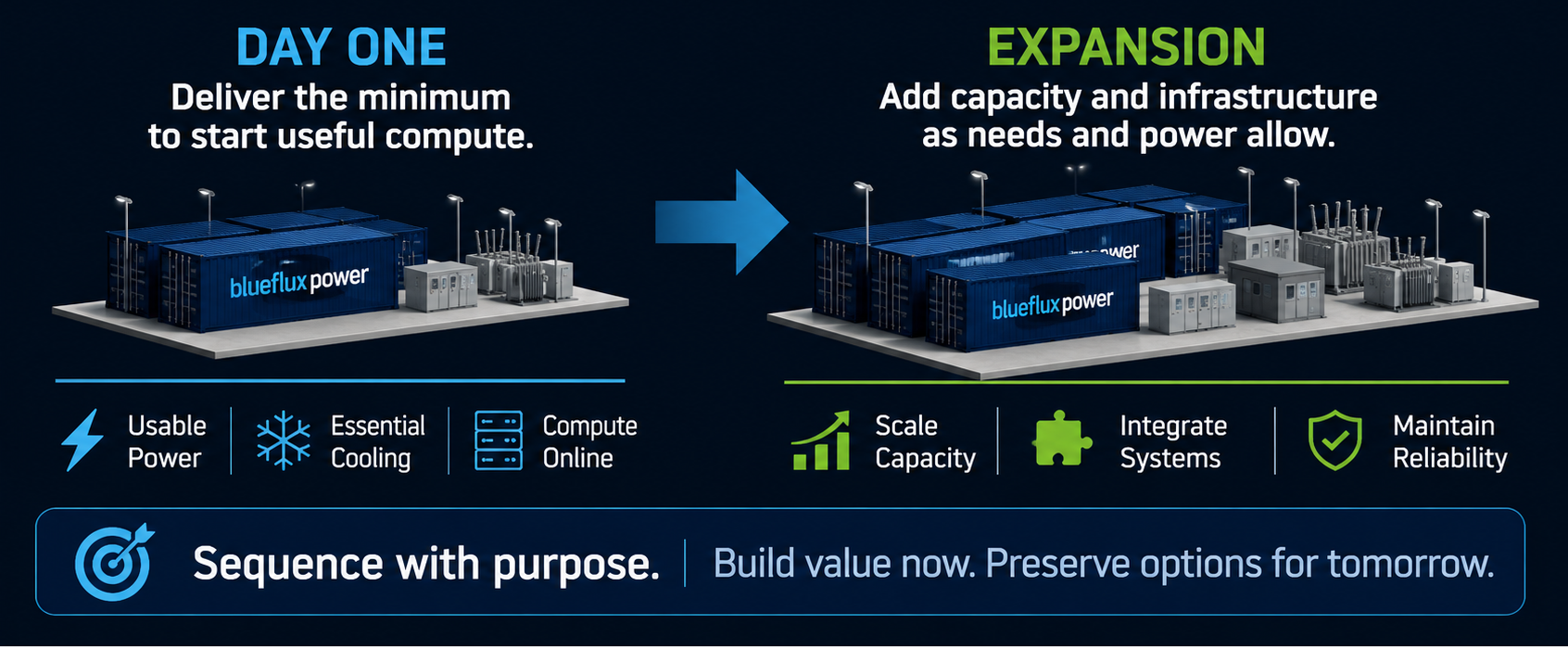
A project may move through more than one technically credible power state before permanent service is complete. The power strategy should define what can safely serve the initial load, how interim sources and distribution connect, and how permanent service is integrated without creating an electrical reset.

The goal is not to make every megawatt permanent on day one.

The goal is to establish a power state that can safely serve the current load and connect credibly to what follows.

POWER STATES TO PLAN

INITIAL POWER STATE

Define the first source, voltage, protection, distribution, controls, and reliability configuration capable of safely serving the initial workload.

INTERIM POWER STATE

Define how additional or alternate sources, switchgear, transformation, distribution, and controls can be introduced while the existing workload remains supportable.

PERMANENT POWER STATE

Integrate the long-term utility, source, protection, distribution, and control configuration required for the intended scale and reliability without destabilizing operating load.

Diagram showing the deployment sequence from day-one power and compute through phased expansion to permanent service.

Each power state should connect credibly to the next.

Voltage, protection, grounding, controls, switchgear, transformation, and distribution interfaces should be planned so the permanent configuration can be integrated without unnecessary electrical rework or unacceptable interruption.

Transition risk

What happens when permanent power arrives?

An interim power state should be judged by whether permanent service can be integrated safely and predictably. The transition must preserve electrical compatibility, protection coordination, controls behavior, reliability, and continuity of service to operating load.

CREATES VALUE

✓ Electrical compatibility - interim and permanent configurations share deliberate voltage, grounding, protection, and connection assumptions
✓ Controlled cutover - permanent service can be energized and transferred without unacceptable interruption to productive compute.
✓ Protection and controls coordination - relays, controls, switching logic, and operating modes remain coherent as the power configuration changes.
✓ Capacity continuity - the change in source or service does not create a new bottleneck between available power and the load.

CREATES RISK

✕ Incompatible configuration - voltage, grounding, source, or protection assumptions do not match permanent service.
✕ Distribution rework - switchgear, transformation, feeders, protection, or controls must be rebuilt to accept the permanent source.
✕ Disruptive cutover - the transition requires an outage or operating condition the workload cannot tolerate.
✕ Long-term constraint - a temporary source or interim distribution choice limits the capacity or reliability permanent service can deliver.

A credible transition answers three questions: what power serves the initial load, which electrical interfaces must remain compatible, and how permanent service is integrated without unacceptable interruption or rework.

Where the evidence leads

The power decision is bigger than the power source.

Taken together, these questions point toward a broader conclusion: power strategy is not simply about securing megawatts, but about aligning source, electrical configuration, timing, reliability, load, and the transition to permanent service.

Power readiness is more than megawatts.

Capacity only becomes useful when source, delivery, protection, reliability, interconnection, and load requirements align with the project.

Power timing changes when compute can operate.

The date a credible power state can serve the load determines when compute can become productive; Economics evaluates the value of that timing.

Sequence iconAscending sequence of four steps with a checkmark badge above the highest step.

Power-state transitions change readiness and reliability.

Changing sources or service configurations can alter protection, controls, fault behavior, reliability, and continuity at the load.

Path forward iconBlack and white line icon showing a starting state, a forward path through checkpoints, and an arrow indicating progress.

Interim power must connect credibly to permanent service.

Earlier power is credible only when the interim electrical configuration can transition to permanent service without unacceptable interruption or wholesale rework.

The right answer depends on the project.

No single power path is right for every project. Site electrical conditions, load profile, utility position, source options, reliability requirements, and transition constraints determine the technically credible approach.

POWER PATH IN PRACTICE

Interim Power Should Connect to Permanent Service

A credible power strategy can use an interim source or service configuration without treating it as a disconnected temporary system. The electrical interfaces, protection, controls, transformation, and distribution should allow permanent service to be integrated without forcing a wholesale reset.
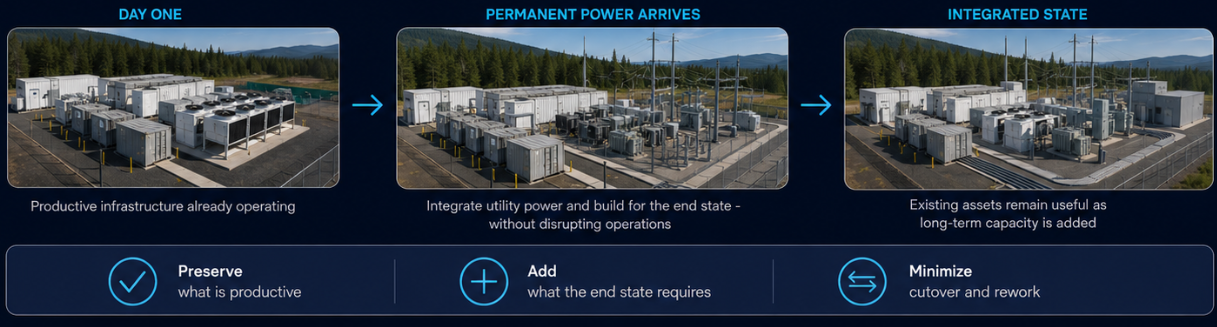
Diagram showing interim power transitioning to permanent utility service without stranding the electrical infrastructure.

Earlier power should not create a later electrical reset.

Power Strategy Framework

What Must a Credible Power Strategy Be Able to Do?

A credible power strategy must do more than identify a source of megawatts. It must connect source, electrical configuration, load, timing, reliability, and transitions between power states into a system the workload can actually use.

Deliver power the project can actually use.

Capacity must arrive with the timing, reliability, interconnection, delivery, configuration, and supporting infrastructure required to operate productive compute.

Match power capacity to the load ramp.

Size each power state to the load it must serve while preserving the electrical interfaces required for the next credible increase in load.

Test whether earlier power changes the decision.

Identify whether an earlier technically credible power state changes when compute can operate; carry the detailed value comparison into Infrastructure Economics.

Preserve reliability as power states change.

Source changes, cutovers, and integration of permanent service should preserve protection, controls, fault behavior, and continuity within the reliability requirements of the workload.

Preserve electrical compatibility as capacity grows.

Switchgear, transformation, feeders, protection, controls, and connection points should support credible load growth without forcing avoidable electrical replacement or rework.

Created by parkjisunfrom the Noun Project

Plan the transition to permanent service.

Define how permanent utility or long-term source capacity will connect, what must change, what must remain compatible, and how the cutover will occur without unacceptable interruption.

Created by Melisa Lutfianifrom Noun Project

The right answer depends on the project.

No single power path is right for every project. Site electrical conditions, load profile, utility position, source options, reliability requirements, and transition constraints determine the technically credible approach.

Lorem ipsum dolor sit amet, consectetur adipiscing elit. Ut elit tellus, luctus nec ullamcorper mattis, pulvinar dapibus leo.

POWER STRATEGY TAKEAWAY

Power Strategy Is a Path, Not a Source.

The right power strategy connects source, electrical configuration, load, timing, and reliability into a credible path from the first usable power state to permanent service. The objective is to deliver power the workload can actually use without creating an avoidable electrical reset when the source or service configuration changes.

The objective is not simply power sooner. It is productive capacity on a credible path forward.

A rational power strategy brings usable capacity online when it creates value, preserves reliability as the system changes, and allows each investment to remain useful as the project grows.

Go Deeper

Power for AI Insights

Continue into analysis of power readiness, utility and interconnection constraints, source timing, electrical configuration, reliability, and transitions between interim and permanent power service.


At AI scale, high-current distribution is not a downstream component choice. It is an early architecture decision that shapes how capacity is
Energy storage can improve how AI infrastructure manages power, resilience, and phased deployment. It is not a substitute for sound architecture, generation
When compute demand arrives before full utility capacity, the useful question is not simply how much power is available. It is whether
Connected decision areas

Keep Following the Decision

Power decisions rarely stand alone. The credible power path depends on the physical architecture that receives it, the project sequence that brings it online, and the economic value of when usable capacity becomes available.

Deployment Strategy

Determine what must become operational first, what can follow later, and how available power changes the deployment sequence.
Explore Deployment Strategy »

Infrastructure Economics

Evaluate whether the value of earlier productive capacity justifies the cost, complexity, capital exposure, and risk required to accelerate it.
Explore Infrastructure Economics »

Data Center Architecture

Translate usable power into the physical electrical, thermal, network, and rack pathways the workload requires.
Explore Data Center Architecture »

Power Decisions Stay Connected

A change in load, schedule, economics, or deployment assumptions can shift the right answer. The strongest power strategies account for those dependencies before they become constraints.

CONTINUE THE EXPLORATION

Explore Your Power Path

Bring your utility timing, available capacity, load ramp, deployment schedule, and intended end state into a more focused exploration of the options available to your project.

Ask the AI Advisor

Explore your infrastructure questions in context and identify the constraints, dependencies, risks, and decisions that deserve attention next.

Start Exploring »

Technical Library

Explore technical explanations, decision frameworks, and reference material behind AI infrastructure choices.

Explore the Technical Library

Continue the exploration

Explore Your Power Path

Bring your utility timing, available capacity, load ramp, deployment schedule, and intended end state into a more focused exploration of the options available to your project.


Ask the AI Advisor

Explore your infrastructure questions in context and identify the constraints, dependencies, and decisions that deserve attention next.

Start Exploring ≫

Technical Library

Explore technical explanations, decision frameworks, and reference material behind AI infrastructure choices.

Explore the Technical Library

CONTINUE YOUR INFRASTRUCTURE DECISION

Explore the related Topic Hubs for decision context, then use the Technical Library to investigate the technical questions behind it.

Technical guidance for AI infrastructure decisions
Explore the seven Decision Areas

Continue Your Infrastructure Decision

What is the economically rational way to address your particular power and deployment constraints?

CONTINUE YOUR INFRASTRUCTURE DECISION

Explore how power availability, delivery timing, operating configurations, and transition choices shape AI deployment. Technical guidance for AI infrastructure decisions