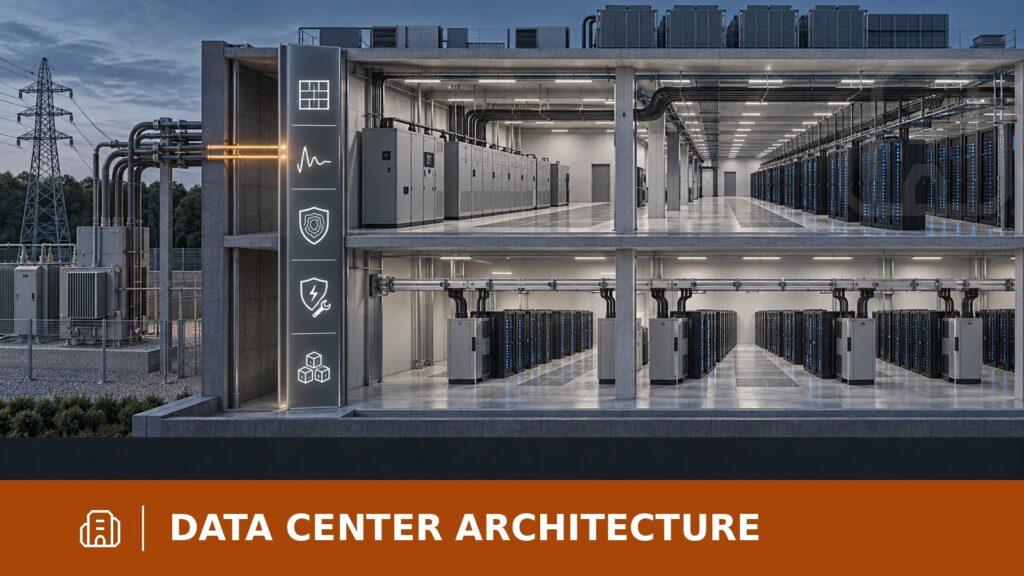
ADAPTIVE INFRASTRUCTURE INSIGHTS

Adaptive Infrastructure

Build for What Comes Next

AI infrastructure rarely reaches a stable final state on day one. Adaptive infrastructure preserves the ability to change capacity, density, technology, power configuration, and operating requirements without forcing the system to start over.

START WITH YOUR SITUATION

Adaptive Infrastructure Problems Rarely Begin With a Stable End State

The challenge may appear as changing density, delayed utility power, uncertain demand, expansion pressure, or technology transition. The common issue is that infrastructure decisions have to be made before the final requirement is fully known.

Requirements are changing faster than the design

“We know today's workload, but not what the next hardware generation will demand.” How much should today's design assume about tomorrow? Explore changing assumptions »

The first configuration will not be the last

“We can put some capacity to work now, but the permanent configuration will take longer.” What must be established now so later capacity can connect without redesign? Explore the first state »

Power availability is changing the architecture

“The utility path, onsite power, and expansion schedule are not lining up neatly.” Which interfaces must remain compatible as power configurations change? Explore the transition »

Density keeps moving

“Rack density and cooling requirements are changing faster than the facility plan.” What must remain flexible as compute evolves? Explore the adaptive imperative »

We expect to expand, but the final footprint is not known

“We know this is not the last phase, but we cannot define every future phase today.” What has to be reserved now so later growth does not require redesign? Preserve the expansion path »

Early infrastructure still has to remain useful later

“We may need a temporary or partial configuration now.” Which foundations and interfaces must remain useful as the system changes? Explore the framework »

Different Starting Points, One Adaptive Problem

The requirement is moving while infrastructure decisions are being made. The strategy has to establish durable foundations without closing off future configurations.

THE ADAPTIVE IMPERATIVE

Infrastructure Should Evolve With the Requirement

Traditional infrastructure planning works best when the end state is reasonably well understood. AI infrastructure often begins under different conditions: compute, power, density, timing, site constraints, and technology can all change before the first phase is complete. The governing principle is therefore simple: long-lived infrastructure should remain useful as faster-moving requirements change.

Long-Lived Infrastructure Should Support Faster-Moving Layers

Long-lived foundations should remain useful while faster-moving compute, cooling, power, controls, and operating layers change around them.

WHEN ASSUMPTIONS CHANGE

Design Around Change, Not a Single Forecast

A plan can be rational today and wrong for tomorrow without anyone making a bad decision. The planning task is to distinguish between decisions that must be made now and decisions that should remain open until better information exists.

VARIABLE LIKELY TO CHANGE WHAT ADAPTIVE INFRASTRUCTURE MUST PRESERVE
Compute requirements The ability to change hardware generations, workload mix, and compute density without forcing a wholesale infrastructure reset.
Power availability Interfaces and connection points that allow source, capacity, and distribution configurations to change without forcing wholesale redesign.
Rack density Electrical and cooling interfaces that can support higher-density equipment without redesigning the entire site.
Capacity timing The ability to add or defer capacity without changing the underlying interfaces and long-lived foundations.
Site and footprint Physical pathways, space, access, and support infrastructure that can accommodate later phases.
Technology choices Standards and interfaces that reduce lock-in and allow components to change on different lifecycles.
Operating requirements Controls, monitoring, resilience, maintenance, and ownership models that can evolve with scale.
Expansion path A first phase that leaves somewhere rational for the next phase to connect.

Infrastructure that works only for today's requirement can become tomorrow's constraint.

Adaptive design distinguishes between decisions that must be made now and decisions that should remain open until better information exists.

Change Is the Planning Condition

The objective is not to predict every future requirement. It is to preserve useful options where uncertainty can materially change the answer.

DESIGN FOR CHANGE

Lock What Is Hard to Change. Keep the Rest Open.

Adaptive infrastructure is not about delaying every decision. It is about distinguishing between foundations that become difficult or expensive to change later and decisions that should remain open while requirements are still uncertain.

Flexibility Begins With Commitment Discipline

Make durable decisions where reversal is costly, and preserve choices where better information can materially change the answer.

KEY QUESTIONS

What must be established now because it will be hard to change later?

Identify long-lived foundations, pathways, structural provisions, safety requirements, and core standards that become difficult or costly to alter once the system is operating.

Which interfaces must be established early?

Define the electrical, cooling, network, controls, physical, and operational boundaries future phases will need to connect into.

Which decisions should remain deliberately open?

Keep technology, capacity, component, and operating choices open when better information could materially change the right answer.

A flexible system defines where change is allowed.

The objective is not to keep everything flexible. It is to make change possible in selected layers without reopening decisions that should remain stable.

PRESERVE THE EXPANSION PATH

Expand Without Starting Over

Expansion is easier when the first phase establishes the physical space, electrical interfaces, cooling approach, controls, networking, and operating model that later phases can extend rather than replace.
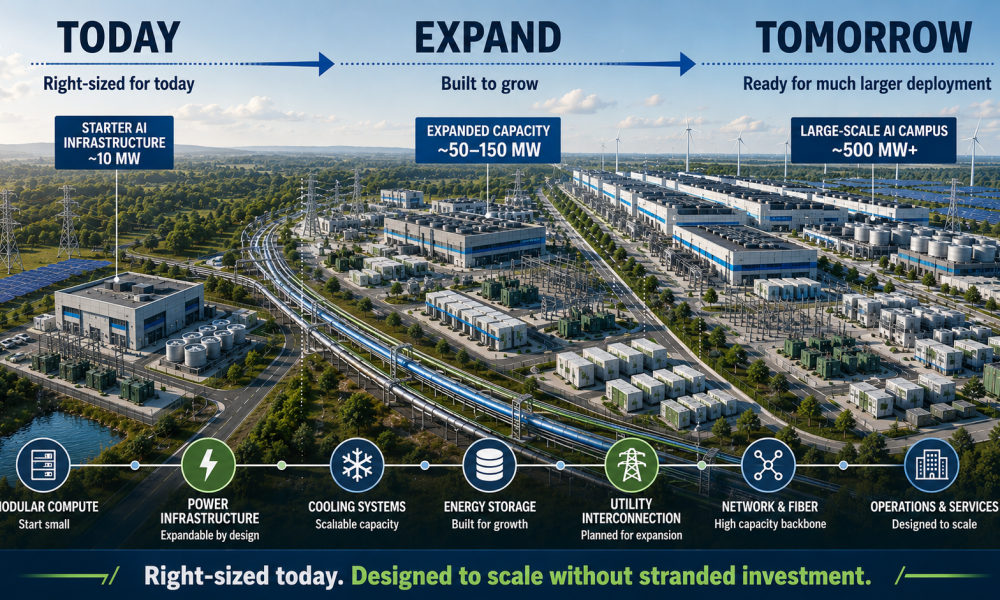
Adaptive infrastructure evolution diagram showing an initial deployment expanding through later phases while preserving existing infrastructure and connection paths.
EXPANSION TEST

The First State Should Anticipate the Next State

Reserve the interfaces, pathways, capacity, and operating assumptions future phases are likely to need - without paying to build every future component on day one.

Can the next phase connect without undoing the first?

A credible expansion path allows new power, compute, cooling, and support systems to be added while productive assets remain useful.

ADAPTIVE INFRASTRUCTURE FRAMEWORK

Preserve Optionality Where Uncertainty Is Highest

Not every decision deserves the same degree of flexibility. The objective is to lock what is foundational, standardize what must connect, and preserve options where requirements are most likely to change.

Lock the Stable Foundations

Make firm decisions around safety, site fundamentals, core standards, and long-lived infrastructure where uncertainty is low.

Standardize the Interfaces

Define consistent electrical, cooling, networking, controls, and physical connection points so systems can change without losing compatibility.

Modularize Capacity

Add power, compute, cooling, and support infrastructure in repeatable increments rather than forcing one irreversible end-state build.

Separate Lifecycles

Allow fast-changing compute and technology layers to evolve independently from longer-lived civil, electrical, and mechanical infrastructure.

Reserve Expansion Paths

Protect the physical space, pathways, capacity, and connection points that later phases are likely to require.

Design for Transition Compatibility

Ensure future power, capacity, technology, and operating configurations can connect without requiring wholesale replacement of what is already in place.

Preserve Flexibility Deliberately

A disciplined adaptive architecture makes firm decisions where foundations are stable and preserves options only where change could materially alter the answer.

ADAPTIVE INFRASTRUCTURE IN PRACTICE

Stable Foundations Support Changeable Layers

Adaptability comes from separating what should remain stable from what must be able to change. Long-lived foundations and standardized interfaces allow faster-moving technology, capacity, and operating layers to evolve without forcing a system reset.
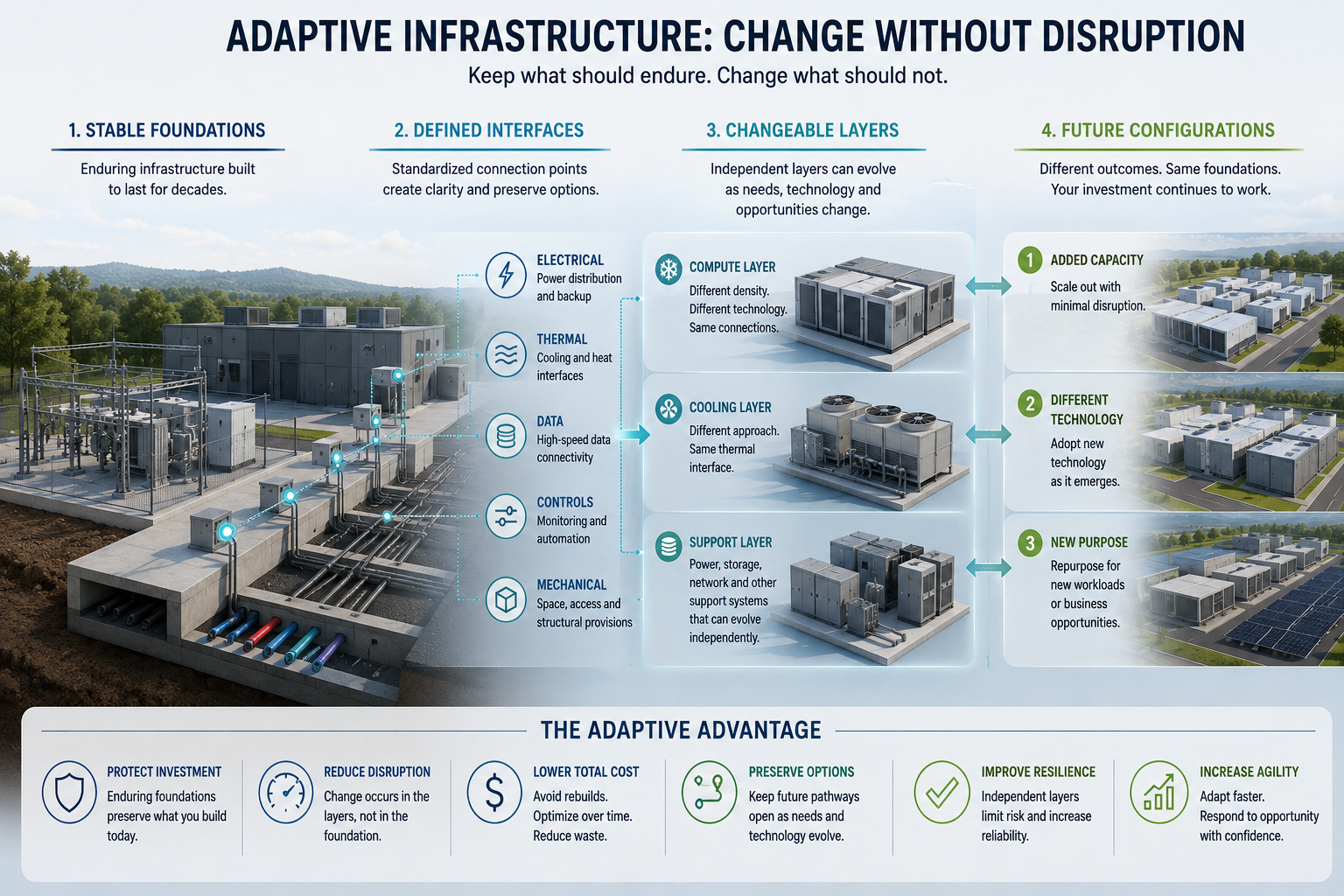
Adaptive infrastructure diagram showing stable foundations, defined electrical, thermal, data, controls and mechanical interfaces, changeable compute and cooling layers, and multiple future configurations that preserve investment while reducing disruption.

Change Should Be Local, Not Systemic

When foundations and interfaces are deliberate, a change in one layer can remain bounded instead of forcing unrelated parts of the infrastructure to be rebuilt.

WHERE THE EVIDENCE LEADS

Adaptability Keeps Change From Becoming a Reset

The recurring lesson is not that every system should remain infinitely flexible. It is that infrastructure should establish durable foundations, standardize interfaces, and localize change so new requirements do not force wholesale redesign.

The End State Will Move

AI requirements, hardware, density, power availability, and operating assumptions can change before the original infrastructure plan is complete.

Long-Lived Foundations Should Outlast Fast-Moving Layers

Infrastructure with longer lifecycles should remain useful as compute, density, power configuration, and operating requirements change around it.

Sequence iconAscending sequence of four steps with a checkmark badge above the highest step.

Interfaces Matter More Than Perfect Forecasts

Standardized connection points and clear system boundaries make change manageable even when the final configuration cannot be predicted.

Path forward iconBlack and white line icon showing a starting state, a forward path through checkpoints, and an arrow indicating progress.

Local Change Should Stay Local

A change in requirements should alter the affected layer without forcing unrelated foundations, interfaces, or useful assets to be replaced.

ADAPTIVE INFRASTRUCTURE STRATEGY TAKEAWAY

Design the First State for the Next State

The strongest adaptive strategies make today's configuration useful while preserving the ability to change power configuration, compute density, capacity, technology, and operating requirements as conditions evolve.

The objective is not maximum flexibility. It is durable usefulness through change.

Adaptive infrastructure works when long-lived foundations stay useful, interfaces remain compatible, and faster-moving layers can change without forcing wholesale replacement of the system.

GO DEEPER

Adaptive Infrastructure Insights

Continue into analysis of modularity, standardized interfaces, lifecycle separation, density change, and infrastructure strategies designed to remain useful as requirements evolve.
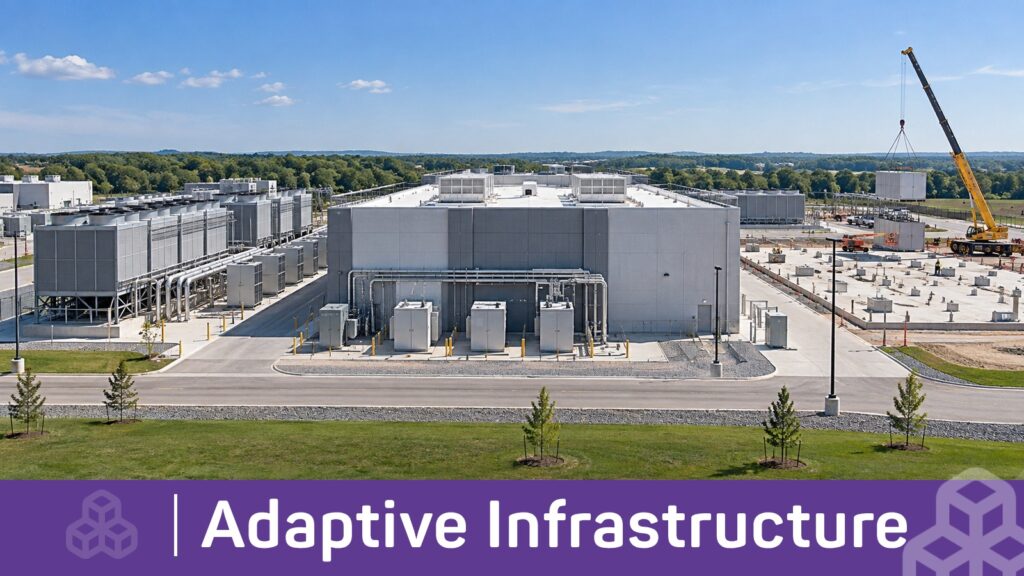
Adaptive AI infrastructure is more than modular equipment. It preserves stable safety, governance, and interface foundations while allowing power, cooling, compute, communications,
Power-system data is useful only when operators can turn it into a trustworthy understanding of system state. Observability connects instrumentation, telemetry and
High-frequency conversion can be useful when it addresses a real system constraint. It is not automatically the right choice simply because the
CONNECTED DECISION AREAS

Keep Following the Decision

Adaptive infrastructure decisions connect directly to power timing, system architecture, deployment sequence, and the economics of when capacity becomes useful.

AI Infrastructure

Understand how power, compute, cooling, networking, facilities, and operations must align as one evolving system.
Explore AI Infrastructure »

Power for AI

Determine how available power, interim generation, utility timing, and permanent power shape the infrastructure sequence.
Explore Power for AI »

Path forward iconBlack and white line icon showing a starting state, a forward path through checkpoints, and an arrow indicating progress.

Deployment Strategy

Determine what should become operational first, what can follow later, and how each phase can lead cleanly into the next.
Explore Deployment Strategy »

Created by Melisa Lutfianifrom Noun Project

Infrastructure Economics

Evaluate how phasing, reuse, optionality, and timing affect capital efficiency, stranded-investment risk, and the value created as capacity becomes useful.
Explore Infrastructure Economics »

Adaptive Decisions Stay Connected

A change in power, density, technology, schedule, or capacity can shift the right answer elsewhere. The strongest strategies preserve the interfaces and options that keep those changes manageable.

CONTINUE THE EXPLORATION

Explore Your Adaptive Infrastructure Path

Use the AI Advisor to explore your infrastructure questions in context or use the Technical Library to investigate related technical questions.

Ask the AI Advisor

Explore your infrastructure questions in context and identify the constraints, dependencies, risks, and decisions that deserve attention next.

Start Exploring »

Technical Library

Explore technical explanations, decision frameworks, and reference material behind AI infrastructure choices.

Explore the Technical Library

CONTINUE THE EXPLORATION

Explore Your Adaptive Infrastructure Path

Use the AI Advisor to explore your infrastructure questions in context or use the Technical Library to investigate related technical questions.


Ask the AI Advisor

Explore your adaptive infrastructure questions in context and identify the constraints, dependencies, transition risks, and decisions that deserve attention next.

Start Exploring ≫

Technical Library

Explore technical explanations, decision frameworks, and reference material behind AI infrastructure choices.

Explore the Technical Library

CONTINUE YOUR INFRASTRUCTURE DECISION

Explore the related Topic Hubs for decision context, then use the Technical Library to investigate the technical questions behind it.

Technical guidance for AI infrastructure decisions
Explore the seven Decision Areas

Continue Your Infrastructure Decision

How should your infrastructure evolve when power, compute, density, and deployment requirements refuse to stand still?

CONTINUE YOUR INFRASTRUCTURE DECISION

Explore how interfaces, phased expansion, and transition choices preserve options as requirements change. Technical guidance for AI infrastructure decisions