Energy storage is increasingly part of the AI infrastructure discussion. That does not make it an automatic answer to every power, resilience, or deployment problem.
For AI-scale facilities, storage can improve how the system responds to volatility, short-duration disturbances, constrained initial capacity, and phased deployment. It cannot create permanent utility capacity, replace a credible generation strategy, or make an incoherent infrastructure plan work.
The question is not simply, “Should this facility have batteries?” The question is: What operating problem must storage solve within the infrastructure system?
Storage Is an Architectural Decision
Traditional data-center power design often treats storage as a narrow continuity component. It provides a controlled transition, supports selected critical loads, or protects operations through a brief interruption.
AI loads change the context. Higher density, variable demand, and the growing gap between compute schedules and utility schedules place more value on operating flexibility. Storage may therefore be considered for several legitimate reasons:
- Supporting short-duration resilience and continuity objectives
- Managing rapid changes in load or power quality
- Improving the use of constrained initial power
- Bridging a defined phase of infrastructure deployment
- Coordinating with utility service, on-site generation, and power-conditioning equipment
Those are different operating problems. They should not be addressed with a generic battery decision.
What Energy Storage Can Solve
1. It can improve short-duration resilience
Storage can create a controlled buffer when the system experiences a disturbance, transition, or rapid change in conditions. For sensitive compute loads and the infrastructure that supports them, the value is not simply that energy is available. The value is that the system can respond in an organized way.
2. It can help make constrained power more useful
A site may have some power available before it has all the power required for its intended buildout. Storage can support a deliberate operating strategy around that initial capacity.
That does not convert a limited utility service into unlimited permanent capacity. It can, however, help the project team define how available power is used within known operating constraints and priorities.
3. It can support a phased deployment path
In some markets, compute demand is advancing faster than utility infrastructure. Storage can be part of a bridge strategy that helps bring productive capacity online earlier while permanent infrastructure continues to develop.
But a bridge requires a destination. The project must still define how additional generation, permanent utility service, expanded distribution capacity, or a coordinated combination of those elements will support the next operating state.
4. It can coordinate with other power resources
Storage can operate alongside utility service, generation, power conditioning, and facility controls. Its value depends on how well those elements work together.
That coordination matters because storage is only one part of the system. Power source, distribution, cooling, compute, communications, and cybersecurity all shape the real operating environment.
What Energy Storage Does Not Solve
It does not replace a long-term power strategy
Storage may reduce exposure to specific operating risks. It does not remove the need to secure durable power capacity and define the facility’s path to full-scale operation.
Every project still needs credible answers to four questions:
- What powers the first productive compute load?
- What powers the next phase?
- What changes when permanent capacity becomes available?
- Can the initial system connect to the expanded system without being discarded or redesigned?
It does not eliminate infrastructure tradeoffs
Storage adds capability, but it also adds cost, integration requirements, safety considerations, maintenance obligations, and operating complexity. The right decision is not always more storage. It may be a different power architecture, deployment sequence, generation strategy, or compute ramp.
It does not fix an undefined load strategy
Storage performs against the operating conditions it is given. If the facility has not defined critical loads, compute priorities, ramp assumptions, resilience requirements, or expansion milestones, storage sizing and integration become exercises in guesswork.
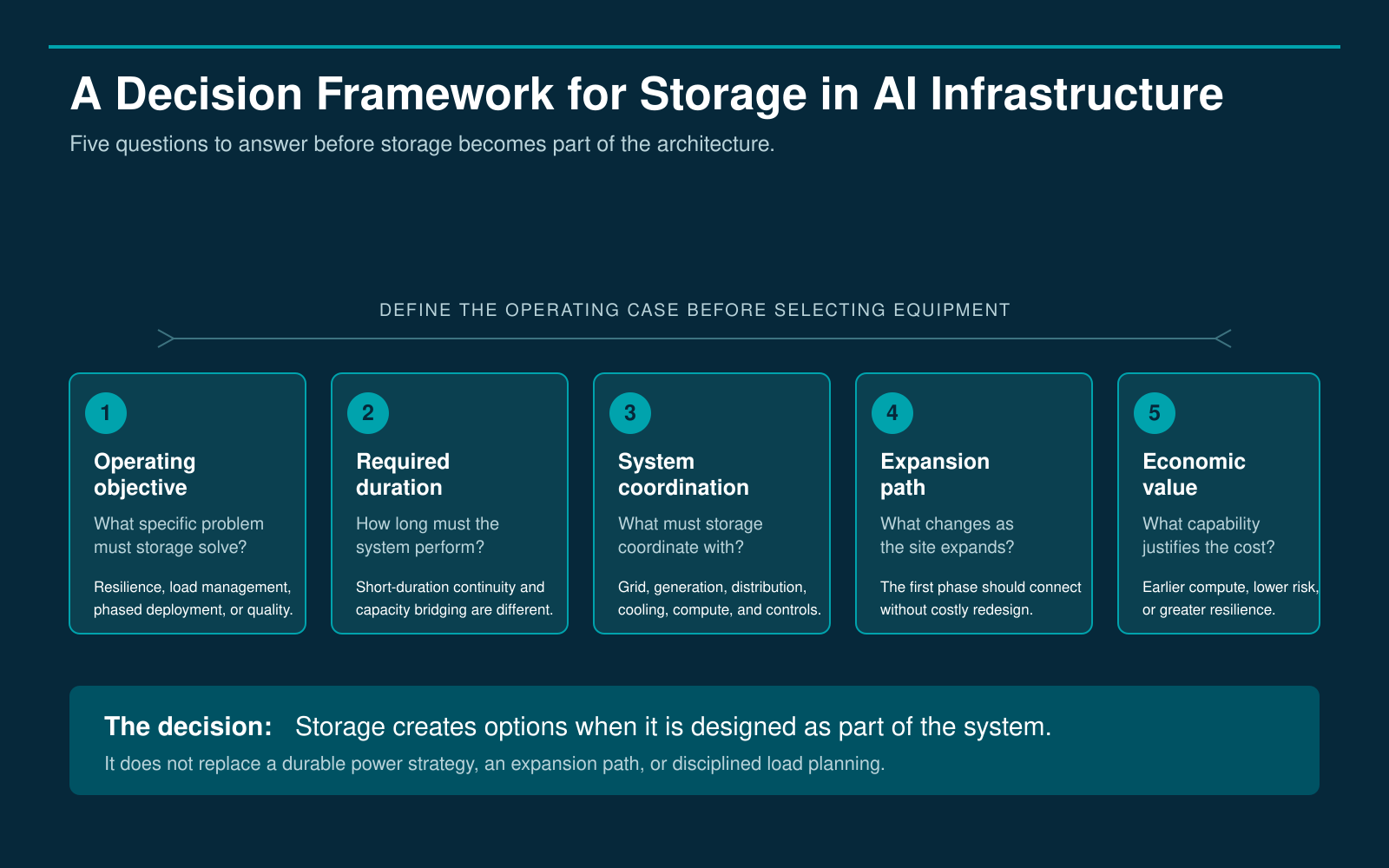
A Decision Framework for Storage in AI Infrastructure
Before committing to a storage strategy, decision-makers should be able to answer five questions.
- What specific operating problem must storage solve? Resilience, load management, phased deployment, power quality, generation coordination, or another defined need?
- What duration is actually required? Short-duration continuity and longer-duration capacity bridging are different design problems.
- What infrastructure must storage coordinate with? The answer may include utility service, on-site generation, distribution and conditioning equipment, cooling, compute controls, communications, and cybersecurity.
- What changes as the site expands? The first phase should not create an expensive redesign during the next phase.
- What economic value does the capability create? The relevant comparison is the value of earlier productive compute, improved resilience, lower operating risk, or a more credible path through a constrained deployment schedule.
The Executive Decision
Energy storage can be a meaningful part of AI infrastructure. Its role must be earned through a clear architectural case.
The strongest storage decisions begin with an operating objective, define constraints honestly, and connect the initial system to a credible expansion path. The weakest decisions treat storage as a universal answer to utility delay, capacity limitation, or deployment complexity.
AI infrastructure does not outgrow power. It outgrows infrastructure designed around incomplete assumptions.
Where the Evidence Leads
The next AI infrastructure conversation should move beyond whether storage is included and focus on how it changes the facility’s operating capability. The real question is not how much equipment can be added. It is what the coordinated system can actually do when compute demand, power availability, and deployment schedules do not align.
For the related sequencing problem, read The First Viable Megawatt: Designing for Productive Compute Before Full Utility Buildout. For a broader comparison of power paths, see Data Center Power Alternatives: A Decision Framework for AI Infrastructure.
Continue Your Infrastructure Decision
Explore Power for AI for the broader decision context, then use the Technical Library to investigate the technical questions behind it.