Power conversion has often been treated as a component-level engineering matter: select an efficient converter, verify its ratings, and integrate it into a larger electrical design.
That framing becomes less adequate as AI infrastructure concentrates more load into less space and asks the electrical system to interact more closely with storage, on-site generation, DC distribution, monitoring, and staged expansion.
The important question is no longer only whether a converter performs well at a specified operating point. The broader question is: What does the conversion architecture enable – or constrain – across the facility?
The Question Has Moved Upstream
High-frequency AC/DC conversion sits at an architectural junction between incoming power, conditioned power, distribution, critical loads, thermal management, protection, controls, and future growth.
That is why it is becoming an AI infrastructure question rather than remaining only a power-electronics question. The conversion choice can influence equipment scale, heat, distribution choices, integration, serviceability, and the facility’s ability to adapt.
Higher Frequency Changes the Design Space
Increasing switching frequency can reduce the size of magnetic components and filters. That can make conversion equipment more compact and can open design choices that are difficult to achieve with line-frequency equipment alone.
In a high-density facility, however, smaller equipment is not an end in itself. Its value depends on what the resulting architecture does for space, heat removal, maintainability, electrical interfaces, and the number of conversion stages between source and load.
Those benefits are not automatic. Higher switching frequency also increases engineering demands involving switching losses, electromagnetic interference, insulation stress, thermal behavior, materials, packaging, and control. The design problem is therefore a tradeoff, not a simple race toward the highest possible frequency.
A credible evaluation asks where the full system reaches the best balance among efficiency, equipment scale, thermal performance, reliability, service access, protection, and cost. The answer will vary with the mission, load profile, source mix, distribution strategy, and operating requirements.
The Facility Consequence Matters More Than the Component Headline
A converter can be impressive in isolation and still be a poor architectural fit. Component efficiency does not reveal how many conversion stages remain in the source-to-load path, how losses accumulate across them, or how the system behaves when actual workloads move away from a preferred operating point.
The same caution applies to footprint. Reducing the size of one assembly may not produce a meaningful facility benefit if the change adds filtering, cooling, protection, cabling, or service-clearance requirements elsewhere. System boundaries matter.
For AI infrastructure leaders, the useful measure is not the attractiveness of one device. It is whether the conversion choice improves the complete path from available power to reliable, productive compute while preserving acceptable risk and operating discipline.
Five Architecture Questions Should Come First
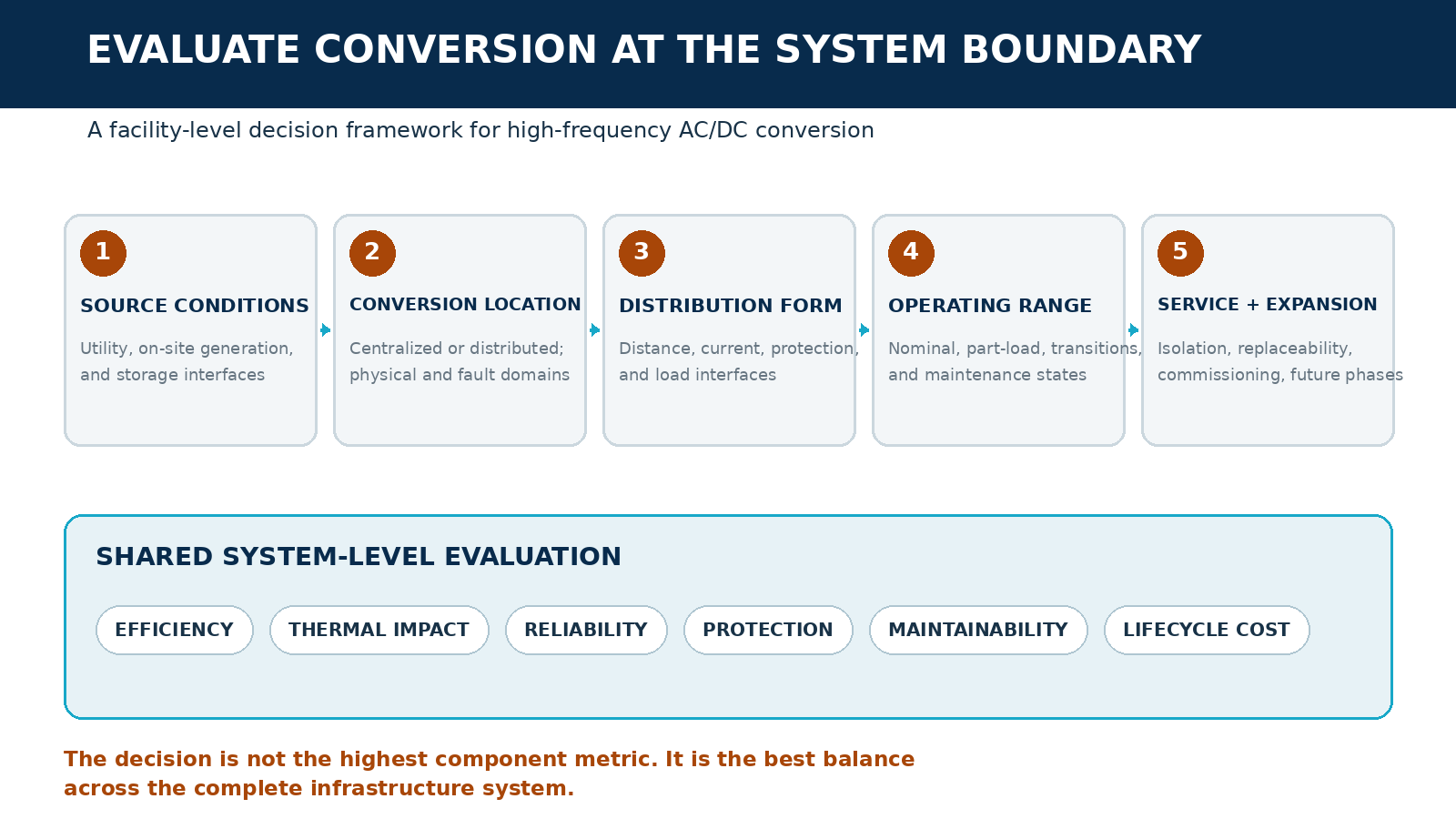
Before choosing a topology or supplier, a project team should settle five higher-order questions.
- What sources must the system accept? Utility service, on-site generation, and storage do not create identical interface conditions. Conversion must be evaluated in the context of the sources that will actually support the facility.
- Where should conversion occur? Centralized and distributed approaches allocate equipment, fault domains, thermal loads, service access, and redundancy differently. The choice affects the physical and operating architecture.
- What distribution form best serves the load? The answer depends on distance, current, voltage, protection, conductor requirements, rack or cluster interfaces, and the facility’s expansion model. Conversion and distribution cannot be optimized independently.
- How will the system behave across its operating range? AI loads are not static. Part-load performance, transitions, disturbances, maintenance states, and phase additions may matter as much as a nominal design point.
- How will the architecture be maintained and changed? Replaceability, isolation, standard interfaces, spares, diagnostic visibility, and commissioning all influence whether an elegant design becomes a dependable operating system.
Integration With Storage and Generation Changes the Analysis
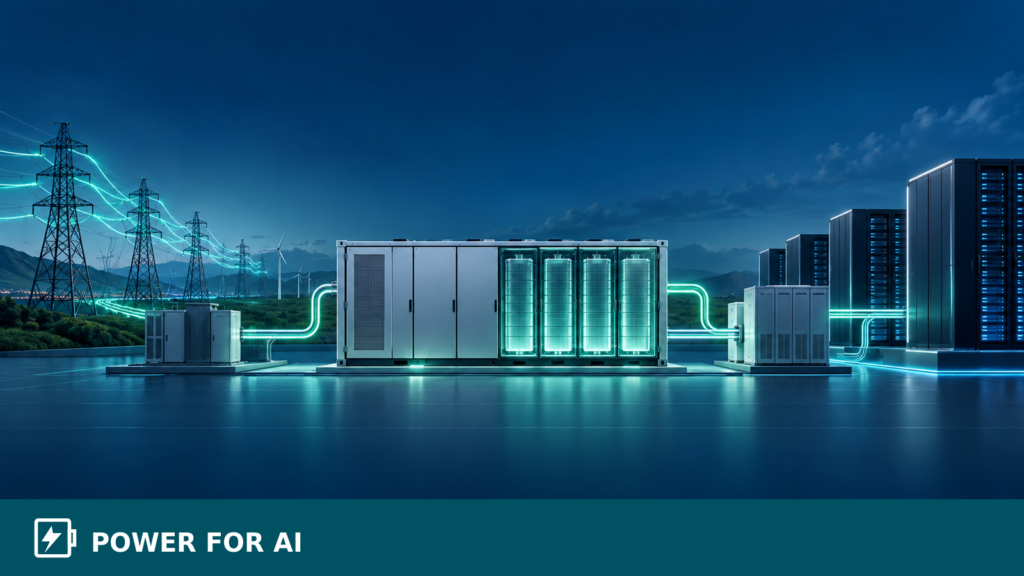
Energy storage is a useful example of why conversion cannot remain a standalone decision. Storage may support ride-through, power quality, ramp management, backup, or source coordination, but every role creates interface and control implications.
Adding storage to a poorly coordinated conversion path can add complexity without solving the facility’s primary constraint. The same principle applies to on-site generation. A project that expects multiple power sources should evaluate conversion, protection, distribution, and operating modes as one coordinated system.
The purpose is not to force every project into a single architecture. It is to prevent local optimizations from creating system-level penalties.
This is also where timing enters the decision. A first phase may need to operate before the ultimate utility configuration is available. The conversion architecture should be assessed against both the first viable operating state and the credible future states that follow.
For the related sequencing problem, read When the Grid Timeline Becomes the Data Center Schedule. For a closer look at storage boundaries, see Energy Storage for AI Loads: What It Solves and What It Does Not.
What a Sound Evaluation Should Produce
A useful conversion study should not end with a generic endorsement of high-frequency technology. It should produce a decision framework that makes tradeoffs visible.
That framework should define the mission and load envelope; map the major source-to-load conversion functions; identify interfaces with storage, generation, distribution, cooling, protection, and controls; compare alternatives across system-level criteria; and document what must be validated through engineering, testing, and commissioning.
The output is not a universal answer. It is a defensible basis for deciding whether high-frequency conversion improves a specific infrastructure architecture.
The Executive Decision
High-frequency AC/DC conversion deserves attention because it can change the physical and electrical choices available to an AI facility. It can influence equipment scale, conversion stages, heat, distribution, source integration, modularity, and service strategy.
But emerging capability should not be confused with automatic suitability. The correct decision depends on the full architecture, actual operating conditions, and the organization’s ability to engineer, validate, commission, and maintain the result.
The durable principle is straightforward: evaluate conversion as part of the infrastructure system, not as an isolated specification. That is the level at which its real value – and its real tradeoffs – become visible.
Where the Evidence Leads
High-frequency conversion should be evaluated against the complete source-to-load system. The real decision is not the highest component metric. It is the best balance among performance, reliability, thermal behavior, protection, maintainability, lifecycle consequences, and the facility states the architecture must support.
For the broader systems context, read AI Infrastructure Is Not a Facility. It Is a Coordinated Operating System. Explore related guidance in the Data Center Architecture Decision Area.
Continue Your Infrastructure Decision
Explore Data Center Architecture for the broader decision context, then use the Technical Library to investigate the technical questions behind it.