The project is ready to move.
The customer needs approximately 6 MW of compute capacity next summer. The site works. The commercial opportunity is real. Equipment can be procured.
Then comes the power update:
The utility can provide 2 MW. The remaining capacity depends on infrastructure that will not be available until 2029.
The obvious conclusion is: the project is power-constrained until 2029.
Maybe.
But that conclusion combines two different questions:
- When will the utility be able to provide the full 6 MW?
- When could the site first support economically useful compute?
Those dates do not necessarily have to be the same.
Lawrence Berkeley National Laboratory now identifies staggered or bridge-to-wires connections as one potential response to this class of problem. Its illustrative example describes a customer needing 20 MW where the utility can initially accommodate 10 MW, with the remaining 10 MW added after a substation upgrade two years later. LBNL is careful to characterize this as one of many potential approaches, not a universal recommendation. Source: Lawrence Berkeley National Laboratory
That distinction matters.
The question is no longer simply, “When do we get all the power?” It is, “What can we responsibly do before then?”
Why waiting is not a neutral decision
Waiting may simplify the infrastructure plan. It does not necessarily simplify the business decision.
A multi-year delay can affect customer commitments, revenue timing, financing, asset utilization, site carrying costs, competitive position, and the risk that today’s compute assumptions change before the infrastructure is complete.
But accelerating the project has costs and risks of its own.
Earlier operation may require additional electrical infrastructure, generation, controls, permitting, fuel, storage, cooling, commissioning, or operating complexity. An interim solution that creates stranded capital or compromises the permanent architecture can destroy the value it was intended to create.
So this is not an argument for faster at any cost.
The actual comparison is: What is the cost and risk of waiting? versus What is the cost and risk of creating a credible operating state sooner?
That is an executive infrastructure decision, not simply a utility scheduling problem.
Start with the power you can actually use
The first mistake is treating power availability as binary.
“We have 6 MW” and “we do not have 6 MW” are not the only possible states.
The more useful questions are:
- What capacity can the system reliably provide today?
- What additional capacity is firmly committed?
- What infrastructure is required for each subsequent increment?
- What operating restrictions attach to that capacity?
- Which dates are reasonably firm, and which depend on upgrades still to be completed?
The scale of current large-load development makes those distinctions increasingly important.
As of March 31, 2026, Georgia Power reported 12,400 MW of committed large-load customers across 31 projects. Its planning data show major projects ramping demand over multiple years rather than moving instantaneously from zero to their ultimate announced load. Source: Georgia Public Service Commission filing
And the utility work required to reach the ultimate state can itself be substantial.
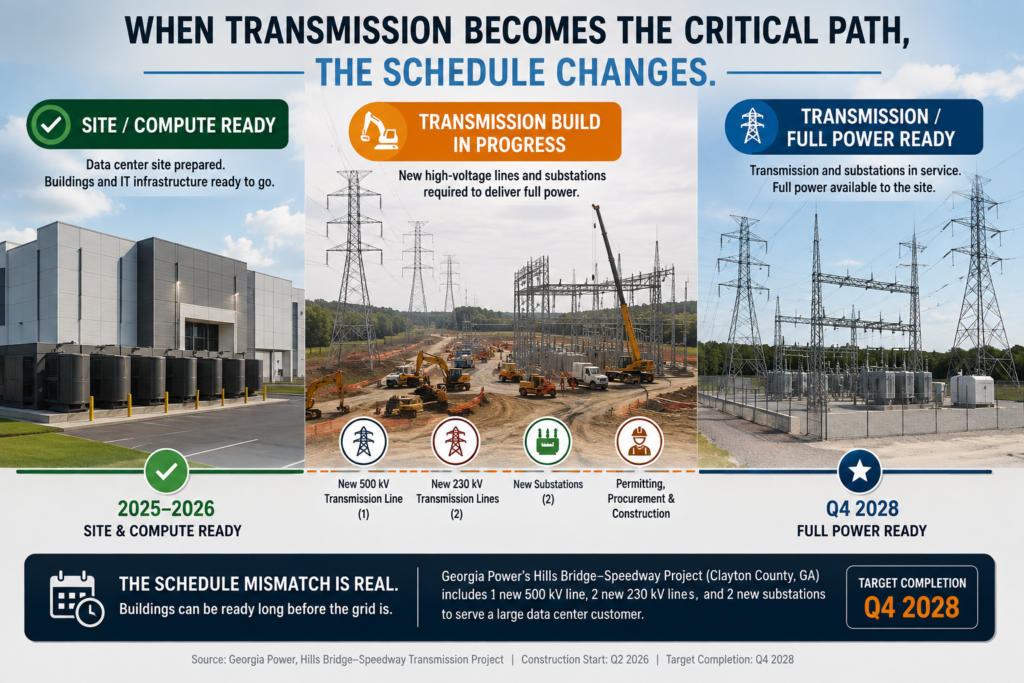
Georgia Power’s Hills Bridge-Speedway project south of Atlanta is being developed to support a large data center customer and includes a new 500 kV line, two 230 kV lines, and two substations. The current tentative project completion date is Q4 2028. Source: Georgia Power
This is not evidence that utilities are failing.
It is evidence that, at AI scale, providing permanent electrical service can become a major infrastructure project of its own. The existing Blueflux analysis, What Happens When Transmission Becomes the Critical Path for Your Data Center?, examines that issue in greater depth.
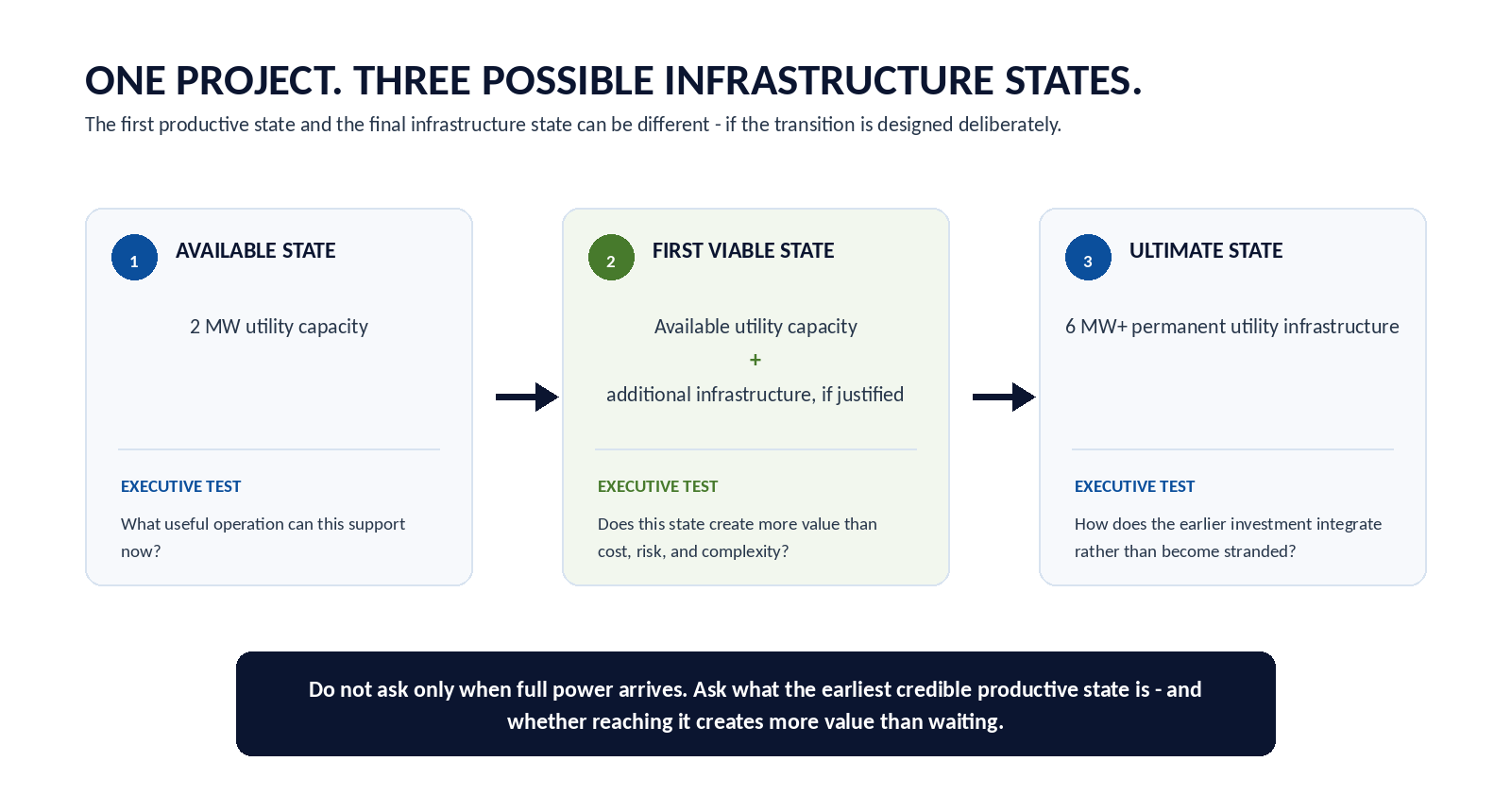
Define the first viable operating state
Once the full-build date and the first-operating date are separated, a better question becomes possible:
What is the smallest infrastructure state that creates meaningful commercial value?
For one project, 2 MW may accomplish very little. For another, it may support a meaningful first deployment, an initial customer, or the first phase of a larger campus.
The point is not to assume that partial utility capacity is sufficient. The point is to determine what useful operation actually requires.
That means going beyond the megawatt number.
- Can the intended compute operate reliably?
- Can it be cooled?
- Can the electrical architecture support the required reliability and failure response?
- Can the site be commissioned and operated safely?
- What permits and operating constraints apply?
- How does the configuration change when additional utility capacity arrives?
Only after those questions are answered does “2 MW available” become a useful project fact.
An earlier state can take several forms
This is also where the conversation can go wrong.
An earlier operating state does not automatically mean installing generators until the grid catches up.
There are several fundamentally different possibilities.
One is staggered utility capacity: energizing the project in increments as utility infrastructure becomes available.
Another is constrained or flexible service: operating subject to defined limits on grid withdrawals. LBNL discusses staggered, static-flexible, and dynamic-flexible approaches while emphasizing that their availability and implementation vary by jurisdiction. Source: LBNL Speed to Power
A third is supplemental infrastructure: combining available utility service with other appropriately engineered resources.
Federal regulators are also examining versions of this broader concept. FERC has directed PJM to establish an interim, non-firm transmission service intended to allow certain co-located loads to withdraw power earlier while required network upgrades are completed. These are specific regulatory mechanisms, not universal options for every project, but they demonstrate that constrained service and ultimate service are increasingly being treated as distinct states. Source: FERC
Those paths are not interchangeable. Each carries different technical, commercial, regulatory, and operational consequences.
The transition may determine whether the idea works
Suppose an earlier operating state is technically possible.
The next question may be more important: What happens to that infrastructure when the remaining utility capacity arrives?
A weak strategy solves the 2027 problem by creating a 2029 problem.
Equipment is installed for speed, used briefly, then removed or replaced. Capital becomes stranded. The permanent design has to work around decisions made solely to meet an earlier date.
A stronger strategy asks whether the first state can become part of the next state.
- Can equipment remain useful?
- Can the electrical architecture accommodate additional utility capacity?
- Can the site expand without disrupting productive compute already operating?
- Can today’s investment continue contributing to resilience, expansion, or another useful function later?
Temporary should describe the infrastructure state. It should not automatically describe the useful life of the investment.
For deeper technical context, see Modular Power Infrastructure for Phased AI Deployment and Capacity Utilization and Stranded Infrastructure.
Sometimes the right answer is to wait
This is the test that keeps the argument credible.
There are projects where waiting for permanent utility service will be the better decision.
- The demand may not be firm enough to justify additional capital.
- Permanent service may be close enough that an interim state creates little economic benefit.
- Permitting may eliminate the schedule advantage.
- Fuel, emissions, land, or operating requirements may make supplemental infrastructure impractical.
- The required reliability may be difficult to achieve economically.
- The transition may create more complexity and stranded investment than earlier operation is worth.
In those circumstances, waiting is not a failure of imagination. It is disciplined capital allocation.
The objective is not the fastest possible deployment. It is the earliest credible deployment that creates more value than the risk and complexity required to reach it.
The question the executive team should ask
If full utility capacity arrives later than the commercial requirement, the project team should be able to answer seven questions:
- What capacity can we reliably obtain, and when?
- What economically useful compute can each increment support?
- What additional infrastructure would be required to operate earlier?
- What new costs, constraints, and risks would that introduce?
- Which investments would remain useful after permanent utility capacity arrives?
- Is the value of earlier operation greater than the cost and risk required to achieve it?
- What is the earliest operating state we would be willing to defend technically, operationally, and financially?
That last question changes the objective.
Speed to power measures how quickly electrical capacity can become available.
The more useful project question is how quickly the infrastructure can begin performing the economic function for which it exists.
We think of that as Time-to-Function.
Not the earliest day equipment can be energized. The earliest day the system can credibly begin doing useful work.
Sometimes the answer will still be 2029. But 2029 should be the result of the analysis – not merely the first date on the utility schedule.
Go deeper
Explore the Power for AI decision area to understand how availability, timing, configuration, reliability, and transition shape AI power strategy.
Then continue into Deployment Strategy to examine how power, site, procurement, commissioning, and infrastructure dependencies determine the earliest credible operating state.
Technical depth:
- Utility Interconnection for Large AI Loads
- How to Interpret Utility Interconnection Queue Data
- Modular Power Infrastructure for Phased AI Deployment
- Capacity Utilization and Stranded Infrastructure
Sources
- Lawrence Berkeley National Laboratory – Speed to Power: Solutions for Accelerating Large Load Connections
- Georgia Public Service Commission – Georgia Power Q1 2026 Large Load Economic Development Report filing
- Georgia Power – Hills Bridge-Speedway 500/230 kV Transmission Project
- Federal Energy Regulatory Commission – PJM Co-Location Order