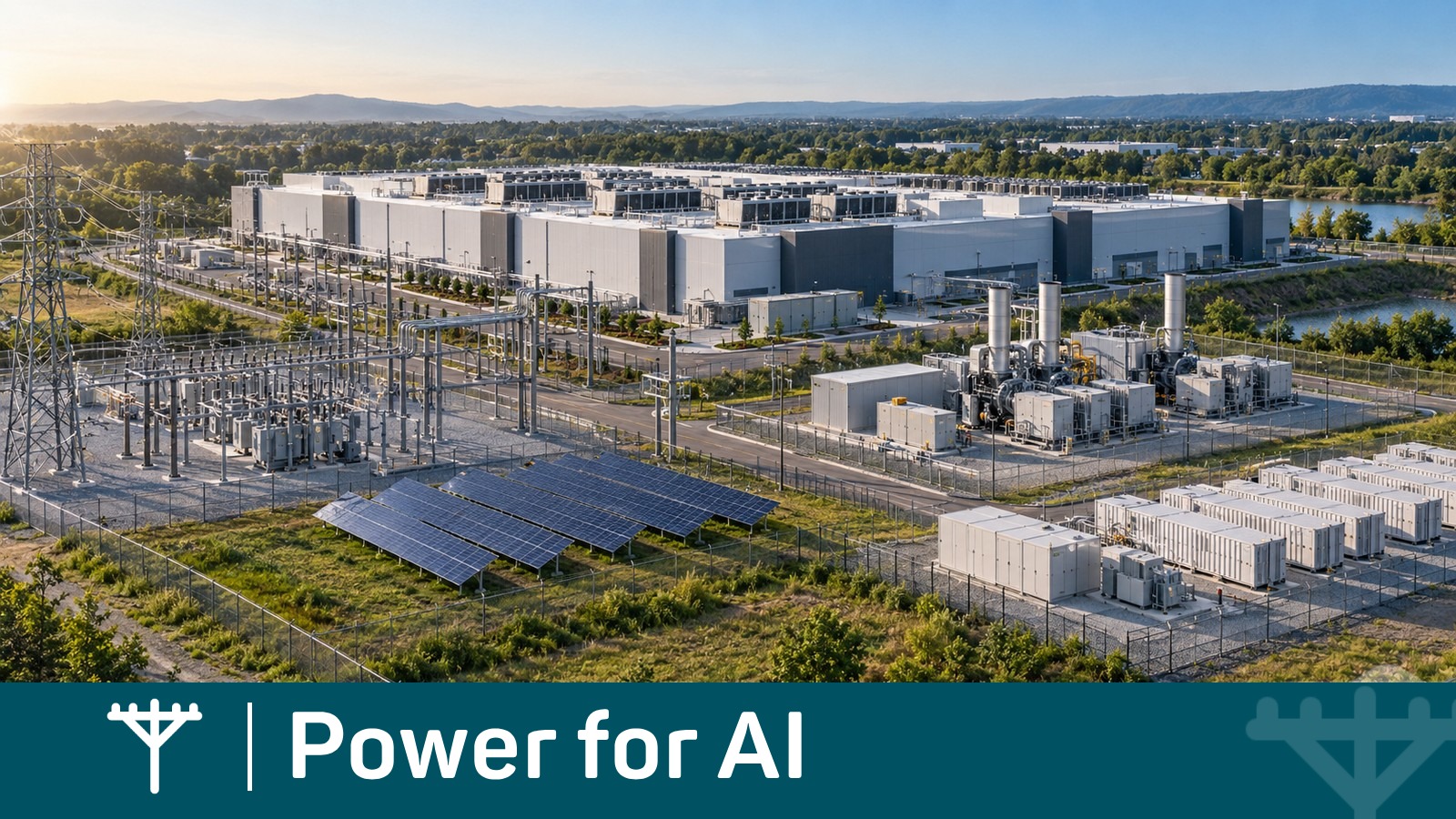
Data center power alternatives are often discussed as a list of technologies: utility service, generators, fuel cells, solar, wind, batteries, or microgrids. That framing starts too late.
The first question is not which technology looks most attractive. It is what operating problem the power architecture must solve.
Does the site need firm capacity before a utility upgrade is complete? Is some grid power available, but not enough for the full compute requirement? Is the constraint energy supply, peak demand, power quality, resilience, or the timing of expansion? And can an initial power configuration remain useful after the permanent infrastructure arrives?
The answers determine whether a power alternative creates a credible operating path or merely moves cost and risk from one part of the project to another.
Why the power question is changing
Data center electricity demand is growing rapidly, but national or regional generation forecasts do not tell a developer when power can be delivered to a particular property. Berkeley Lab’s 2025 update estimates that data centers could account for 11.8% of U.S. electricity use by 2030, with a scenario range of 9.5% to 15.3%. The scale matters, but the site-level challenge is more specific: generation, transmission, substations, distribution equipment, interconnection studies, and construction all have their own schedules.
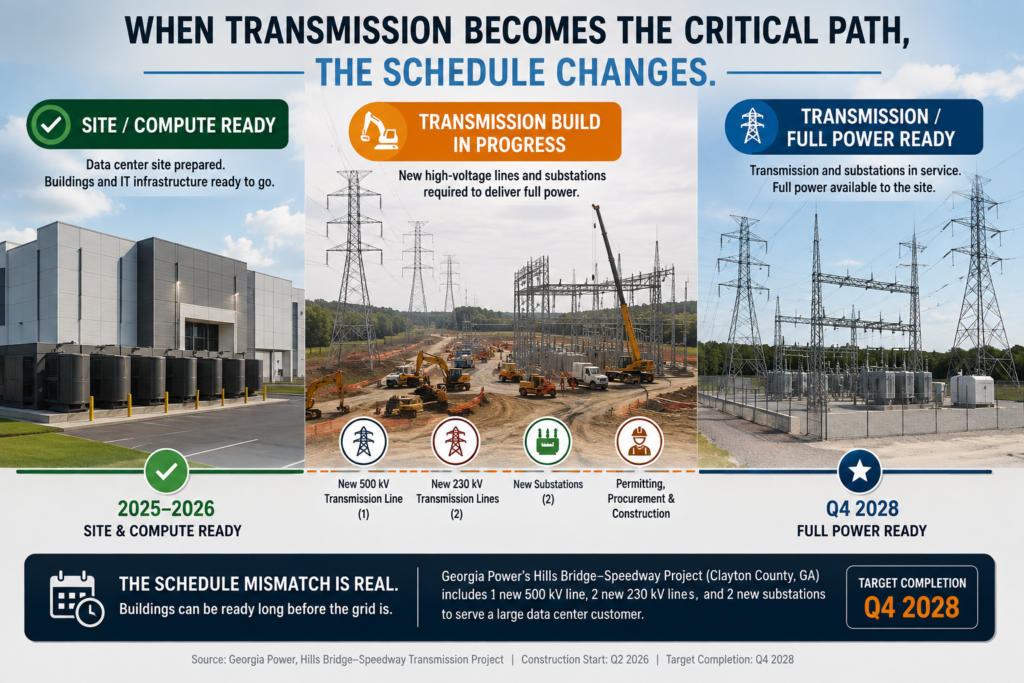
That distinction is visible when transmission becomes part of the data center’s critical path. A region may have adequate generation in aggregate while a particular site still cannot receive the required capacity on the required date.
For that reason, “alternative power” should not be interpreted simply as replacing the electric utility. In many cases, utility service remains the preferred long-term foundation. The practical issue is whether utility power alone can support the compute mission, deployment schedule, reliability requirement, and expansion plan.
Power source and power architecture are different decisions
A power source produces or supplies energy. A power architecture determines how utility service, onsite generation, storage, controls, distribution, and critical loads work together.
This distinction prevents several common planning errors.
- A renewable-energy contract may address energy sourcing, but it does not necessarily create additional deliverable capacity at the site.
- A battery can shift energy, manage peaks, or support transitions, but it must be sized around a defined power and duration requirement.
- An onsite generator may provide dispatchable capacity, but fuel supply, air permitting, noise, maintenance, and operating constraints remain part of the project.
- A microgrid can coordinate several resources, but coordination introduces protection, control, operating, and interface requirements of its own.
The stronger planning approach begins with the required operating state and then selects the resources capable of supporting it.
Five practical power configurations
Most data center power strategies can be understood through five broad configurations. These are not mutually exclusive technologies. They are operating patterns that may use different equipment depending on the site and mission.
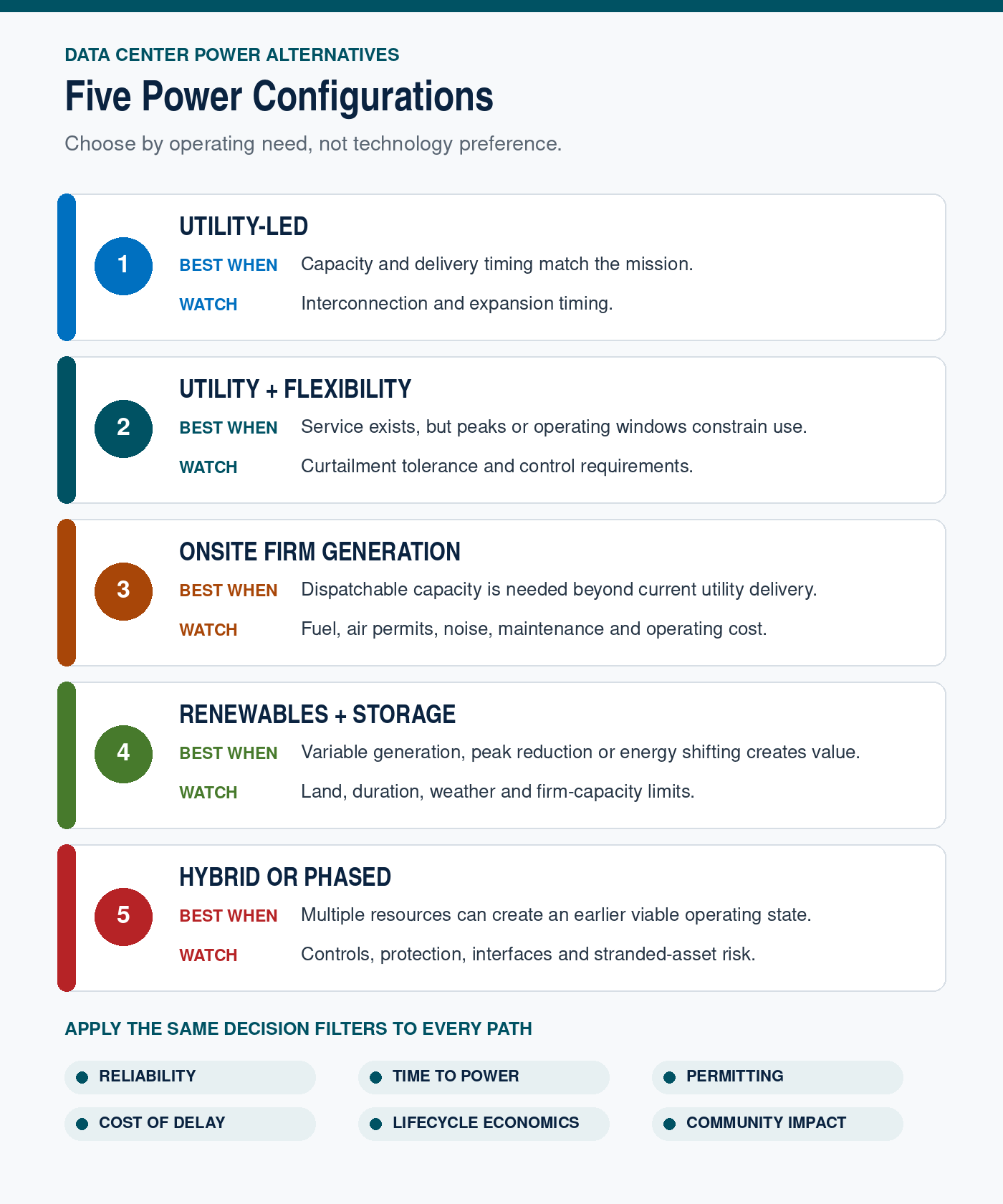
1. Utility-led power
A utility-led configuration is often the simplest and most durable answer when sufficient capacity can be delivered on a schedule that matches the compute requirement. It can provide access to a diverse generation system without placing primary-generation operations on the data center owner.
Its principal limitation is not necessarily the resource itself. It may be the schedule and infrastructure required to deliver it. Interconnection, transmission upgrades, transformers, switchgear, and substation work can make the final utility solution unavailable when the compute is ready.
2. Utility service with operational flexibility
Some sites have utility service available, but the commercial terms or physical capacity do not support unrestricted operation at the ultimate load. A flexible configuration may combine utility power with storage, controllable loads, demand management, or agreed curtailment windows.
This approach can make constrained capacity more useful, but only when the compute mission can tolerate the operating limits. Workload flexibility, service commitments, storage duration, control authority, and recovery procedures must be defined rather than assumed.
3. Onsite firm generation
Dispatchable onsite generation can supplement or, in some configurations, serve as the primary source of power. Potential technologies include reciprocating engines, gas turbines, fuel cells, and other project-appropriate generation systems.
The advantage is greater control over when capacity becomes available. The tradeoff is that the data center project also becomes a power-generation project. Fuel availability and delivery, equipment maintenance, emissions, air permits, noise, water use where applicable, operating personnel, spare parts, and black-start or restart procedures become material design questions.
EPA guidance specifically identifies stationary combustion turbines and engines as common primary and backup power sources for data centers and notes that they are subject to applicable air-emission standards and permitting requirements. Those obligations cannot be treated as secondary details after equipment selection.
4. Renewables with storage
Solar, wind, and other renewable resources can contribute energy, reduce grid purchases or peaks, and support environmental objectives. Storage can shift some of that energy across time, support fast transitions, and provide other power-management functions.
But neither the renewable resource nor the storage system should be evaluated by nameplate rating alone. Land, resource availability, output variability, storage duration, round-trip losses, degradation, recharge conditions, and the relationship between generation profile and compute load all affect the usable result.
This configuration is strongest when its role is explicit. It may reduce peak demand, support a defined operating window, improve resilience, or complement firm utility or onsite generation. It should not be presumed to provide continuous firm capacity unless the complete system has been engineered and validated for that duty.
5. Hybrid or phased power
A hybrid configuration coordinates multiple resources – for example, partial utility service, onsite firm generation, storage, and renewable energy – as one operating system. A phased strategy uses those resources to establish an initial viable state and then changes the mix as permanent utility capacity or later project phases become available.
This is often the most adaptable option, but it is not automatically the easiest. Control logic, protection coordination, synchronization, islanding behavior, equipment interfaces, operating authority, and transition planning all become more important as the number of interacting resources increases.
The central economic question is whether the initial infrastructure continues to create value in the final state. If bridge equipment becomes disposable as soon as utility capacity arrives, earlier operation may come at the price of stranded capital. If it later supports resilience, peak management, expansion, or another useful operating role, the transition economics may be stronger.
Use the same decision filters for every alternative
No configuration should be selected on time to power alone. Each alternative should be tested against the same set of project requirements.
- Reliability: Can the complete system support the actual availability, redundancy, power-quality, recovery, and maintenance requirements of the compute mission?
- Time to power: Which permits, equipment lead times, utility actions, construction activities, and commissioning steps control the date of usable capacity?
- Permitting and resources: What land, fuel, emissions, noise, water, environmental, and interconnection constraints apply?
- Cost of delay: What happens economically if compute delivery, customer commitments, or revenue begin later?
- Lifecycle economics: How do capital cost, operating cost, maintenance, fuel exposure, financing, useful life, and transition costs compare?
- Community impact: Does the configuration credibly address effects on the grid, ratepayers, neighboring properties, local infrastructure, and public confidence?
These filters turn a technology discussion into an infrastructure decision.
When waiting for utility power is the better answer
An alternative configuration is not justified merely because it can be built sooner. Waiting may still be the better decision when the cost of delay is modest, the compute commitment is uncertain, permitting risk is high, fuel or operating requirements are unattractive, or the interim equipment would have little value after the utility solution arrives.
The same is true when added system complexity weakens reliability rather than improving it. A faster configuration that cannot be permitted, financed, operated, or transitioned credibly is not faster in any meaningful project sense.
The objective is therefore not maximum speed. It is the fastest credible path to productive capacity that preserves long-term infrastructure value.
From a final endpoint to a sequence of operating states
Traditional planning often begins with the ultimate build and works backward. That remains necessary, but it may not be sufficient when compute, utility infrastructure, and construction move on different schedules.
A more useful model defines a sequence:
- Establish the compute requirement and the date at which it must become productive.
- Determine what power is physically deliverable at the site in each relevant period.
- Design the earliest viable operating state that meets the mission.
- Define how capacity, reliability, and infrastructure expand over time.
- Engineer the transition into the permanent state before committing to the initial one.
This is the same problem illustrated when a project needs 6 MW but the utility can initially deliver only 2 MW. The first phase should not be judged solely by how many megawatts it supplies. It should be judged by whether those megawatts can support useful compute, whether the operating model is credible, and whether the phase improves the economics of the complete project.
Go deeper
Explore Power for AI to examine how source, delivery, timing, and configuration shape AI infrastructure decisions. Then continue to Deployment Strategy and First Productive MW vs. Full Build to evaluate sequencing and the economics of earlier operating capacity.