
A useful model preserves the relationships between commands, physical state and measured response. It also makes its limits visible.
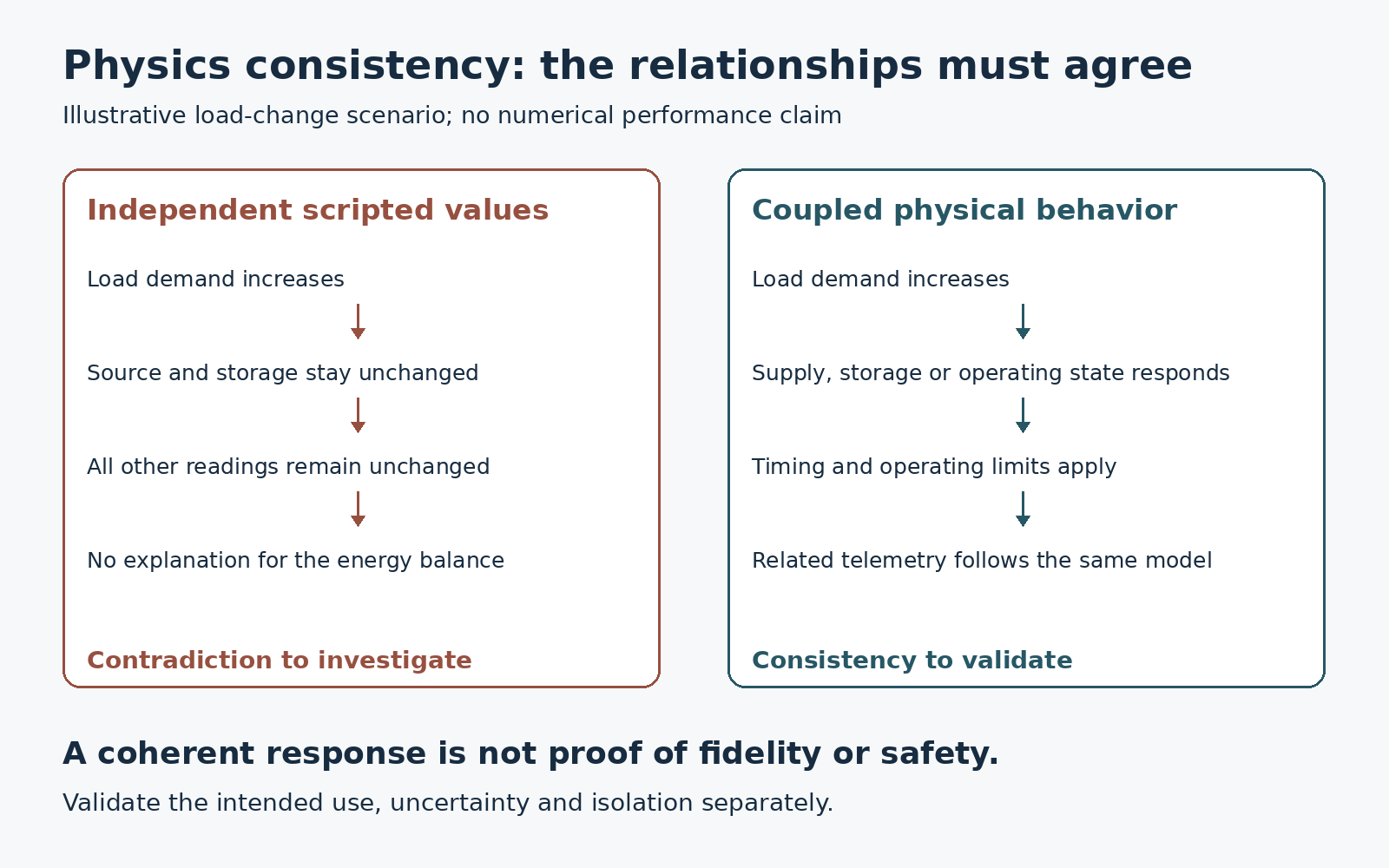
A controller reports that electrical load has increased. The surrounding telemetry remains unchanged: no change in source demand, stored energy, losses or operating limits. The individual readings may look reasonable. Together, they tell a contradictory story.
This is the practical meaning of physics consistency in a digital twin. Within its declared scope and accuracy, the model must preserve the physical relationships that connect inputs, equipment state and outputs. A realistic dashboard is not sufficient.
For an isolated environment used to examine suspicious OT interactions, the decision is specific: Which physical relationships must remain credible for the observation to support a useful response decision?
Consistency starts with cause and effect
An electrical system cannot respond independently at every measurement point. Load, voltage, current, conversion losses and stored energy constrain one another. The relevant relationships depend on the architecture and operating conditions; there is no universal response curve for every facility.
Consider a deliberately simplified illustration: when a load requires additional energy over an interval, that energy must be supplied by a source, released from storage, or accommodated by changes in operating state. A model that increases reported consumption while leaving all those contributors unchanged needs an explanation. Otherwise, its outputs conflict.
The same discipline applies across the facility. Cooling has thermal inertia. Storage has energy and power limits. Equipment has operating states. Those relationships are part of the model’s meaning, not decoration added to a visual interface.
Timing is part of physical behavior
Different processes respond over different timescales. A control command, a sensor sample, a power-electronics response and a thermal change do not necessarily occur together. A model can produce plausible final values while misrepresenting the transition that connects them.
Test sequences as well as snapshots. Ask whether the model preserves relevant delays, rates of change, measurement intervals and state transitions. State the chosen time resolution and the behaviors it cannot resolve. Faster simulation does not automatically provide more trustworthy evidence.
Credible does not mean identical in every detail
A digital twin should be judged against an intended use. An engineering study of a switching transient and an environment for reviewing supervisory commands require different detail, timing and validation. Adding fidelity everywhere can increase maintenance and calibration work without improving the decision.
NIST’s work on digital-twin credibility emphasizes verification, validation and uncertainty assessment throughout the model lifecycle. Applied here, the useful questions are whether the model was implemented as intended, whether its behavior is sufficiently representative for the stated use, and how uncertainty changes interpretation.
Define the model boundary, operating range, required accuracy and failure criteria before relying on its results. Changes to equipment, firmware, control logic or calibration can invalidate an earlier assessment.
Physical credibility and isolation are separate requirements
A convincing model does not establish a safe production boundary. Access paths, credentials, data transfer, reset behavior and response authority require their own controls and testing. The isolated environment must not acquire an unintended path to command the live facility.
NIST’s OT security guidance treats safety, reliability and performance as central requirements. NIST’s digital-twin security report also identifies security and trust issues associated with the technology itself. Neither document establishes that a particular deception environment is safe or effective.
In the earlier article, What an Isolated Digital Twin Changes in OT Cyber Defense, the key distinction was between representing a facility and controlling it. Physics consistency improves what the representation can tell an operator; isolation determines where interaction is permitted.
Four questions before using the result
- Purpose: Which response decision is this model meant to inform?
- Relationships: Which physical dependencies and time behavior must it preserve?
- Evidence: Against what tests and operating range has it been validated?
- Boundary: How has separation from production been tested independently?
A coherent simulated response is evidence about behavior inside that model. It does not, by itself, establish attacker identity, prove intent or predict an identical outcome in the live facility. Interpretation needs accountable operators and corroborating evidence.
The infrastructure lesson is broader than cybersecurity: useful models make dependencies explicit. That is the same systems discipline described in AI Infrastructure Is Not a Facility. It Is a Coordinated Operating System.
The decision question: What would make you stop trusting the model’s output, and is that limit documented before the model is used?