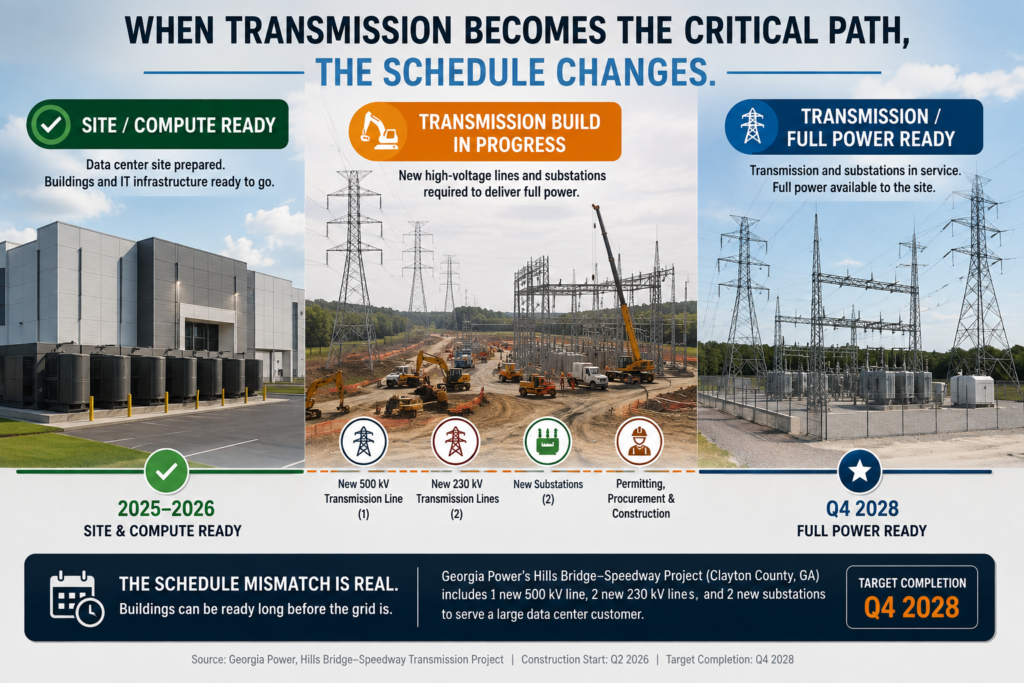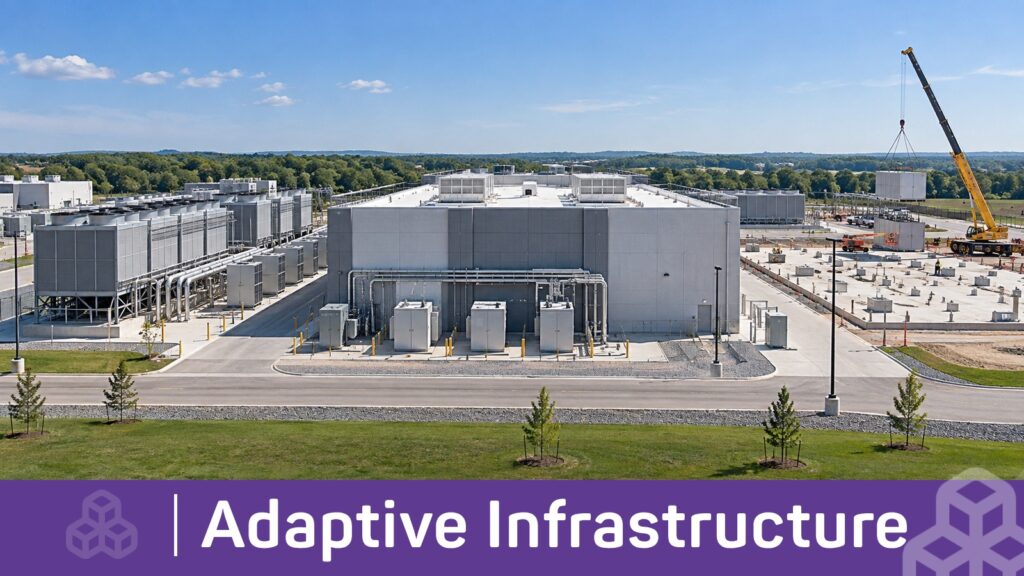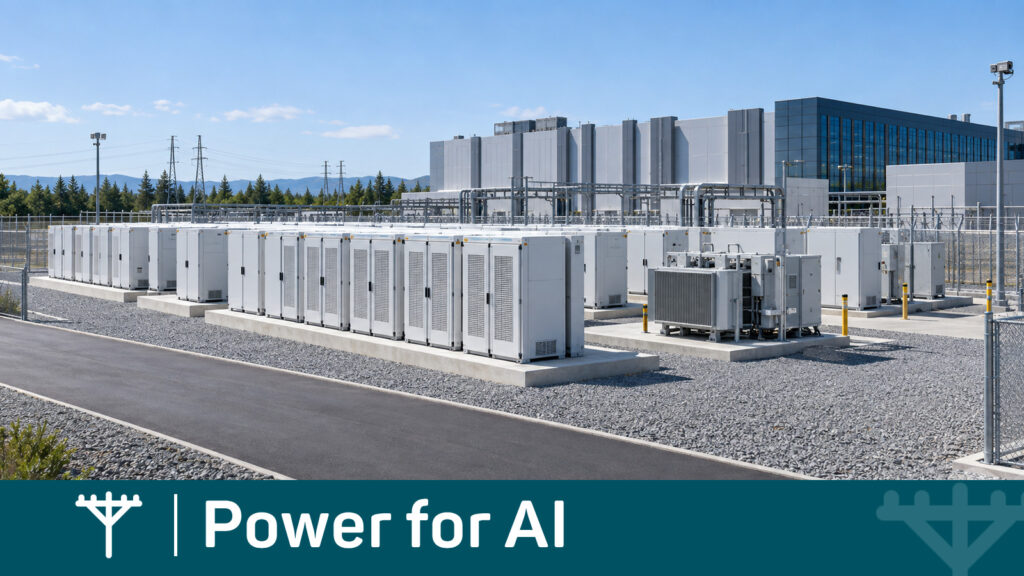

Fabrication can be ahead of schedule while power availability is still years behind the project. A prefabricated power room, compute enclosure, or modular cooling plant can shorten factory and site construction work. It does not, by itself, create electrical capacity that a utility or on-site source can reliably deliver to an operating workload.
For developers of AI infrastructure, this is the distinction that matters: manufacturing readiness is a supplier milestone; available power is an operating condition. Confusing the two can move capital spending forward without moving the first productive compute date.
The question is not whether modular construction is fast. It is whether faster fabrication removes the constraint that is actually controlling the project.
Three dates that should not be presented as one
Factory-ready
Equipment is manufactured, assembled, tested to the applicable factory scope, and prepared for shipment. This can reduce uncertainty and compress work that would otherwise be performed in the field, subject to design maturity and supplier capacity.
Electrically available
A defined quantity of power can reach the intended point of service under the applicable commercial, utility, protection, and operating conditions. This is not the same as a requested interconnection size, theoretical nameplate capacity, or an unsigned forecast for an energization date.
Productively operable
A specified compute workload can run within its required power-quality, cooling, communications, resilience, security, and operational boundaries. Energizing equipment is a milestone, but it does not necessarily mean that customers can use the service.
Each date belongs on the critical-path schedule. If factory completion advances by months while the other two dates do not, the project has accelerated delivery of equipment, not necessarily the delivery of productive compute.
Why available megawatts require more than a connection request
Grid connection for large loads is an engineering and coordination process. Site-level availability can depend on existing feeder or transmission capability, transformer and substation capacity, protection coordination, network reinforcement, service terms, and the timing of equipment and regulatory decisions. The details differ substantially among utilities, locations, and load sizes.
In its 2026 report Speed to Power, Lawrence Berkeley National Laboratory describes multiple categories of solutions to large-load connection bottlenecks, including interconnection processes, planning and procurement, market operations, and cost allocation. A separate 2026 national-laboratory report examines the mismatch between fast data-center development and slower utility infrastructure timelines, as well as strategies including phased energization and appropriately evaluated on-site generation.
Neither report treats prefabrication as a substitute for a usable electrical service arrangement. A complete equipment package must still be matched to the electrical conditions under which it will operate.
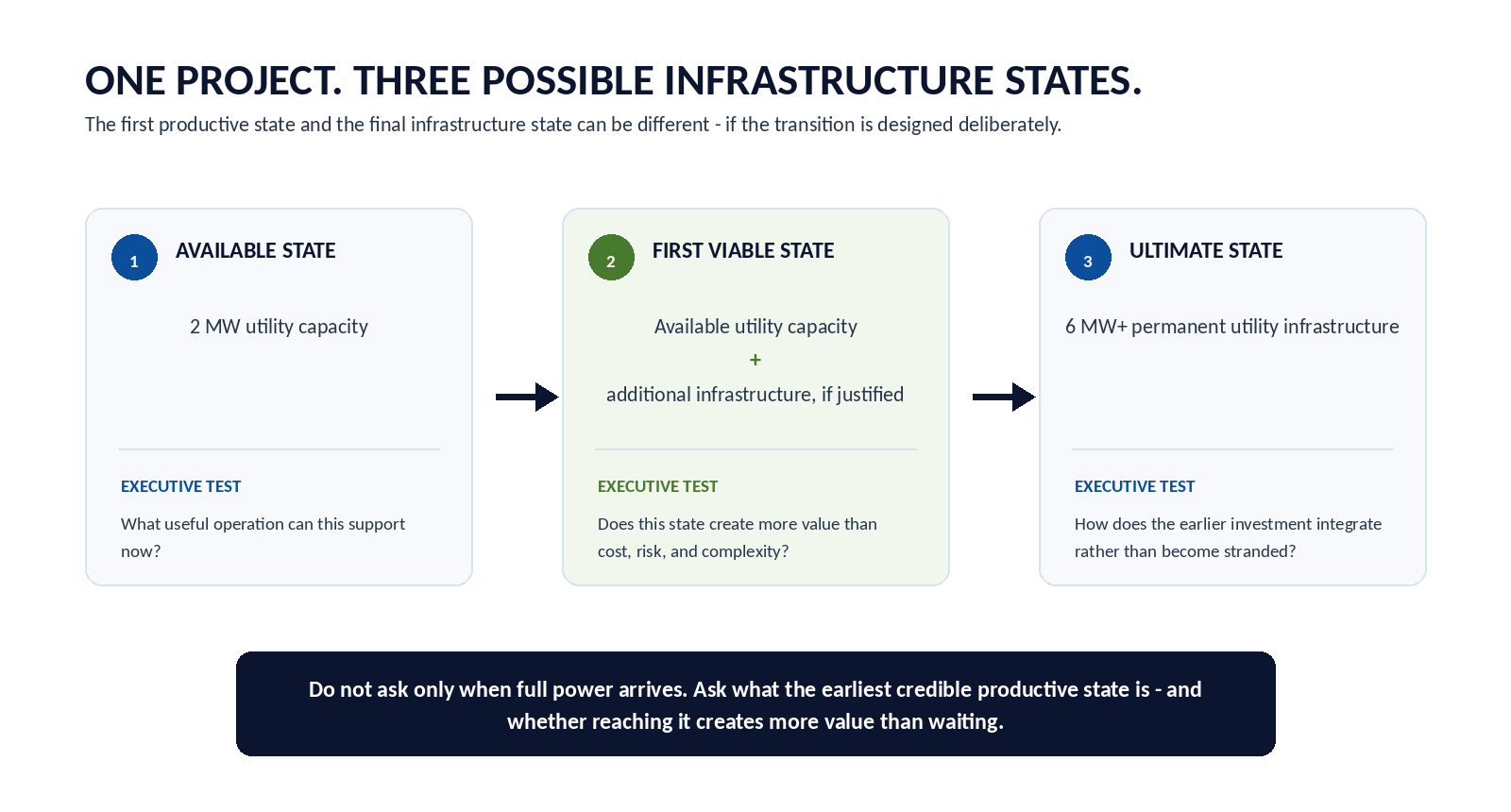
A hypothetical example: 6 MW planned, 2 MW available
Consider a developer designing a 6 MW project whose supplier can deliver modules well before the utility expects to provide the full service. Assume, for illustration, that only 2 MW could be available earlier. The team should not automatically choose either to wait for all 6 MW or to deploy one-third of the original design.
The useful question is whether a defined initial workload can be supported under a separately verified 2 MW operating envelope. That evaluation would include facility overhead, realistic IT load, thermal capacity, startup and transient behavior, backup and ride-through design, cyber and operational controls, customer commitments, and what happens when the next capacity phase is added.
Even the 2 MW starting point must be confirmed: service terms and actual availability matter. An interim generation or storage proposal is not equivalent to guaranteed utility capacity, and it carries its own fuel, reliability, safety, emissions, cost, and approval constraints.
Four tests before accelerating fabrication
1. Confirm the source-side capacity
What capacity is contracted, technically supportable, and available on which date? Identify the relevant utility or generation milestone, the conditions attached to it, and the party accountable for delivery. Distinguish firm commitments from studies, planning estimates, and aspirational dates.
2. Translate megawatts into a usable workload
What portion of delivered power is actually available to the intended compute service after cooling, conversion, distribution losses, auxiliaries, reserve requirements, and the selected resilience model? Do not confuse site service capacity with usable IT capacity.
3. Validate interfaces and the operating envelope
Are protection, switchgear, power conditioning, cooling, telecommunications, telemetry, cybersecurity, controls, and commissioning requirements aligned with the first operating state? The fastest enclosure is not useful if the interfaces remain unresolved.
4. Compare the economics of the first productive date
What changes in the date of usable customer service, capital deployed before utilization, integration risk, and the cost of future expansion? Test the possibility that waiting for a stable architecture is less expensive than building the wrong interim plant.
Where modular construction genuinely helps
Modularization is valuable when manufacturing and on-site construction are on the critical path, interface design is settled, site access is feasible, and the utility and other dependencies will be ready to support commissioning. It can also support phased expansion when modules are designed around clear operating boundaries and the transition to the larger facility is planned from the start.
But a factory cannot accelerate every external dependency. If utility availability is the bottleneck, the engineering team must first address the service problem or choose a justified alternate operating approach. Faster fabrication then becomes a means of implementing the chosen solution, not the solution itself.
The decision to make first
Before locking a fabrication schedule, ask: What is the earliest defensible date when an identified workload can operate safely and reliably, and which dependency actually sets that date?
That is a more useful planning baseline than module delivery or mechanical completion alone. A project should be evaluated by time to function, with construction method selected in service of that outcome.
For the broader framework, see Modular Data Centers Solve the Construction Problem. But Is Construction Your Constraint?, You Need 6 MW Next Summer. The Utility Can Deliver 2 MW. What Now?, and the First Viable Megawatt decision brief.
Sources and further reading
- Lawrence Berkeley National Laboratory, Speed to Power: Solutions for Accelerating Large Load Connections (June 2026).
- National Laboratory of the Rockies, The Role of the U.S. Electric Distribution System in Serving Data Center and Other Large Loads (May 2026).
- Pacific Northwest National Laboratory, A Framework for Streamlining Large Load Interconnection (May 2026).