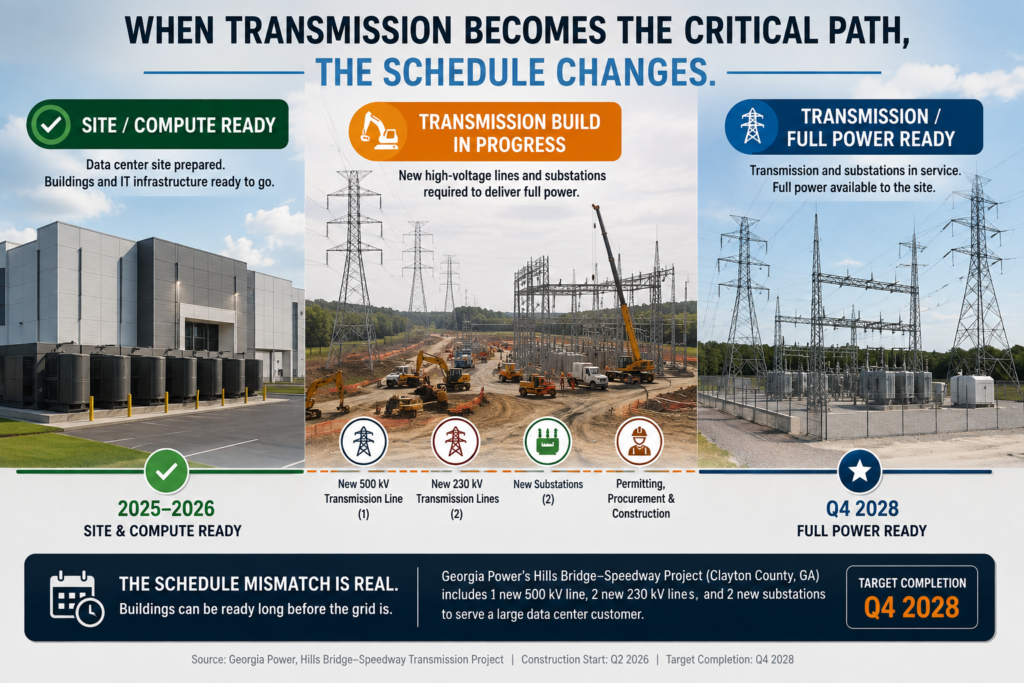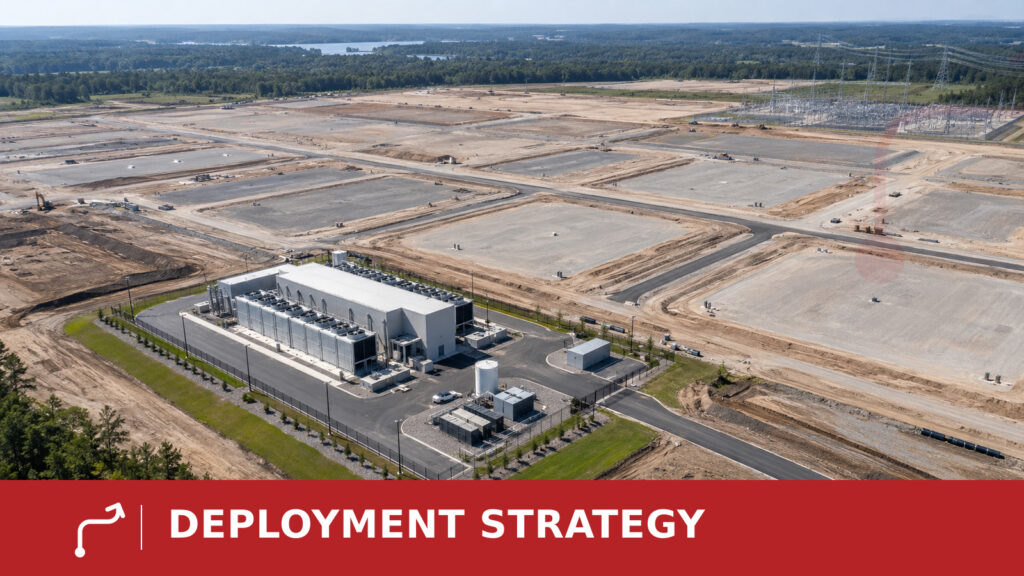
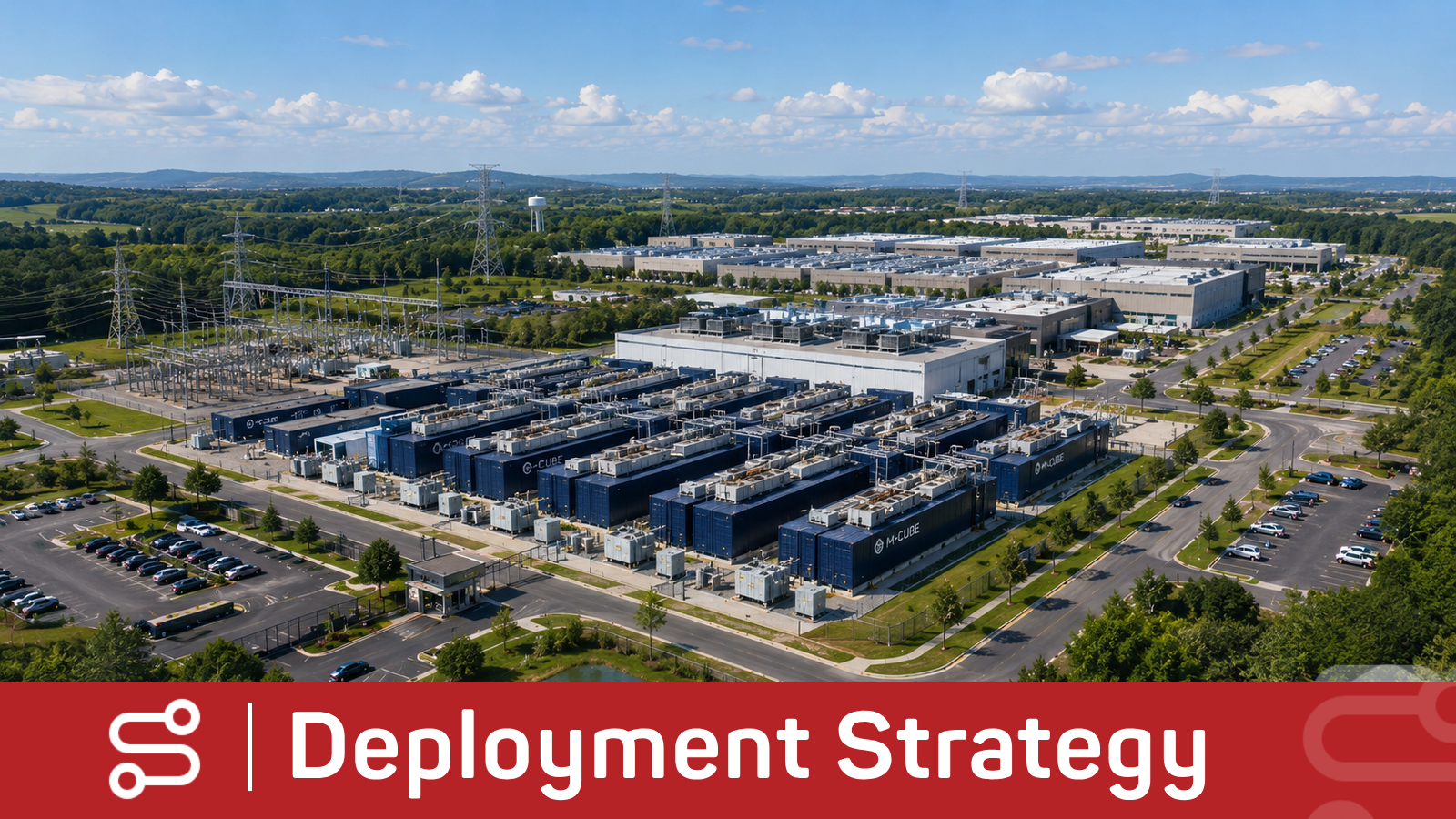
“Deploy in months” is a construction claim until the project can identify the date a real workload will operate. Modular facilities can shorten fabrication and field assembly. But a delivered module is not a utility service commitment, a permit, an energized fiber route, a commissioned cooling system, or an accepted production service.
Those dependencies can run in parallel, and some can be solved earlier than expected. They can also leave a finished facility waiting for a single external commitment. For a developer or compute buyer, the critical distinction is not whether a supplier can ship equipment quickly. It is which conditions must be satisfied before the first useful AI workload can go into service.
Five dates that are often collapsed into one promise
A credible schedule distinguishes at least five milestones. Factory-ready means the purchased module or equipment package is complete to its factory acceptance scope. Site-ready means civil works, access, physical connections and local prerequisites support installation. Energized means available electrical power can be supplied under the relevant technical and commercial conditions. Commissioned means the required integrated systems have been tested and accepted. Productive means a specified workload is actually operating within the agreed service, reliability, security and support boundaries.
Those dates need not occur in a simple sequence. However, the promised in-service date must account for the last unresolved dependency, including transitions between organizations. A schedule built around the supplier’s earliest possible delivery can therefore be accurate about equipment and misleading about usable capacity.
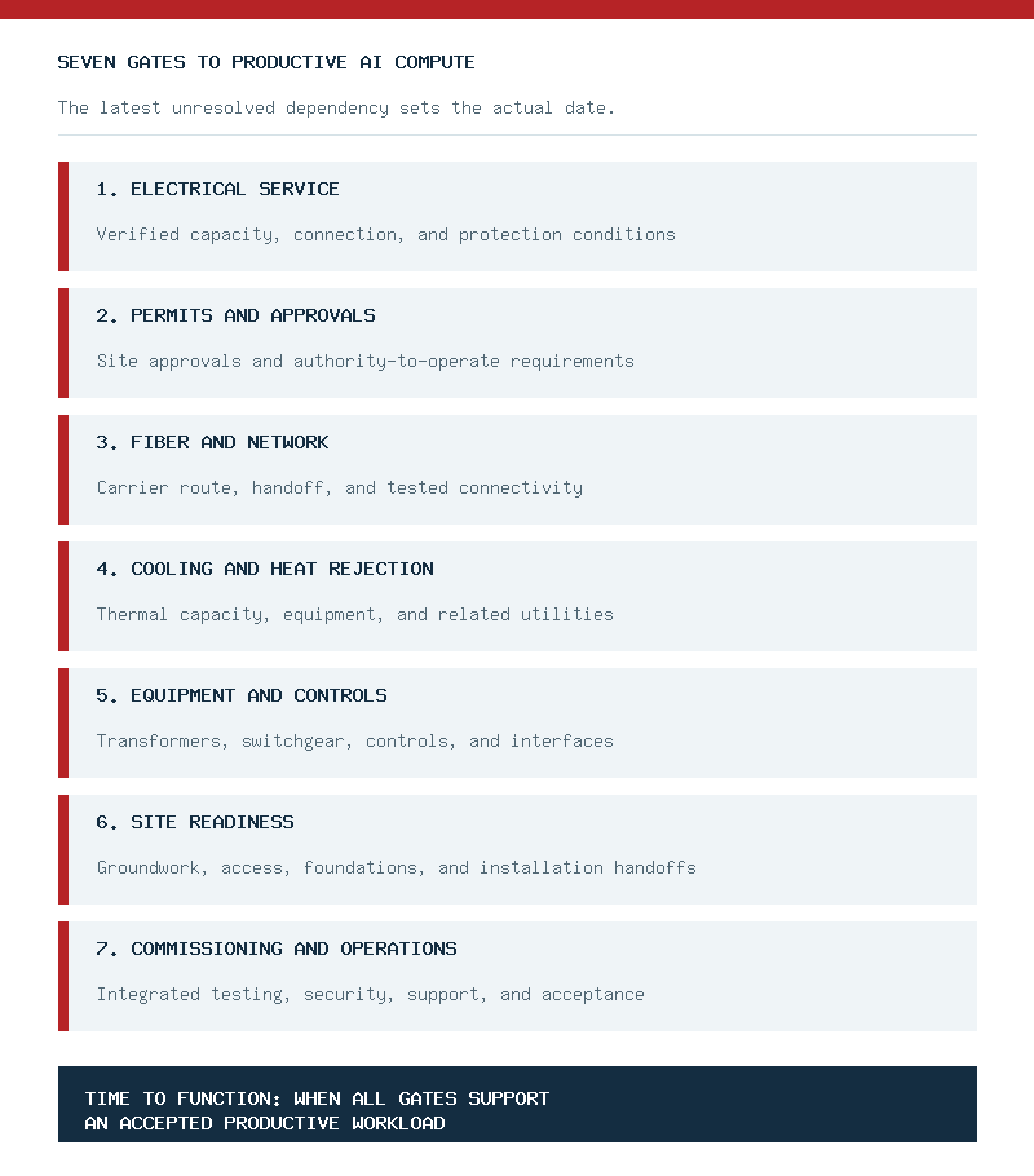
Seven readiness gates behind the headline
1. Electrical service
Is deliverable capacity actually available at the point of service? A planned connection request, equipment nameplate rating and utility service agreement are different things. Verify amount, timing, conditions, protection coordination, power quality and responsibility for network improvements. The Lawrence Berkeley National Laboratory’s 2026 Speed to Power report describes large-load connection bottlenecks across planning, interconnection, resource procurement, operations and cost allocation. Prefabrication addresses none of these by itself.
2. Permits and approvals
Local land-use decisions, civil permits, environmental requirements, construction conditions and operating authorizations can each have separate owners and dependencies. The correct gate is not merely “application submitted.” It is the approval or condition required to perform the next specific activity. Actual applicability depends on the site and the jurisdiction.
3. Network and fiber
An available carrier route is not the same as a tested connection into the intended service. A buyer needs a credible path for fiber construction, provider handoff, equipment activation, routing, redundancy where required, and acceptance testing. Network readiness belongs on the same schedule as electrical and mechanical readiness.
4. Cooling and heat rejection
Compute cannot operate within an acceptable envelope on power alone. Thermal design must be matched to the workload and actual site conditions: cooling plant, distribution, controls, heat rejection, water where applicable, maintenance and failure response. Modular cooling equipment still requires working interfaces, utilities and acceptance tests. The Uptime Institute’s 2026 Global Data Center Survey identifies power constraints, costs, supply-chain limits and staffing as ongoing challenges for operators.
5. Equipment, controls and supply chain
Transformers, switchgear, protection devices, power conditioning, cooling equipment and control interfaces have distinct delivery and integration requirements. Procurement readiness is not simply a purchase order date: factory testing, interface design, receiving, installation, software configuration and spares can determine whether the equipment is usable at the intended phase-one load.
6. Site readiness
Foundations, roads, access for heavy loads, crane and set-down plans, grounding, duct banks, fire access, physical security and service clearances can restrict installation. A faster factory can actually make the site less ready relative to delivery unless the receiving and interconnection schedule is synchronized.
7. Commissioning and operating acceptance
Once equipment is installed, the required interfaces must behave as a system under defined operating and fault conditions. The integrated test plan should cover power protection, cooling, monitoring, network, cybersecurity boundaries, operator responsibility and workload acceptance. NERC’s Large Loads Action Plan highlights the continuing importance of large-load modeling, interconnection studies, commissioning and operations. A single successful energization is not evidence that every operating dependency has been resolved.
Infographic: Seven parallel readiness gates must converge before the first productive AI workload.
Turn the claim into an accountable decision
Before relying on a “months” estimate, ask every workstream to provide an evidence-backed milestone and identify the acceptance event rather than merely a forecast date. A practical executive review should establish:
- The workload: What will run first, for whom, at which utilization and operating requirements?
- The power position: Which MW are deliverable, when, under whose agreement and operating conditions?
- The dependency map: Which authority, utility, carrier, supplier or construction team controls each unresolved gate?
- The integration sequence: Which interfaces must be completed and tested together, including a first viable operating state?
- The decision economics: Does moving a milestone forward also move the earliest customer-service date, or only accelerate spending?
- The transition: If a smaller first phase is feasible, what changes when full capacity becomes available?
These questions also reveal the difference between risk reduction and schedule theater. A supplier may genuinely improve fabrication duration without changing the highest-risk external commitment. Equally, a project may use phased utility service, appropriate on-site power or adjusted workloads to create a usable initial state, but only if the operating conditions, approvals, reliability and economics withstand independent review.
What a credible time-to-function plan changes
The deliverable should be an integrated, evidence-backed path to the first productive compute date, not merely a construction completion chart. It identifies the controlling dependencies, accountable parties, alternative operating states and decision gates that can actually change the in-service date.
When a data center developer has the building plan but not a synchronized power, network and operating plan, that is the real project to solve. Modular construction may be an excellent tool in that plan. It cannot replace the plan.
For the companion analysis, read Modular Data Centers Solve the Construction Problem and Faster Fabrication Does Not Create an Available Megawatt. See the Deployment Strategy topic hub for more on sequencing infrastructure decisions.