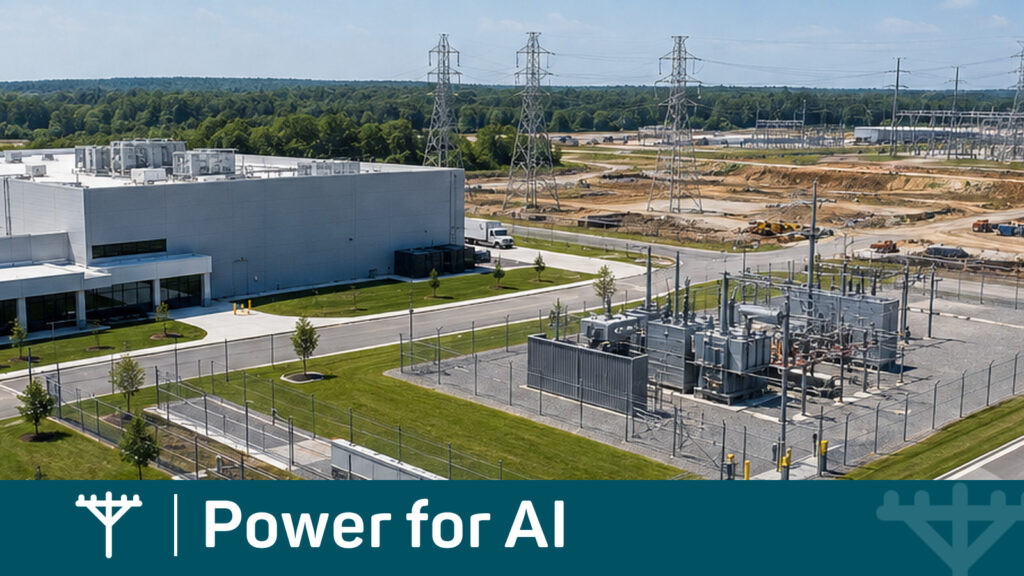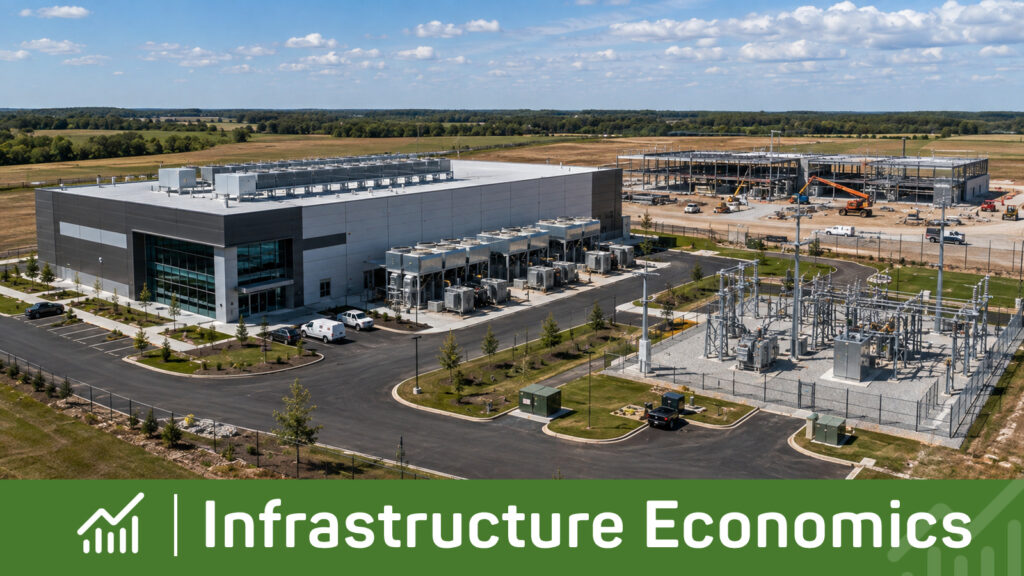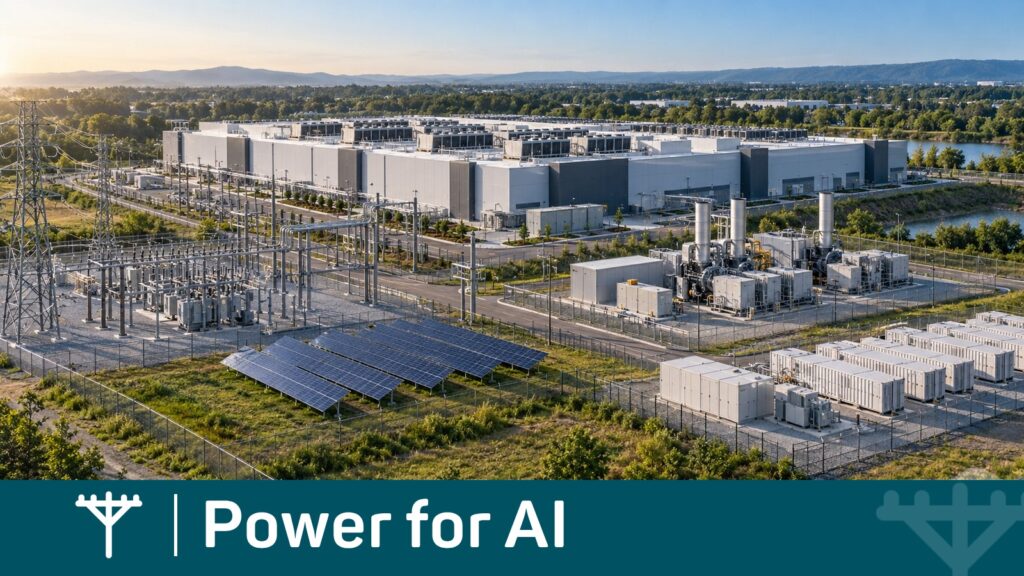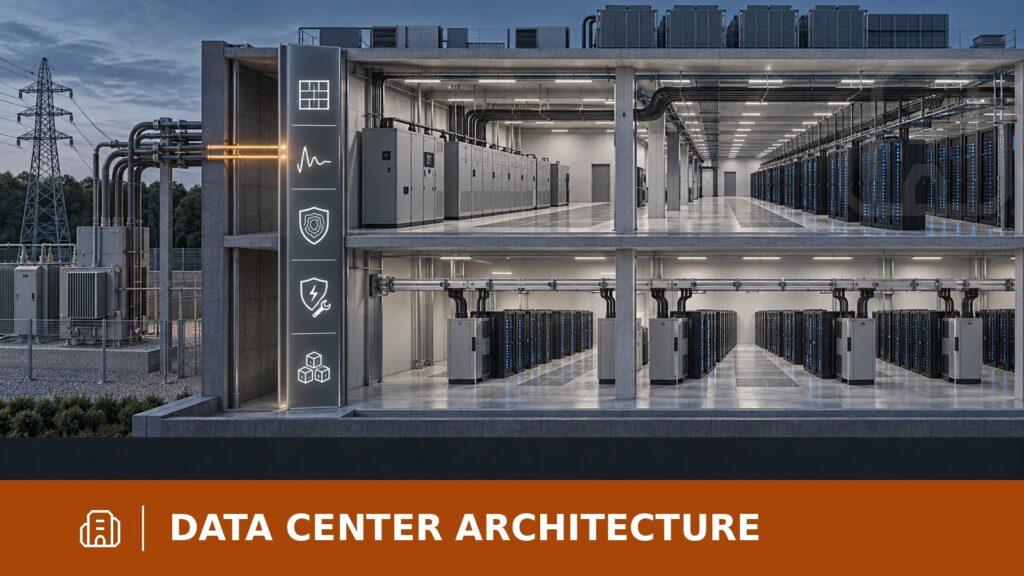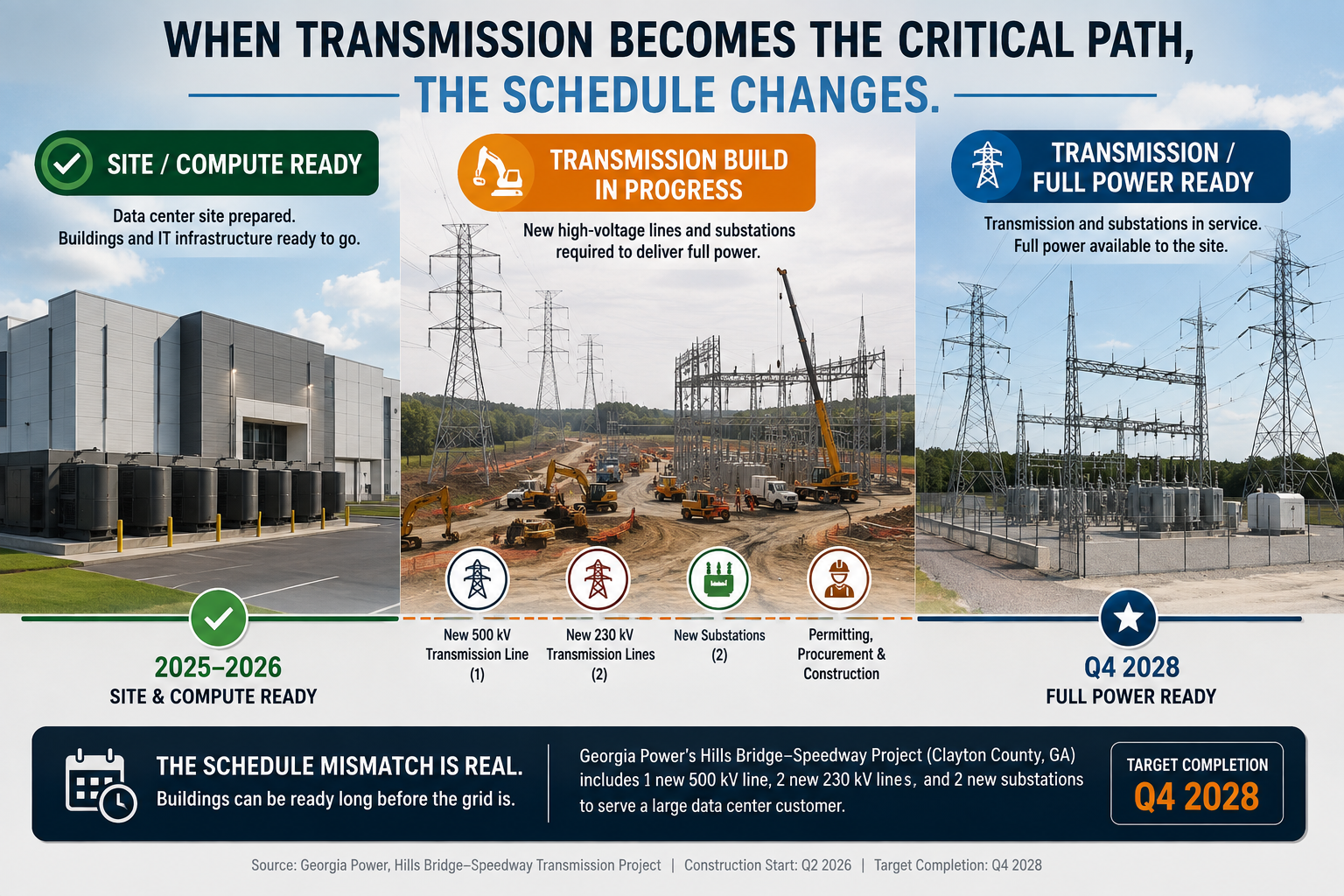
Georgia Power is building three new high-voltage transmission lines and two substations to serve a large data center customer south of Atlanta. Its current tentative schedule targets project completion in Q4 2028.
That raises a larger question for AI infrastructure developers: when serving the site requires a transmission project of its own, is the data center construction schedule still the project schedule?
A transmission project for one data center customer
Georgia Power’s Hills Bridge-Speedway 500/230 kV Transmission Project in Henry and Clayton counties is being developed to support the electric needs of a large data center customer that requires new transmission infrastructure.
The published scope includes one new 500 kV line, two new 230 kV lines, and two new substations. The Speedway 230 kV Substation is planned on the customer’s property. Georgia Power’s current timeline shows easement acquisition beginning in Q4 2025, construction beginning in Q2 2026, and project completion in Q4 2028, with the schedule identified as tentative.
This is more than a conventional service extension. Surveying, easements, high-voltage lines, substations, construction, testing, and energization now sit on the path to full service.
Georgia Power is doing what a utility is expected to do: expand the system to serve major new load while strengthening the surrounding grid. For the data center customer, the strategic implication is different. Transmission has become part of the deployment critical path.
Generation capacity is not the same as deliverable capacity
Georgia is responding aggressively to extraordinary large-load growth. In December 2025, the Georgia Public Service Commission approved an agreement allowing Georgia Power to add 9,885 MW of new energy, with most of that new energy expected to serve large customers such as data centers. In its Q1 2026 Large Load Economic Development Report, Georgia Power reported 12,400 MW of committed large-load customers across 31 projects, with 8,500 MW of those commitments already associated with projects that had broken ground.
But system-level generation and site-level delivery are different problems.
A region can be adding substantial generation while a specific site still requires years of transmission and substation work before that power can be delivered at the required scale.
For large AI loads, the better question is not simply, “Is there enough power in the region?” It is, “When can sufficient power actually become usable at this site?”
The critical path changes
When customer-specific transmission is required, a second schedule is layered onto site control, entitlements, design, equipment procurement, construction, and commissioning. That schedule can include route engineering, land surveys, easement acquisition, line construction, substation construction, testing, and utility energization – activities that sit partly outside the developer’s direct control.
That changes the questions executives should ask early:
- How much of the ultimate load can the existing system serve before new transmission is complete?
- Which power milestones are controlled by the developer, and which depend on the utility schedule?
- Can a smaller amount of productive capacity come online before the ultimate build is complete?
- If an initial power configuration is used, can it remain useful after permanent grid infrastructure arrives?
- What capital becomes stranded when the project transitions to its long-term state?
Those are sequencing questions, not simply electrical-engineering questions.
The strategic choice is not “grid or no grid”
The permanent utility solution will remain the right long-term foundation for many large data centers. Grid infrastructure offers scale, reliability, operating simplicity, and access to a broader generation system that interim or on-site alternatives may not replicate economically.
Those alternatives carry real tradeoffs of their own: capital requirements, fuel and logistics dependencies, permitting and emissions considerations, operating complexity, and a future infrastructure transition that must be engineered carefully.
So the question is not whether developers should abandon the grid.
The question is whether the final grid solution should always determine when the first productive megawatt can come online.
For some projects, waiting will still be the rational choice. For others, the economic value of earlier compute availability may justify a phased strategy – but only if the initial state has a credible path into the permanent architecture rather than becoming disposable infrastructure.
Time to power is an economic variable
When infrastructure schedules stretch across years, timing affects customer commitments, revenue, financing, equipment utilization, market entry, and the risk that compute assumptions change before the original infrastructure plan is complete.
That does not mean faster at any cost. Speed without a credible transition can simply move risk into the future.
The better objective is the fastest credible path to productive capacity that also protects long-term infrastructure economics. That is why time to power belongs in the same executive discussion as capital cost, operating cost, reliability, and expansion strategy.
What this should change in data center planning
The Hills Bridge-Speedway project should not be read as evidence that utility infrastructure is failing. It is evidence that AI-scale loads can be large enough to require infrastructure programs that look more like regional power projects than conventional service connections.
- Evaluate transmission before treating a site as power-ready. Regional generation does not answer how or when power reaches the property.
- Separate the initial state from the ultimate state. The first productive phase may have a different infrastructure path than the final campus buildout.
- Design the transition, not just the endpoint. Early infrastructure should be judged partly by whether it remains useful when permanent utility capacity arrives.
- Measure productive power. The meaningful milestone is capacity that can reliably support operating compute at the site.
Go deeper
Explore how power availability, configuration, timing, and transition shape AI deployment in Power for AI, then continue into Deployment Strategy to examine how infrastructure sequencing affects the path from first capacity to full buildout.