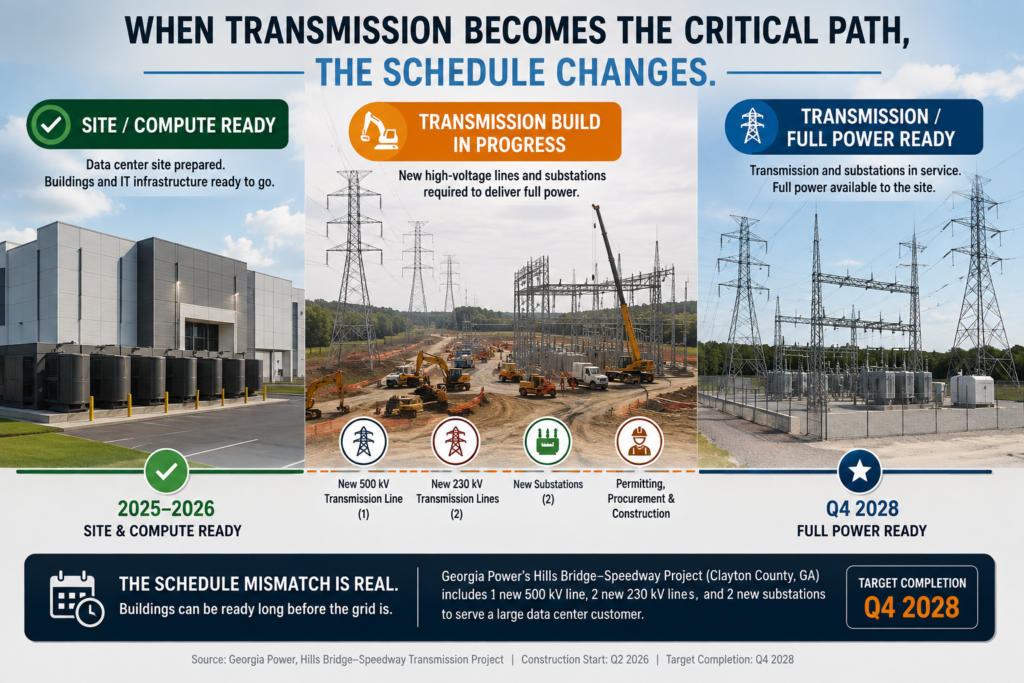
AI infrastructure demand does not wait politely for the utility schedule. A developer may have a committed customer conversation, a site, a limited source-side power position, and a much later date for the utility capacity required for full buildout. That mismatch is increasingly a deployment decision, not merely an interconnection problem.
The weak response is to treat the available power as too small to matter until the full buildout arrives. The other weak response is to force an interim installation into service quickly, then assume the first phase can be discarded or worked around later. Neither approach begins with the right question.
The more useful question is this: can the first available megawatt support a productive operating state that is intentionally connected to the future campus?
Start with a viable operating state
A viable operating state is more than an energized load. It has a defined user, workload, operating model, service boundary, and set of constraints. It may support an early customer deployment, a contained compute service, validation of operating processes, or a staged revenue model. Its value comes from what it can do responsibly now, not from pretending it is the finished facility.
That distinction matters because early source-side power changes several decisions at once. The project must decide what compute is appropriate for the initial state, how the critical load will be supported, what operating procedures are required, what must remain modular or accessible, and which dependencies are genuinely deferred rather than ignored.
Treat the transition as part of the first decision
The first operating state should be assessed against the later state before equipment is selected or work is sequenced. A practical review asks whether early conversion and distribution choices remain understandable and maintainable when utility capacity is added; whether cooling, communications, and cybersecurity can serve both states; and whether the project has preserved workable access, space, controls, and operating boundaries for the transition.
This is not an argument for one technical pattern. The right answer depends on the source, site conditions, permitted work, load profile, required continuity, schedule, and commercial model. It is an argument for making the dependencies explicit early enough that a near-term decision does not quietly create a long-term constraint.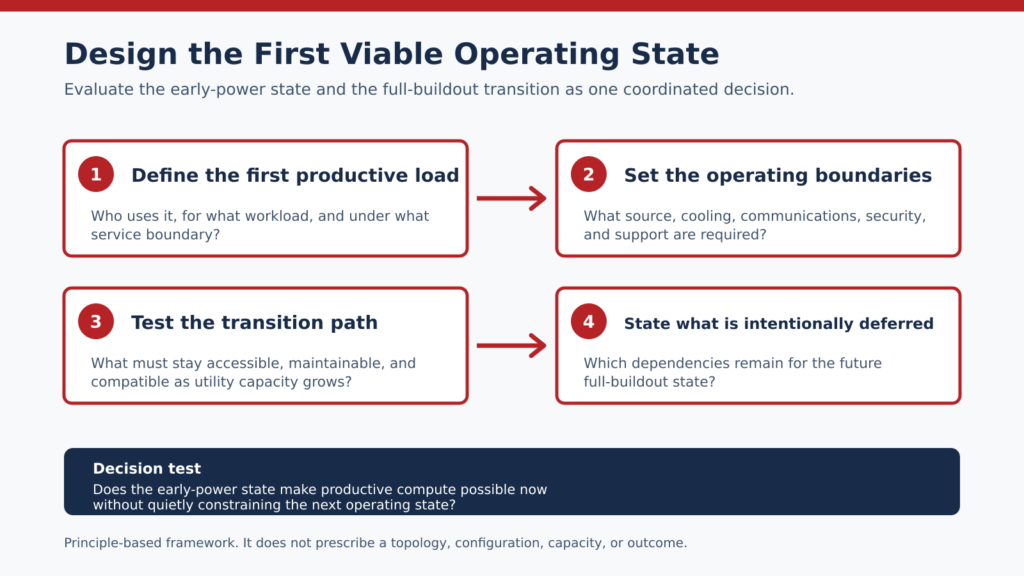
Use decision criteria instead of a capacity headline
Available megawatts are necessary information, but they do not complete the decision. A smaller power position may be valuable when it can support a defined workload and a credible operating model. A larger one may be less useful if the path to critical load, cooling, communications, controls, and operating support is incomplete.
The decision therefore belongs across the infrastructure system: source and conditioning, distribution, cooling, compute, communications, and cybersecurity. Each discipline has to be adequate for the initial use case, and each has to be considered against the next stage. A partial deployment becomes stronger when its boundaries are intentional and visible.
What an interim phase should not become
An interim phase should not become a slogan for bypassing engineering, permitting, operating discipline, or stakeholder reality. It does not remove the need for full utility capacity where the ultimate load requires it. It does not turn every site into a quick-start project. And it should not be sold as a universal schedule or performance promise.
It is a structured way to investigate a narrower opportunity: productive compute before the full buildout, with a clear view of the costs, constraints, and transition work that remain.
The practical next step
For a project facing this mismatch, the starting point is a deployment map. Define the first viable load, identify the source-side and site constraints, state what must be true for reliable operation, and map the points at which the future utility-connected state changes the decision. That work can reveal whether the first megawatt is a valuable operating milestone or simply an attractive number without a workable path behind it.
Continue Your Infrastructure Decision
Explore Deployment Strategy at https://blog.bluefluxpower.com/deployment-strategy/ for the broader decision context, then use the Technical Library at https://blog.bluefluxpower.com/technical-library/ to investigate the technical questions behind it.