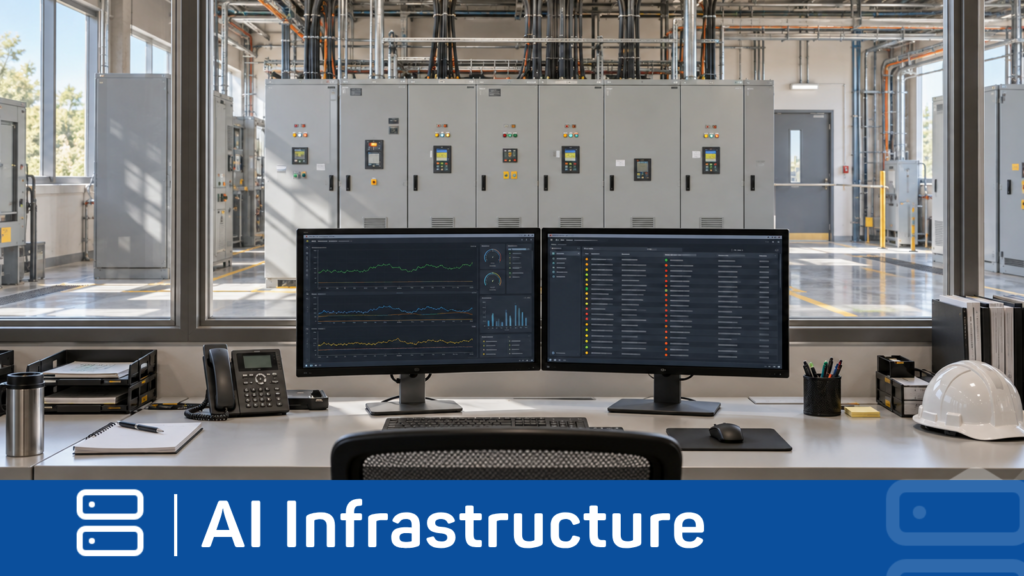
An AI infrastructure site is no longer only a collection of electrical and mechanical assets. Power equipment, storage, meters, controllers, alarms, remote-service tools, and operating dashboards increasingly exchange information and influence physical behavior. That makes cybersecurity part of the infrastructure decision itself.
The mistake is to treat that fact as an IT cleanup task after the electrical and operating model has already been chosen. Once a system has connected monitoring, remote access, automated control, or interfaces to outside parties, it has created an operational technology boundary. The question becomes whether that boundary was designed deliberately enough for the consequences it carries.
Start with operational authority
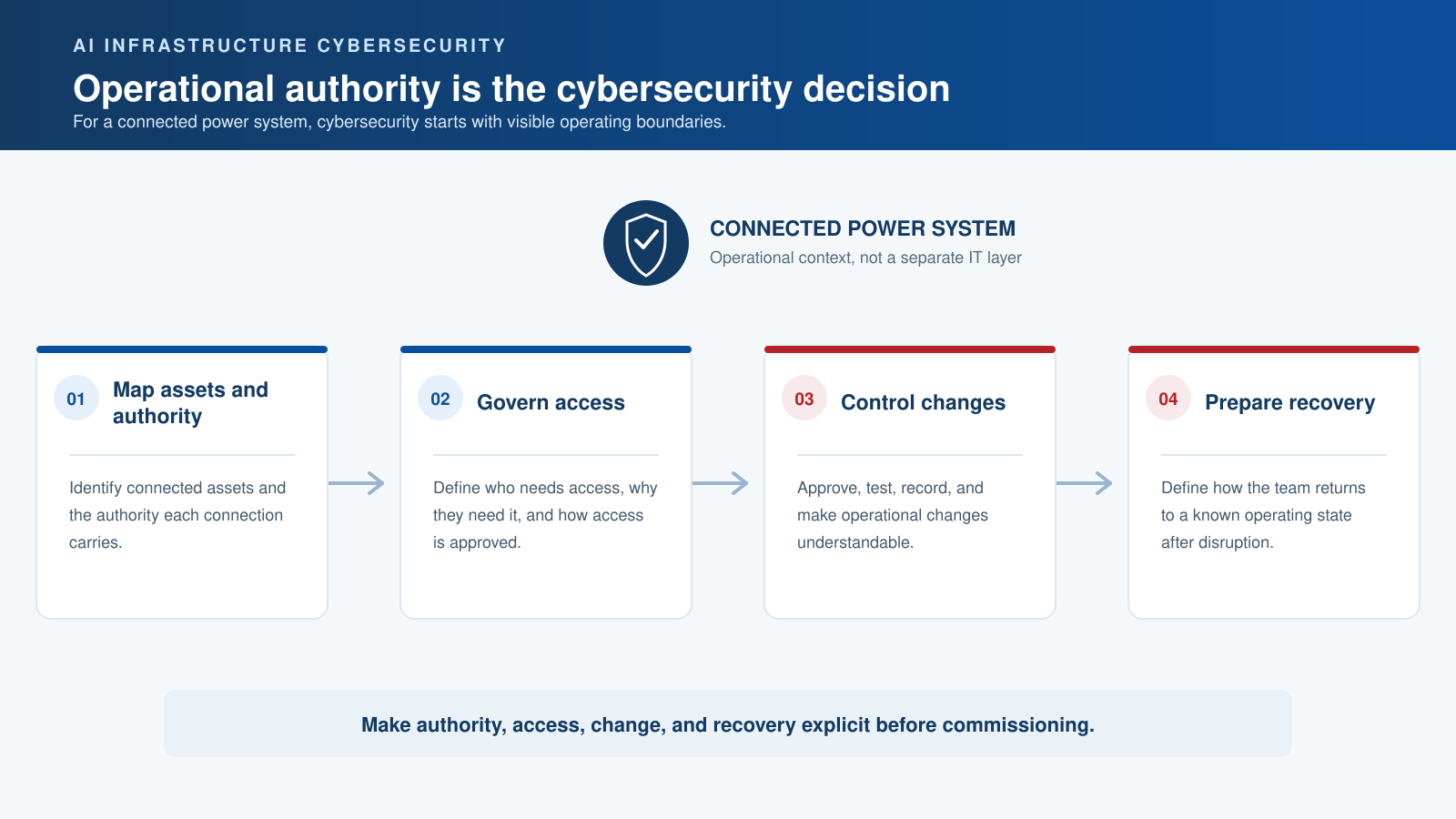
Not every connected device creates the same risk, and not every system should be managed in the same way. A useful review starts by identifying what each connection can see, change, interrupt, or conceal. A read-only meter, a remote maintenance session, a control interface, and an integrated power-management environment may all be useful. They also create materially different obligations for access, monitoring, change control, and recovery.
This is why asset inventory is more than a compliance exercise. A project team needs to understand which assets exist, who can reach them, what authority is delegated, what dependencies connect them, and how the system behaves when a connection is lost or disputed. Without that map, the security discussion is often reduced to a list of tools rather than a credible operating model.
Design the boundary before commissioning
The most important cybersecurity decisions frequently occur before the facility enters service. They include where IT and operational networks meet, which parties can use remote access, how vendor support is approved and recorded, which functions can be automated, how changes are tested, and who has authority to act during an abnormal condition. These are operating decisions with security consequences, not merely configuration details.
A defensible system also needs to remain understandable to the people who must run it. If the incident response plan assumes knowledge, access, or coordination that the operating team does not possess, the plan is not a control. The same is true of recovery: a project should understand how it will return to a known operating state after a cyber or communications event, without improvising under pressure.
Avoid the false choice between visibility and security
AI-scale facilities need visibility into load, condition, alarms, and system behavior. That visibility can improve maintenance, reliability, and decision quality. The goal is not to make a power system opaque. It is to make the information paths, control paths, and responsibilities explicit enough that visibility does not quietly become unmanaged authority.
That requires coordination across disciplines. Electrical design determines critical loads and failure consequences. Communications design determines how information moves. Cybersecurity defines safeguards and monitoring. Operations determines whether procedures can actually be followed. Procurement and vendor management shape the access rights and support dependencies that may persist for years. None of these decisions is complete in isolation.
Questions a project team should ask early
A practical team can begin with a short set of questions: Which power-system functions are connected? Who needs access, and for what purpose? What actions can each connection take? How will the team identify abnormal activity or unauthorized changes? How will remote support be approved? What information and authority must remain available during a communications disruption? And how will the operating team recover a known-good configuration after an event?
The answers will differ by project. The point is not to prescribe a universal architecture. It is to prevent the project from discovering late that its control and connectivity choices created an operating exposure no one owns.
The practical next step
For teams planning AI infrastructure, cybersecurity should enter the decision process alongside source, distribution, cooling, compute, communications, and operations. Define the system boundary, map authority and access, test the recovery assumptions, and make the ownership model visible before commissioning. That work will not eliminate risk. It can make risk more intelligible, governable, and operationally manageable.
Related decisions
- AI Infrastructure Is Not a Facility. It Is a Coordinated Operating System.
- Energy Storage for AI Loads: What It Solves and What It Does Not
- High-Current Distribution Is a System Decision, Not a Bus-Bar Detail
- Where High Frequency Conversion Helps and Where It Does Not
Continue Your Infrastructure Decision
Explore AI Infrastructure for the broader decision context, then use the Technical Library to investigate the technical questions behind it.