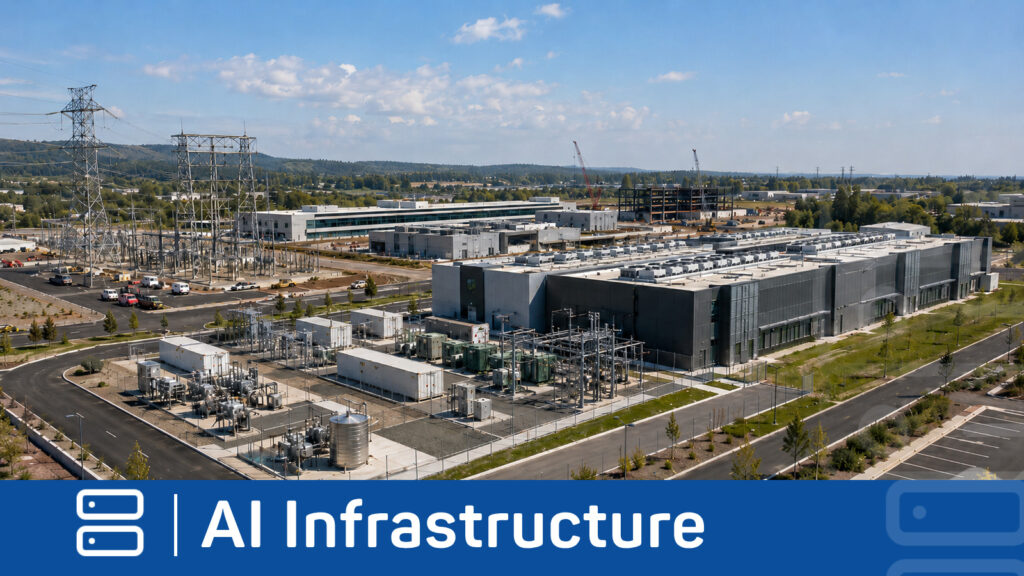
AI infrastructure is often described as a facility filled with servers. That description is technically incomplete and strategically dangerous. The building matters, but the productive system extends from energy source to compute workload.
Power availability, electrical distribution, cooling, compute, communications, cybersecurity, controls, and operations all shape whether capacity can be commissioned, used reliably, expanded, and maintained. A weakness at any interface can limit the entire installation, even when every individual component meets its own specification.
The better model is a coordinated operating system: multiple specialist disciplines designed around one compute mission, one sequence of operating states, and one set of performance requirements.
Why the facility framing falls short
A facility framing encourages teams to divide the project into familiar packages: utility service, generation, electrical equipment, mechanical systems, data halls, network connectivity, servers, and software. Specialization is necessary, but the project can appear complete on paper while critical relationships remain unresolved.
The utility may plan around deliverable capacity while the compute team plans around nameplate load. The electrical design may satisfy equipment ratings while the cooling design assumes a different rack-density profile. The network may be redundant without sharing the same failure boundaries as power. Control systems may collect data but lack a common model for operating authority, alarms, and recovery.
These are not merely coordination inconveniences. They affect when the infrastructure becomes productive and how it behaves during maintenance, expansion, curtailment, equipment failure, or a change in workload.
What an infrastructure operating system means
The term does not mean that one software platform controls every device or that one vendor should own every discipline. It means the infrastructure is designed as a system whose physical and digital layers operate toward a common outcome.
That outcome should be stated in operational terms: the required compute capacity, availability, density, deployment date, service commitments, expansion path, and recovery behavior. Equipment choices follow from those requirements.
The U.S. Department of Energy’s data center design guidance treats information technology, environmental conditions, air management, cooling, electrical systems, heat recovery, and performance measurement as related design areas. That integrated view matters because a decision in one layer creates consequences in others. The operating-system perspective makes those dependencies explicit before they become field problems.
Six disciplines support one productive mission
Blueflux organizes the problem through six connected disciplines. Each retains its own engineering depth, standards, and accountable experts. The objective is not to blur those boundaries; it is to make the boundaries work.
1. Power source and generation
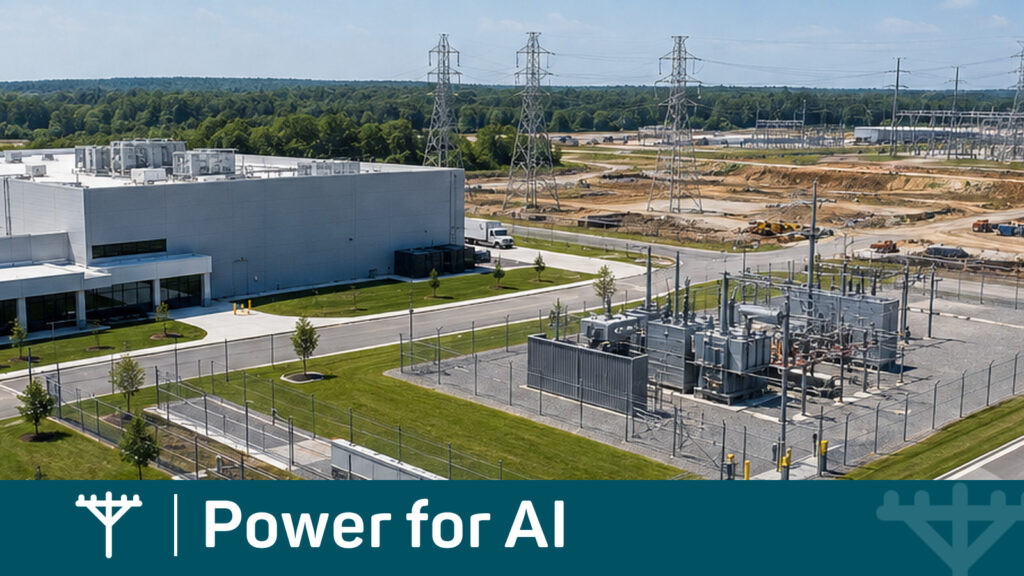
This discipline establishes which energy resources can physically support the site, in what quantity, under which operating and commercial conditions, and on what schedule. Utility service, onsite generation, storage, and hybrid configurations each create different fuel, interconnection, permitting, maintenance, and control requirements.
2. Power distribution and conditioning
Available energy does not become usable compute capacity until it is transformed, protected, conditioned, and delivered to the load. Voltage levels, conversion stages, protection coordination, fault current, power quality, redundancy, and equipment interfaces determine how much of the source capacity can be used safely and reliably.
3. Cooling
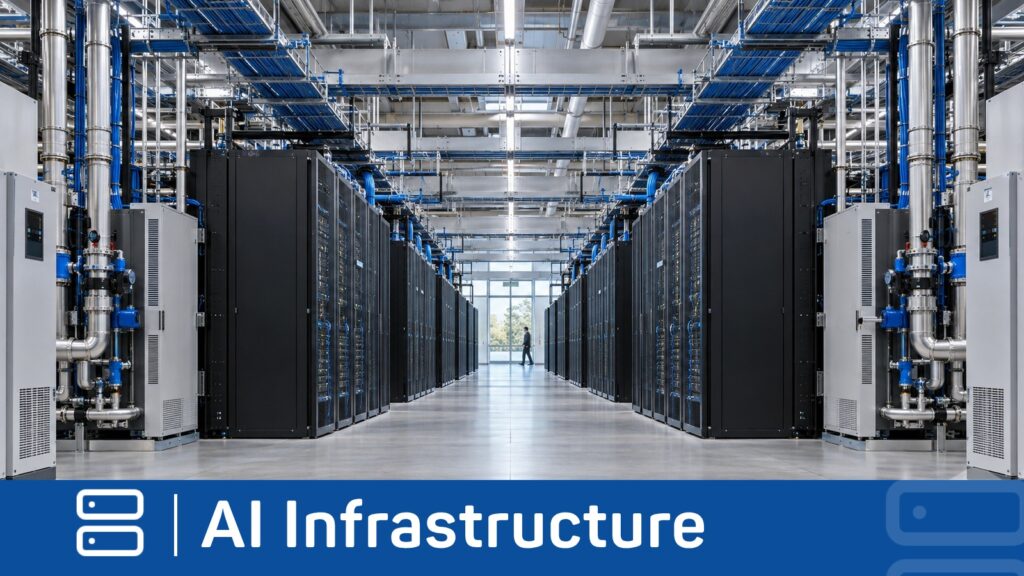
Cooling must remove the heat produced by the actual compute configuration across normal operation, maintenance, failure, and expansion states. Airflow, liquid loops, coolant distribution, heat rejection, water use, controls, and local climate cannot be separated from rack density and electrical load.
4. Compute
Compute is the productive purpose of the infrastructure. Workload type, rack configuration, density, utilization, service commitments, and technology-refresh assumptions define what the supporting systems must accomplish. Treating compute as a late equipment selection forces every upstream discipline to design around uncertain or generic loads.
5. Communications
Internal networks, external connectivity, telemetry, timing, and control communications determine how data moves and how the infrastructure is observed and managed. Physical routes, logical redundancy, latency requirements, and failure domains must align with the site’s operating model.
6. Cybersecurity
Cybersecurity governs trust across increasingly connected infrastructure. Identity, access, segmentation, monitoring, vendor interfaces, incident response, and recovery apply to information technology and to operational systems. NIST’s Cybersecurity Framework 2.0 emphasizes six continuing functions: Govern, Identify, Protect, Detect, Respond, and Recover. The infrastructure must preserve those outcomes as systems and operating states change.
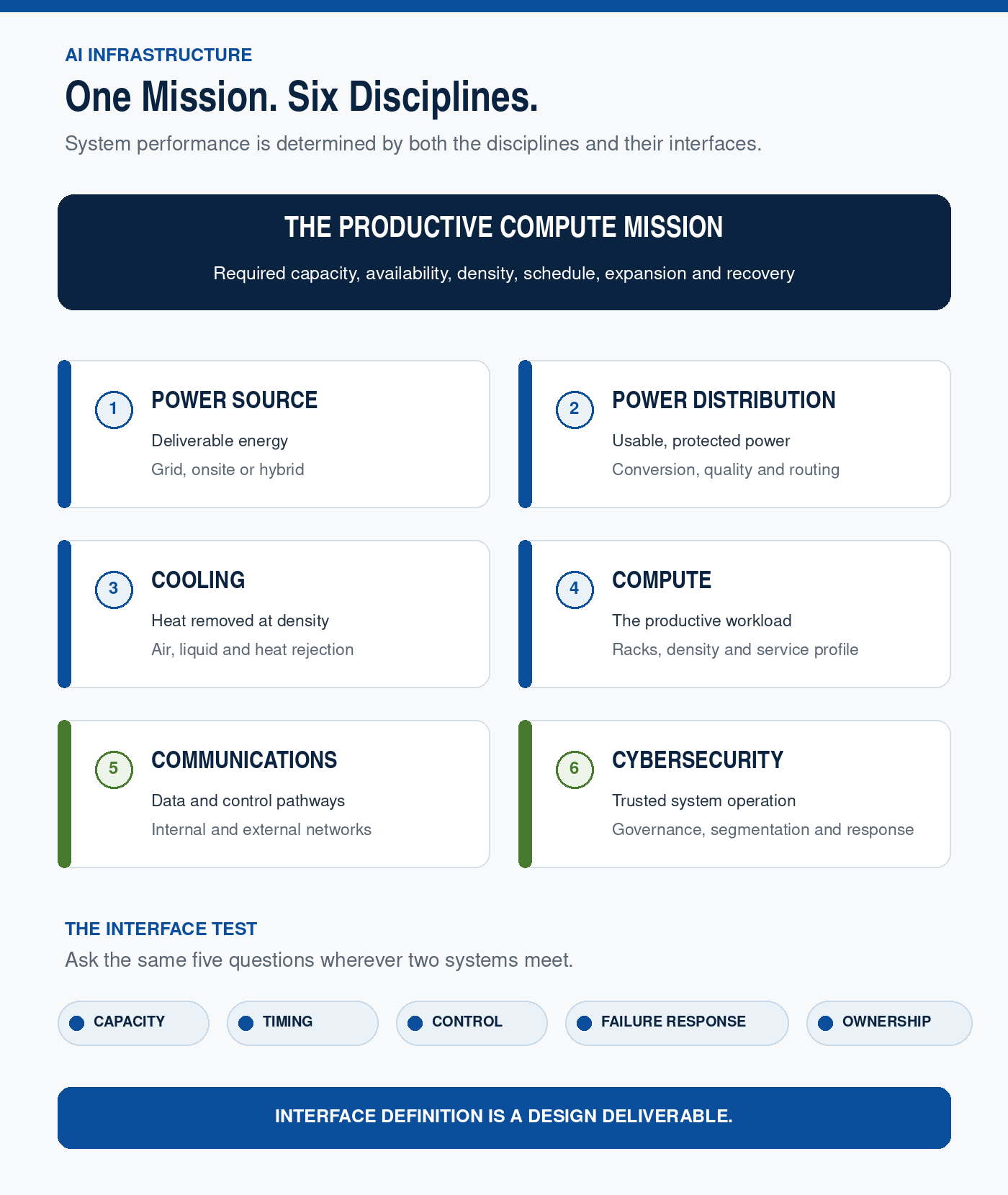
The interfaces determine system performance
The most consequential project questions often sit between the six disciplines rather than within them.
- Capacity: Are electrical, thermal, network, and compute capacities defined on compatible assumptions?
- Timing: Do utility, equipment, construction, commissioning, and compute-delivery schedules support the same operating date?
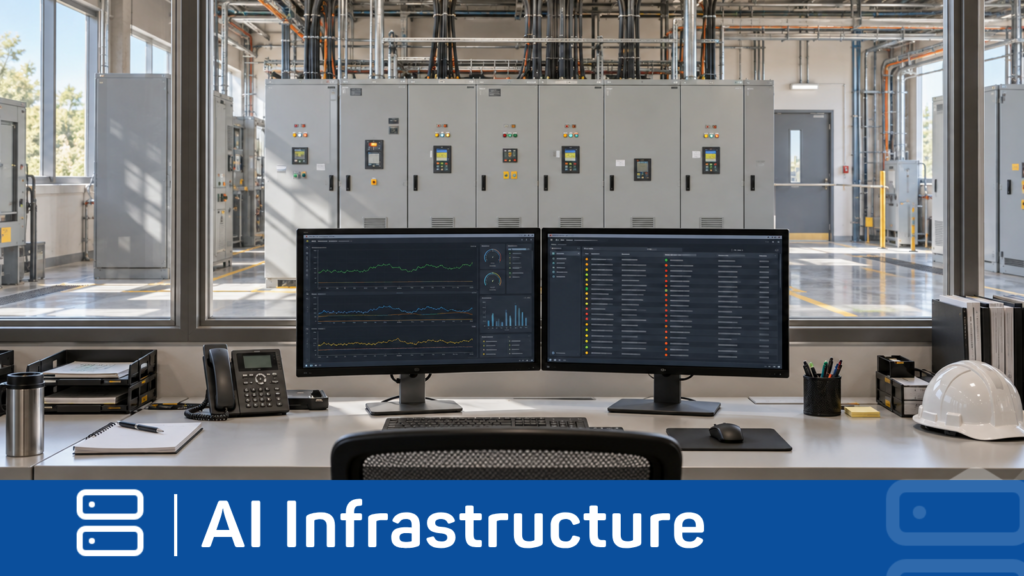
- Control: Which system has authority in each operating mode, and how are commands, limits, and alarms coordinated?
- Failure response: Do power, cooling, network, controls, and compute failover sequences support the same service requirement?
- Ownership: Who is accountable for each interface during design, commissioning, operation, maintenance, and change?
A technically strong component can still weaken the system if its assumptions are incompatible with the other layers. Interface definition is therefore a design deliverable, not an administrative task.
Common failures begin at the boundaries
Fragmented delivery creates predictable failure patterns. Power capacity is reserved without a complete path to the racks. Cooling is sized to an average density that does not match the intended deployment. Backup systems are tested individually but not through the complete sequence of events. Controls expose overlapping authority. Cybersecurity requirements arrive after vendor interfaces are fixed. Expansion capacity exists physically but cannot be commissioned without interrupting the operating load.
These problems may not appear in a procurement checklist because every party can satisfy its contracted scope. They emerge when the project is tested as one operating system.
Commissioning must therefore validate interactions, not just components. Normal operation, degraded modes, maintenance states, communication loss, source transitions, thermal excursions, control failures, and recovery sequences should be evaluated against the compute mission.
Integrated accountability does not eliminate specialists
There is a legitimate risk in pushing integration too far. A single organization that claims complete expertise across every discipline can obscure technical depth, concentrate risk, and reduce independent challenge. The answer is not to replace specialists with generalists.
The stronger model preserves qualified discipline leadership while assigning explicit accountability for system architecture, interfaces, operating states, and change control. Specialists remain responsible for the integrity of their work. The integrating function remains responsible for ensuring that the separate systems form a coherent whole.
This distinction also improves commercial clarity. Suppliers can be evaluated on defined interfaces and operating outcomes rather than broad promises of compatibility. Owners can identify where risk has been allocated and where it remains between contracts.
From final design to operating states
A conventional project plan often focuses on the completed facility. AI infrastructure may need to become productive in phases, before every permanent element reaches its final state.
The project should define the first viable operating state, subsequent capacity additions, maintenance and degraded states, and the ultimate configuration. Each state needs its own capacity, reliability, control, permitting, cybersecurity, and operating logic. Transitions between states must be engineered with the same discipline as the endpoints.
This approach connects directly to data center power alternatives and to the question of the first productive megawatt. Earlier capacity creates value only when the complete system can operate credibly and the initial infrastructure remains useful as the project evolves.
A practical executive test
Before approving an AI infrastructure strategy, management should be able to answer six questions:
- What productive compute mission is the infrastructure expected to support?
- Which assumptions are shared across power, cooling, compute, communications, and cybersecurity?
- Who owns the interfaces and resolves conflicts between disciplines?
- What are the planned operating states and transition conditions?
- How will the complete system be commissioned and tested under failure?
- Which investments remain useful when the compute or deployment plan changes?
If those answers exist only inside separate technical packages, the project does not yet have a complete infrastructure architecture.
Go deeper
Explore AI Infrastructure for the complete decision framework. Then review What Makes AI Infrastructure Adaptive? and The New AI Infrastructure Problem to examine how integrated architecture supports change across different technology and deployment cycles.