High-frequency conversion is often introduced through attractive component-level possibilities: smaller magnetic components, different switching behavior, a more compact conversion stage, or a new degree of controllability. Those possibilities can matter. But for an AI infrastructure team, they are not the decision by themselves. The decision is whether a change in conversion frequency improves the operating facility the team is actually trying to build.
That requires looking beyond a converter or transformer in isolation. A facility must carry a load profile, operate within protection and maintenance boundaries, fit a physical arrangement, accept a credible source and distribution path, and expand without creating avoidable rework. A conversion choice can improve one of those conditions while making another more demanding. The proper comparison is therefore architectural, not merely component based.
Frequency Is Not a Standalone Architecture Decision
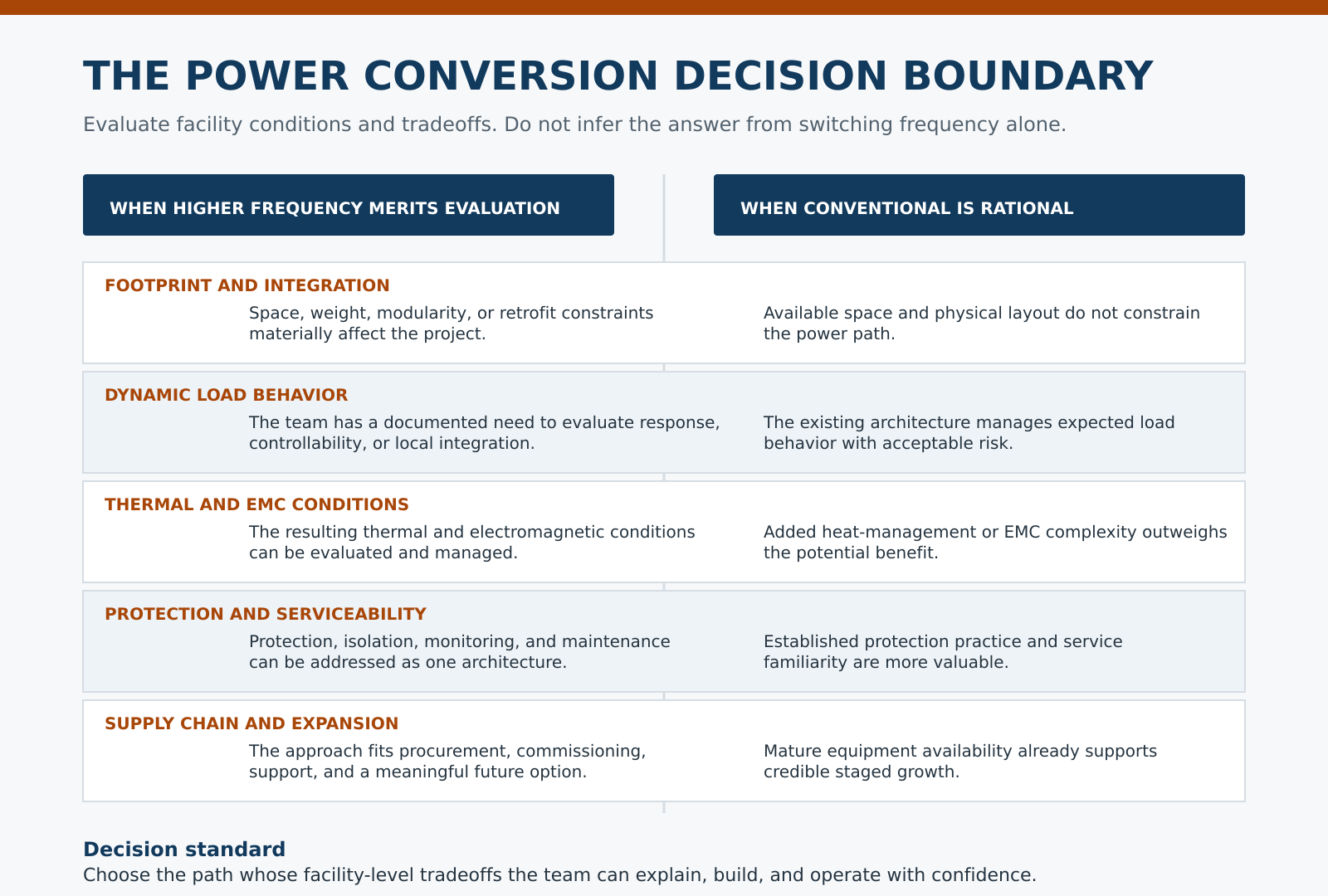
Frequency is not a standalone architecture decision. The relevant issue is whether a proposed conversion approach changes a facility condition that matters: footprint, load behavior, thermal management, protection, serviceability, integration, or expansion. Those consequences must be evaluated together, not inferred from switching frequency alone.
Where High Frequency Can Merit Evaluation
High-frequency conversion can merit serious evaluation when a project has a specific constraint that the approach may address. Space and weight can matter where conversion equipment must fit a limited room, a modular deployment, or a constrained retrofit. The ability to manage a changing load or integrate with a selected distribution approach can also be relevant. In some circumstances, the relationship among conversion, energy storage, distribution, and compute demand may make a different frequency regime worth exploring.
None of those conditions establishes a universal answer. They establish a reason to ask a better question: does the potential benefit survive once the full power path, operating model, and build sequence are considered? If it does, the architecture deserves deeper engineering evaluation. If it does not, the familiar approach may remain the more defensible choice.
Where the Benefit May Not Justify the Change
A conventional architecture remains rational when it meets the project requirements with acceptable space, efficiency, reliability, serviceability, schedule, and commercial risk. This is particularly true when a project values mature supply chains, established service practices, straightforward protection coordination, or a predictable integration sequence more than a theoretical advantage in component size or switching behavior.
The practical caution is simple: a conversion-stage benefit can be real without being decisive. Additional stages, thermal management, electromagnetic compatibility, controls integration, fault behavior, spare-parts strategy, commissioning requirements, and technician familiarity all belong in the decision. The relevant issue is not whether these considerations make high-frequency conversion unsuitable. It is whether the project has a documented reason to carry them.
Four Facility-Level Questions
- What constraint is this conversion approach intended to solve: footprint, response to load behavior, integration, expansion, or another measurable project condition?
- How does the choice change the full power path, including conversion stages, protection boundaries, thermal conditions, monitoring, maintenance access, and commissioning?
- What assumptions about load growth, source availability, and distribution architecture must remain true for the benefit to hold?
- If the project uses a conventional approach, what real operating or deployment opportunity is being given up – and is that opportunity material enough to justify a different architecture?
The Decision Standard
High-frequency conversion helps when it removes a meaningful facility constraint without creating a larger operational or integration burden elsewhere. It does not help merely because it is newer, more compact, or technically interesting. Teams should compare the alternatives against their actual first productive state and credible next phase, then select the path whose tradeoffs they can explain and operate with confidence.
Continue Your Infrastructure Decision
Explore Data Center Architecture for the broader decision context, then use the Technical Library to investigate the technical questions behind it.